
Model Release Contract: Template, GDPR, and Digital Consent Explained
As soon as recognizable people appear in your images, you need their permission to publish them – and the model release contract is the tool you use to document that permission. It records who is pictured, what the images may be used for, and to what extent. Without that foundation, you're on thin legal ice.
This post explains clearly what belongs in a model release contract, how image rights and GDPR interact, which mistakes happen most often – and how to capture consent digitally instead of on paper. Important note: this post is orientation, not legal advice. For a specific case in doubt, you should consult a lawyer.
What is a model release contract – and when do you need one?
A model release contract (also called a model agreement or consent form) is the written agreement between you as the photographer and the person pictured about how their images may be used. It's relevant whenever a person in the image is recognizable and the shots are meant to be published or used commercially.
The legal framework rests on two pillars that apply across the EU:
- The right to your own image – as a rule, a person's likeness may only be published with their consent.
- The GDPR, because a photo of an identifiable person is personal data, and processing it needs a legal basis (overview of personal data and consent under GDPR).
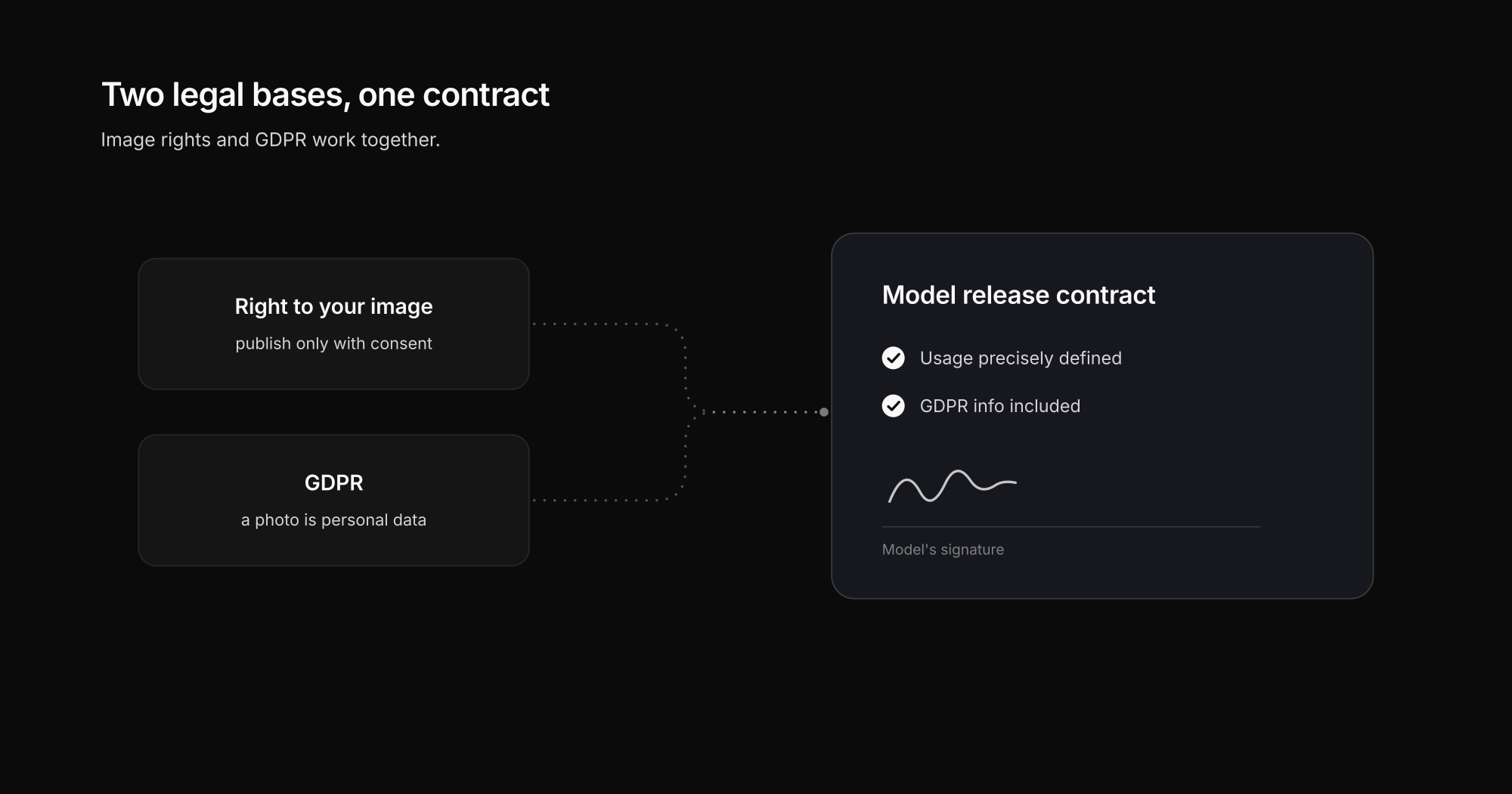
In short: as soon as a face is recognizable and the image is meant to go out, you need documented consent. The model release contract is the cleanest form of it.
What belongs in a model release contract? (Checklist)
A solid agreement covers more than just "may be published." These points should be included:
- The parties: name and address of photographer and model; for minors, the legal guardians.
- Scope of use: where may the images appear – print, website, social media, advertising?
- Duration and territory: unlimited or restricted in time and geography?
- Sharing with third parties: may the images be passed to clients or agencies?
- The model's own use: may the model use the images themselves, e.g. for their own portfolio?
- Compensation: fee, TFP (time for prints), or free of charge – what was agreed?
- Data protection notices: information about the processing under GDPR and the pictured person's rights.
- Date and signature from both sides.
As a starting point, you'll find well-founded templates and explanations from specialized sources. But always adapt such a template to your specific use case rather than using it blindly.
Consent or contract: the right legal basis
One point often causes confusion in practice: does the use rest on consent or on a contract? The difference matters more than it sounds.
- Consent is the classic form of agreement – but under GDPR it can in principle be withdrawn at any time. If the model later withdraws, continued use can become problematic.
- Contract as the legal basis: if image use is agreed contractually (Art. 6(1)(b) GDPR), it binds both sides more firmly. That's exactly why it's called a model *release contract* and not just a consent form.
For practice this means: a cleanly worded contract that describes the use specifically and makes data protection transparent is the safest foundation.
Common mistakes with model releases
These mistakes come up again and again in practice – and are easy to avoid:
- Agreed only verbally. "Obviously I'm allowed to post the pictures" doesn't hold up in a dispute. Without documentation, there's no proof.
- Too vague. A blanket "may be used" without naming the channel, duration, and purpose is open to challenge.
- Overlooking minors. Minors often can't validly consent on their own – then the guardians' agreement is required.
- Forgetting data protection. Beyond the contract, pictured people must be informed about the data processing and their rights.
- No clean record. A slip of paper somewhere in a folder helps little when, two years later, you have to prove who agreed to what and when.
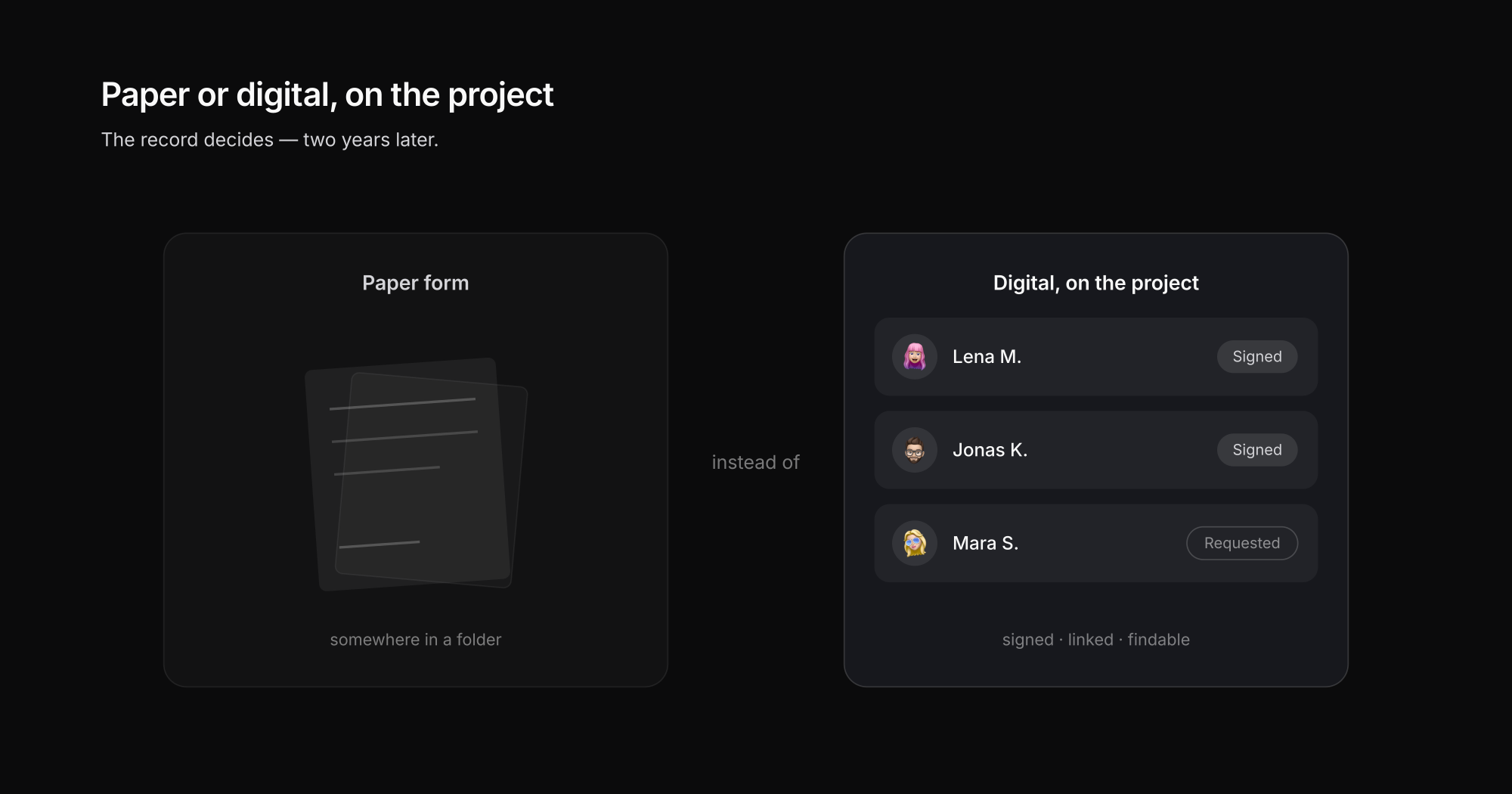
Capturing a model release digitally: paper vs. attached to the project
The last mistake – the missing clean record – is most elegantly solved by not running the model release on paper at all. The comparison shows why the digital route wins:
| Aspect | Paper form | PDF by email | Digital, on the project |
|---|---|---|---|
| Record findable | Slip in a folder | Search the inbox | Stored right on the project |
| Signing on-site | Only with a printer | Cumbersome | On the phone in seconds |
| Link to the images | Manual | Manual | Automatically connected |
| GDPR notices | Attach separately | Attach separately | Integrated |
Digital means, concretely: on set you show a link or QR code, the model reads the text, agrees, and signs right on their phone. The release then sits cleanly on the right project – not in a filing folder and not scattered across the inbox.
That's exactly what model release at Exportlab provides: consent is captured digitally and connected directly to the corresponding shots and the contract workflow. And if you also want to know how to hand over the finished images professionally, our post on delivering photos to clients helps.
FAQ: Model release contract
When do I need a model release contract?
Whenever a person in your photo is recognizable and you want to publish or commercially use the images. For purely private shots without publication it's usually not needed, but for any outward use – website, social media, advertising – it's strongly recommended.
What has to be in a model release contract?
At minimum: the parties, the permitted scope of use (channels, duration, territory), any sharing with third parties, the compensation, data protection notices under GDPR, and the date and signature of both sides. For minors, additionally the consent of the legal guardians.
Is verbal consent enough?
Legally, verbal consent can be valid, but in practice it's risky because you have no proof. If a dispute arises, you have to be able to show that consent was given and to what extent. A written or digital agreement protects both sides.
Is a digital model release legally valid?
Consent captured and documented digitally can be just as valid as one on paper, as long as it's clearly identifiable who agreed to what and when. The advantage: the consent is unambiguously tied to the images and findable at any time.
What applies with minors?
Minors often can't validly consent to publication on their own. In these cases the guardians' consent must be obtained – depending on the situation, from both parents. This should be expressly documented in the model release.
Conclusion
A model release contract is the foundation for publishing images of recognizable people with legal certainty. It documents who agreed and to what extent – and reconciles image rights with GDPR when it describes the use specifically and makes data protection transparent. You avoid the most common mistakes – verbal deals, vague wording, missing records – most reliably by capturing consent digitally and documenting it right on the project. That way you always have proof at hand, without digging through a filing folder. This post is not legal advice, but it gives you the structure to approach the topic cleanly.