
No Clients as a Photographer or Videographer? Why Inquiries Slow Down and What Helps
Having no clients as a photographer or videographer can feel like a verdict on your work. Your portfolio improves, your equipment gets better, you keep posting—and the inbox still stays quiet. It is especially unsettling when previous years were stronger even though the quality of your work was lower.
A slowdown rarely has one cause. The economy, tighter client budgets, in-house content teams, AI tools, low-cost competitors, and weaknesses in your own acquisition process can all act at the same time. The useful question is not simply, “Is the market bad?” It is: Where exactly is my business getting stuck?
Is the creative market actually slower?
Economic uncertainty can affect creative services quickly. Many businesses treat photography and video as spending that can be delayed. Campaigns get reduced, productions are postponed, and simple content is brought in-house.
The wider data is mixed rather than uniformly negative. Germany’s KfW SME Digitalisation Report 2025 found that the share of small and medium-sized companies completing digital projects fell to 30 percent and related spending declined. At the same time, Germany’s Federal Statistical Office reported real revenue growth of 2.1 percent across the service sector in 2025.
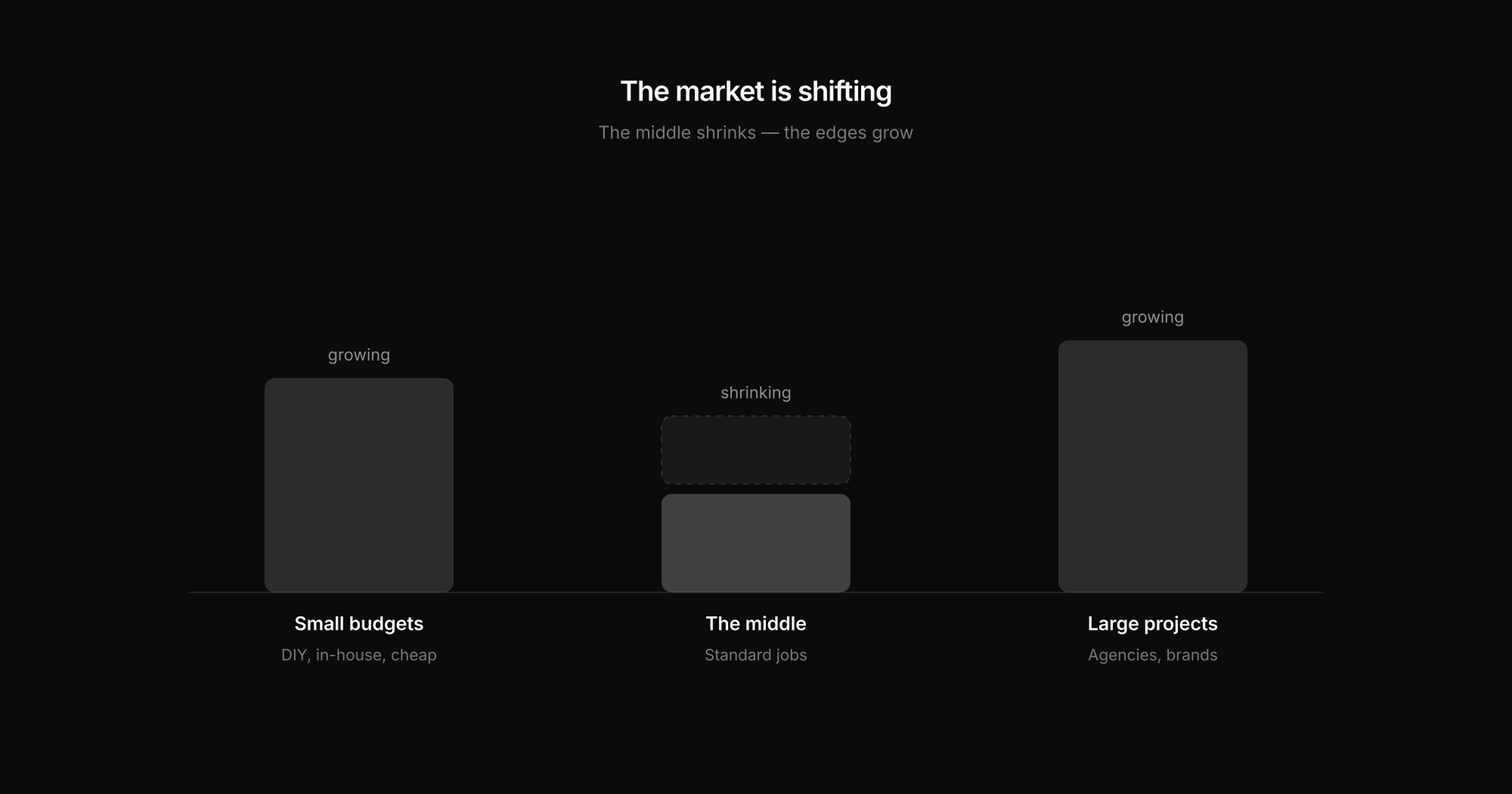
Both can be true. The overall service economy may grow while specific industries, regions, and price segments struggle. The middle of the market is often the hardest place: tiny clients have almost no budget, while large companies already use agencies or internal teams. The projects in between—the ones many freelancers depend on—can disappear first.
So the answer to “Is it the economy or my marketing?” is often: both, but not in equal measure.
Why photographers and videographers get fewer inquiries
Clients buy outcomes, not files
A company with a tight budget is not primarily buying a camera day or a polished edit. It wants more applications, stronger sales, clearer onboarding, better event coverage, or content that saves the team time. If your offer is only described as “brand film,” “corporate portraits,” or “three reels,” it is easy to compare purely on price.
That does not mean promising results you cannot control. It means explaining where the content will be used, which problem it solves, and what business value it supports.
More content is produced in-house
Smartphones, templates, simple editing software, and generative AI have lowered the technical barrier. For quick social posts, many companies now use an employee instead of hiring a specialist. This does not eliminate demand for high-quality production, but it reduces the volume of small standard jobs that used to be outsourced.
Competition is growing at the low end
New creators can enter with little equipment and very low prices. Influencers and content creators may also work in exchange for products, accommodation, or exposure. Competing with them solely on price is usually unsustainable for a professional business.
Referrals are powerful but fragile
Word of mouth can work brilliantly for years. The weakness becomes visible when two repeat clients cut spending at the same time or one important referral source disappears. Without a second acquisition channel, the result feels less like a decline and more like a sudden stop.
Social engagement is not the same as demand
A video can perform well and still generate no qualified inquiries. It may reach peers, hobbyists, or people looking for entertainment rather than buyers. The key question is not only how many people engage, but who they are and what they intend to do next.
Diagnose the problem before changing everything
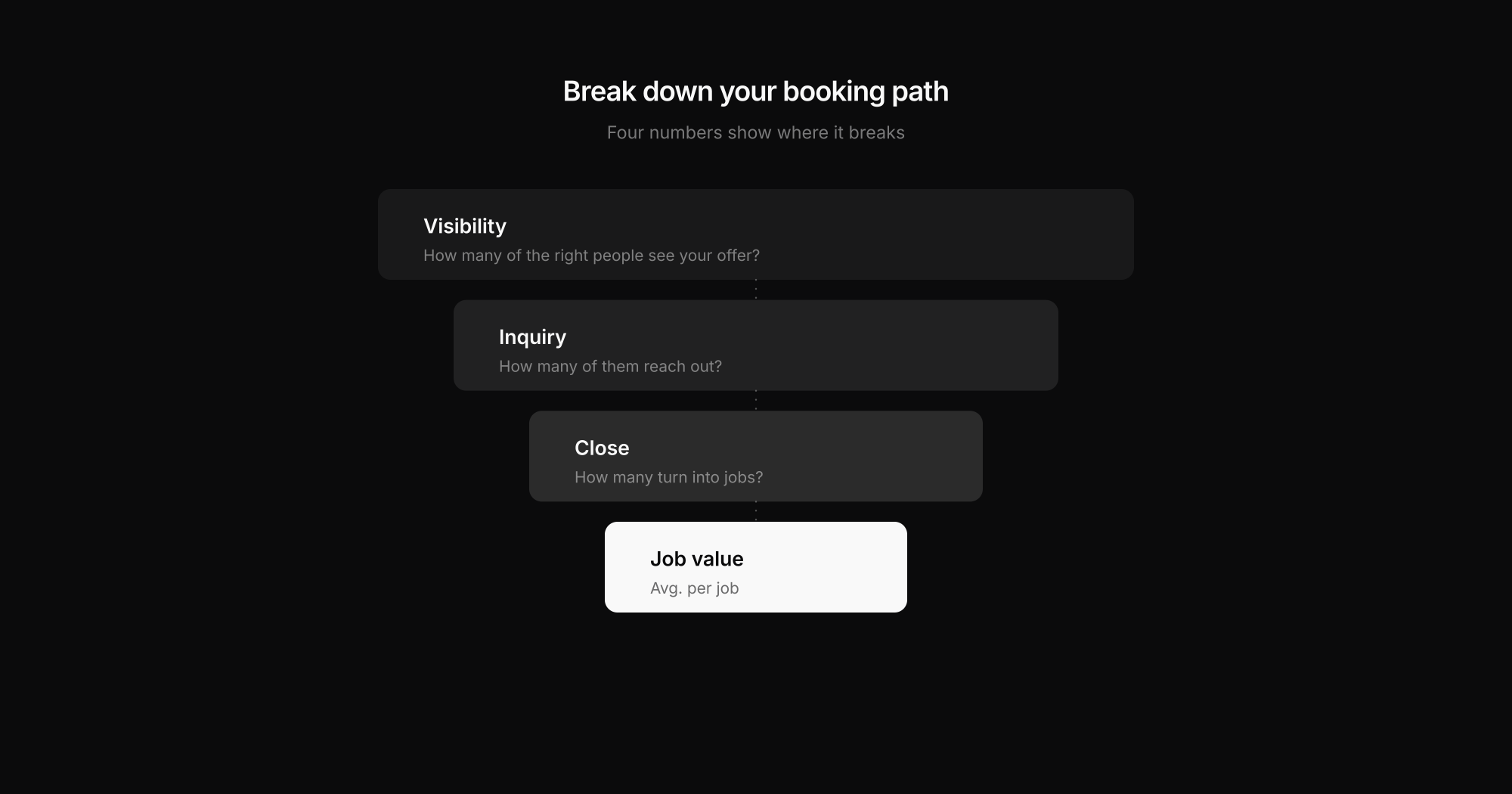
Before lowering prices, rebuilding your website, or switching niches, break the sales process into four numbers:
- How many relevant people see your offer?
- How many of them inquire?
- How many inquiries become paid jobs?
- What is the average project value?
Each problem requires a different response.
| What you observe | Likely issue | Useful next move |
|---|---|---|
| Very little traffic and no inquiries | Not enough relevant visibility | Build one acquisition channel consistently |
| Traffic but almost no inquiries | Unclear audience, offer, or call to action | Sharpen the website and positioning |
| Plenty of calls but few bookings | Poor-fit leads, weak value, or low trust | Review sales calls and adjust the offer |
| Many small jobs but little profit | Offer is too broad or badly packaged | Bundle services and set a minimum scope |
| Repeat clients disappear | Too much dependency on a few accounts | Reactivate old clients and develop a new segment |
Compare at least three to six months with the same period in the previous year. Seasonality, holidays, wedding cycles, and annual budget approvals can otherwise distort the picture.
What can help during a slow period
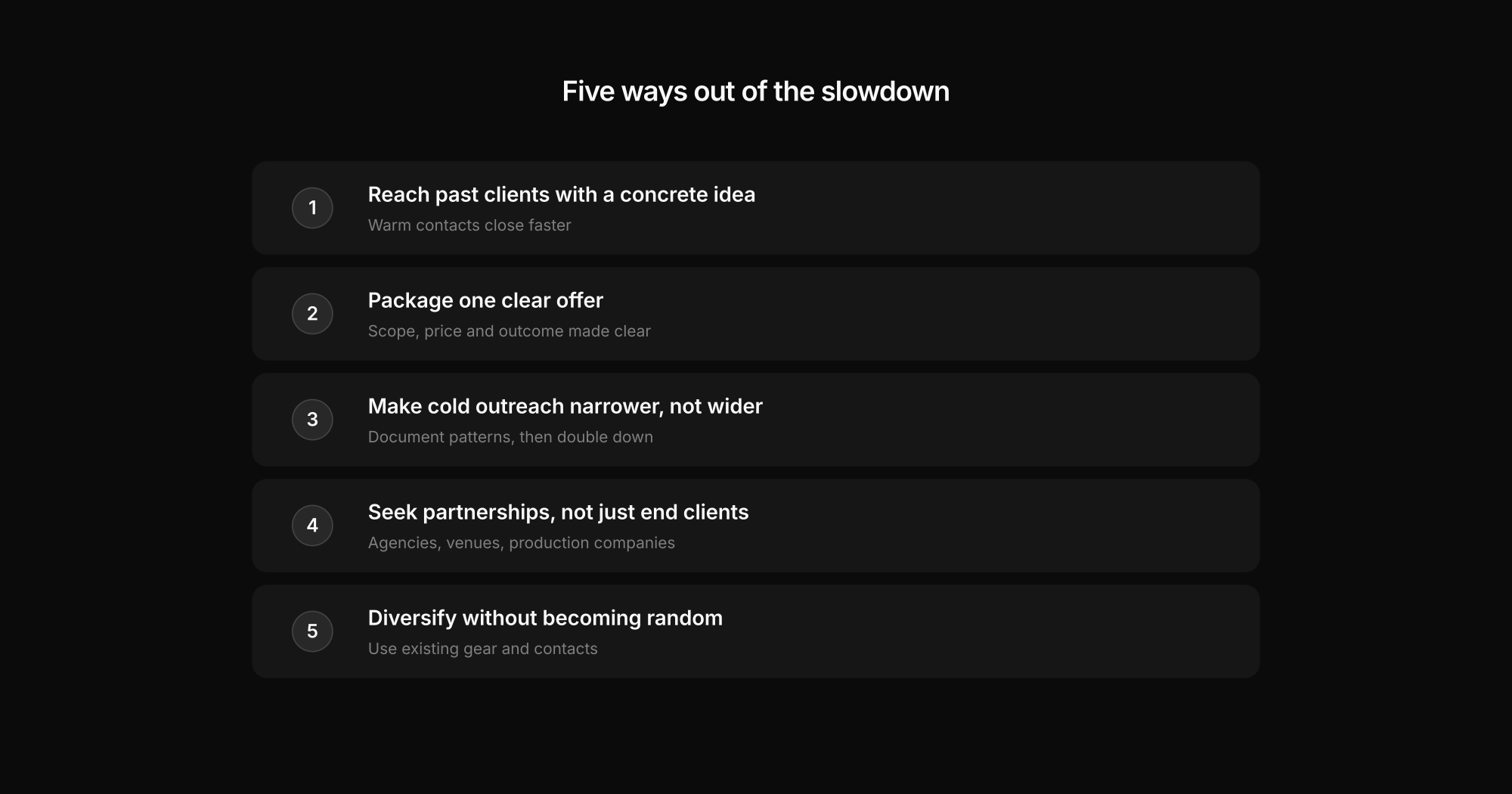
1. Return to previous clients with a specific idea
“Let me know if you need another video” is easy to ignore. A concrete suggestion is stronger:
- updated team portraits after a hiring phase
- recruiting clips for open positions
- a new image library for web, press, and social media
- an onboarding or facility-tour video
- recurring event coverage
- a short campaign tied to a recent company development
You are not sending a generic reminder. You are demonstrating that you understand the client and can see a useful next project.
2. Productize one offer
Custom production remains valuable, but uncertain buyers find clear scope easier to approve. A monthly content day, a fixed recruiting package, or a recurring event package gives the client a visible result and a predictable price range.
Productizing does not mean turning your work into a cheap commodity. It reduces uncertainty. The client knows what is included, and you know how much effort delivery requires. Recurring packages can also soften the gaps between larger projects.
3. Make cold outreach narrower, not merely more personal
Sporadic outreach wins are not necessarily random. They may reveal that a certain trigger, industry, role, or opening line works. Track every positive reply:
- industry and company size
- recipient’s role
- reason for contacting them now
- outcome you proposed
- subject line and opening
- response time
Patterns become clearer after 30 or 50 well-targeted contacts than after five extremely polished emails. Good outbound combines genuine relevance with enough volume to learn.
4. Build partnerships, not only end-client relationships
Production companies, agencies, event suppliers, venues, web studios, and communications consultants often need reliable photo and video support. White-label work may be less visible than winning a large direct client, but it can be more predictable. You do the work well without having to acquire and manage every end customer yourself.
5. Diversify without becoming random
A related second service can protect weak months: photo plus video, corporate plus events, recording plus editing, or video production plus podcasts. Diversification works best when it uses the same skills, equipment, or relationships.
Changing direction every week has the opposite effect. You never stay in one market long enough to build proof, referrals, or a repeatable offer.
What not to do immediately
The first reaction is often a large price cut. That may generate a few jobs, but it can make the underlying problem worse. You need more projects to survive, work under greater pressure, and have even less time for sales. It also attracts buyers who may leave as soon as someone cheaper appears.
A complete rebrand is rarely the first answer either. A new logo and a redesigned feed will not help if the right people never see your offer or cannot understand its value.
Finally, do not confuse busywork with business development. Reordering your portfolio, comparing equipment, and endlessly polishing your website feel productive. During a slowdown, every week also needs actions that can lead to real conversations.
A simple 30-day plan
- Week 1: Review your numbers, identify the most profitable jobs from the past two years, and select ten suitable former clients.
- Week 2: Define one clear package and test it with two previous customers.
- Week 3: Choose one narrow target group and contact 20 to 30 relevant prospects with a credible idea.
- Week 4: Review replies, objections, calls, and bookings. Double down on patterns that worked and remove weak approaches.
The goal is not to guarantee a full calendar within 30 days. The goal is to rebuild a system that produces measurable signals.
FAQ: No clients as a photographer or videographer
Does a slowdown automatically mean the economy is bad?
No. Economic weakness can reduce budgets, but it does not explain every result. Industry, region, price level, positioning, repeat-client concentration, and acquisition channels also matter. Start with your own pipeline data.
Should I lower my prices when inquiries stop?
Not automatically. If nobody sees the offer, a lower price changes nothing. If prospects inquire but do not book, price may be one factor, but unclear value, low trust, poor fit, or excessive scope may matter more. A smaller, clearly defined entry offer is often better than a general discount.
Should I specialize or offer more services?
Either can work. Specialization makes your message and outreach clearer. A related second service can reduce seasonal risk. The services should share customers, skills, or processes rather than look like unrelated side businesses.
Can social media still bring photography and video clients?
Yes, but it is not automatic. Social media works best when the content is aimed at a defined buyer, addresses specific problems, shows relevant proof, and gives the viewer a clear next step. Reach without buyer fit is not a reliable sales channel.
When should I consider a side job or employment?
When reserves are falling, fixed costs are no longer secure, or financial pressure is causing poor decisions, additional income can be sensible. It is not a failure. Stability can give you enough space to improve the creative business without panic.
Conclusion
Having no clients as a photographer or videographer does not automatically mean your work is poor, and it does not mean the economy is the only cause. The market is changing: simple production moves in-house, some buyers delay spending, and low-cost competition grows. At the same time, work remains available for businesses that communicate a clear outcome, maintain relationships, acquire clients systematically, and reduce dependency on a small number of accounts.
Treat the slowdown as a diagnosis problem rather than a verdict. Measure the pipeline, start with warm contacts, test one understandable offer, and focus your outreach on a group whose concrete problem you can solve.