
Photography Contract: What to Include and How to Get It Signed Digitally
A handshake and a text message – that's how a surprising number of shoots begin. It usually works out. Until it doesn't: the client suddenly uses the images for advertising when only a private print was agreed. A shoot falls through and nobody discussed a cancellation fee. The invoice goes unpaid because "that's not what we agreed." A photography contract prevents exactly those moments – not because you distrust your client, but because clear terms protect both sides.
This post shows what belongs in a photography contract, which mistakes to avoid – and how to get it signed digitally instead of emailing PDFs back and forth. It gives practical orientation for typical photography contracts and is not a substitute for legal advice – rules differ by country, so check what applies in yours.
Does a photographer even need a contract?
Short answer: for a professional shoot, you should put the key points in writing. Not because a verbal agreement is invalid – in most jurisdictions a verbal contract is perfectly valid – but because of provability: if nobody can show what was agreed in a dispute, it's your word against theirs. The moment money changes hands, usage rights are transferred, or people are identifiable, get it in writing.
This isn't just for big jobs. It's precisely the many small shoots – portraits, headshots, family photos – where misunderstandings pile up. A contract you set up cleanly once and just adapt per job saves you exactly those discussions.
What to include in a photography contract: the checklist
A good photography contract doesn't have to be long, but it should cover these points:
- The parties. Who's commissioning, who's shooting – with full contact details.
- Scope of work. What exactly is agreed: type of shoot, duration, number of delivered images, editing scope. The more specific, the less "I thought there'd be more photos."
- Fee and payment. Price, payment terms, deposit. Also: what a re-edit costs, what an extra image costs.
- Delivery timeline. When the client gets the images – and in what form (web, print, a finished gallery).
- Usage rights. The most important and most-forgotten point. As the creator you keep the copyright; you only grant the client specific usage rights. Private? Commercial? Social media? Time-limited? It has to be spelled out.
- Cancellation and no-show. What happens if a date falls through – on both sides. Cancellation fee, rescheduling, deposit kept or refunded.
- Image rights of the people depicted. If people are identifiable, secure how the images may be used – depending on the use, this involves personality/image rights and data-protection questions. For publication, advertising, or passing to third parties, this is often handled through a documented consent or a model release, which ties closely to the photography contract.
- Data protection. How you handle the images and the client's data.
- Clear confirmation from both sides. For many photography contracts, a handwritten signature isn't legally required – what matters is that both sides clearly agree to the content and that it's documented. A signature is the cleanest way to do that (more on that below).
Usage rights: where it most often goes wrong
When a photography contract leads to a dispute, it's almost always about usage rights. The reason: client and photographer often mean completely different things by "I get the images."
As the photographer you're the creator – the copyright always stays with you and can't be transferred. What you transfer are usage rights, and you can define them as narrowly or broadly as you like:
- Geographic: just your country, or worldwide?
- Time: unlimited, or one year?
- Scope: private only, or also commercial advertising, social media, passing to third parties?
A portrait client printing the image privately needs different rights than a company putting it in a campaign. If you don't regulate this, courts in many jurisdictions fall back on the purpose the license was evidently granted for – not on what the client later wishes. "I get the images" therefore does not automatically mean "I can do anything with them." But for you that also means lost income when the client wants to use the images more broadly than the original purpose covers – had you regulated it, you could have charged for that extra scope.
Common photography contract mistakes
- Verbal only. "We know each other" is often enough for validity – but in a dispute it's your word against theirs. Put the key points in writing at least.
- Forgetting usage rights. The most expensive mistake – see above.
- No cancellation fee. If the client cancels on the shoot day, you've reserved the day and earned nothing. Regulate it in advance.
- Copying a template unchecked. Clauses that don't fit your shoot, or outdated data-protection wording.
- Contract too late. The contract belongs *before* the shoot, not after. And few people happily sign retroactively.
Get the contract signed digitally – instead of print, scan, email
This is where most template guides lose the thread: they hand you the document and leave you alone with the paperwork. Yet the signing step is exactly the most annoying part in practice – print, sign, scan, email back, and then the PDF sits somewhere in an inbox.
For many everyday photography contracts, an electronic signature workflow is practically sufficient: you send the client a link, they confirm on their phone or computer, done. No printer, no scanner. In the EU, the eIDAS Regulation ensures an electronic signature isn't denied legal effect merely for being electronic; in the US, the ESIGN Act gives electronically concluded contracts and signatures legal effect (with some consumer-protection and state-level specifics). What matters is the tier:
- Simple electronic signature – practical and evidentially useful for the bulk of normal photo jobs, but doesn't automatically satisfy every statutory writing requirement.
- Advanced electronic signature – higher requirements for identity and integrity.
- Qualified electronic signature – in the EU, only this is expressly equated with a handwritten signature and satisfies a legally required written form.
In practice: a simple signature workflow covers the usual shoot. Only if a statutory writing requirement, special compliance rules, or country-specific requirements apply do you need to check whether an advanced or qualified signature is required.
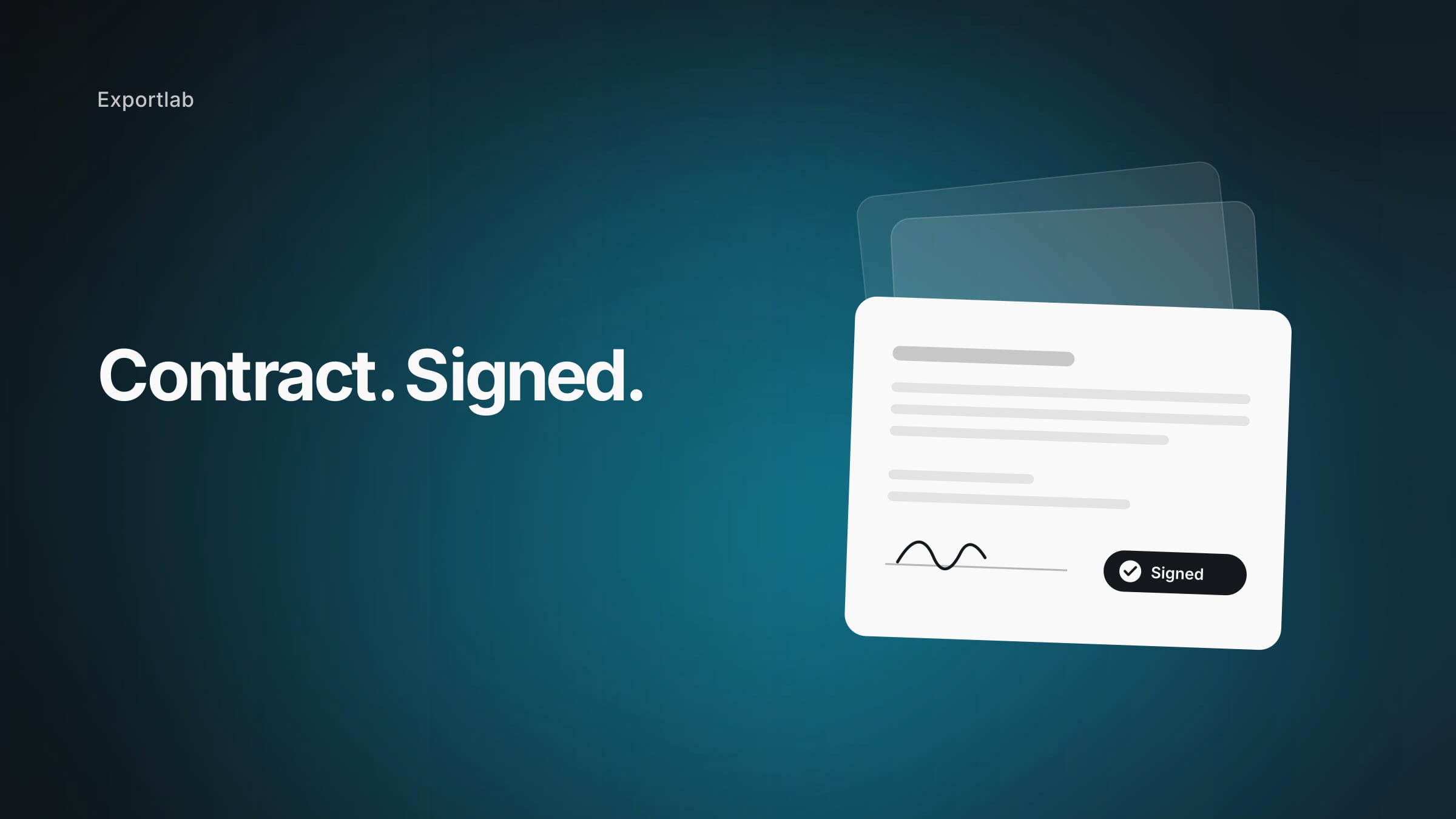
That's exactly the flow Exportlab's contracts at the project provide. And you don't have to start from scratch: Exportlab ships with ready-made contract templates that cover exactly the clauses from the checklist above – you just fill in your details:
- Photography Services Agreement – the standard template for a photo shoot (services, fee, cancellation, usage rights, delivery).
- Video Production Agreement – for single video projects.
- Media Production Retainer Agreement – for ongoing work with recurring clients.
You pick the right template, fill in project name, date, fee, and delivery timeline via placeholders, send it to the client for signature – and the signed version stays neatly attached to the project, alongside the gallery, the model release, and the delivery. The signature workflows capture a timestamp, IP address, device information, and document versions as an audit trail, which improves traceability and evidence – though, to be fair, that isn't automatically the same as a qualified electronic signature.
If a particular contract needs a higher signature tier or a certified trust-service provider, that can be connected through Exportlab's API as a custom setup – there's no publicly documented out-of-the-box integration with a specific signature provider, but API-based connection on request.
How to create a photography contract: step by step
- Take a template with the points from the checklist – either your own or a ready-made one like Exportlab's.
- Adapt per job: scope, fee, usage rights for the specific shoot.
- Before the shoot, send it to the client for digital signature.
- Store the signed version – ideally at the project, where the images live too.
- For photos of people, also obtain the model release.
FAQ: Photography contract
Does a photographer need a contract?
For professional shoots, yes. The moment money changes hands, usage rights are transferred, or people are identifiable, everything should be in writing. A verbal agreement is valid but unprovable in a dispute.
What must a photography contract include?
The core points: the parties, scope of work, fee and payment, delivery timeline, usage rights, cancellation/no-show terms, image rights of the people depicted, data protection, and both signatures. Usage rights are the most important and most-forgotten point.
Is a digital signature on a photography contract legally valid?
For most everyday photography contracts, a simple electronic signature workflow is practically sufficient – the client confirms via a link on their phone or computer. Under the EU's eIDAS Regulation, an electronic signature isn't denied legal effect just for being electronic; in the US, the ESIGN Act gives them effect. But in the EU, only the *qualified* electronic signature is equated with a handwritten one, and it's required where a statutory written form applies. Clarify legally if in doubt.
Do I have to give clients a right of withdrawal?
Possibly. If you sell to consumers and the contract is concluded online, by phone, or away from your business premises, a statutory right of withdrawal (cooling-off period) may apply in many jurisdictions. Whether and how you must inform clients depends on the case – a point many guides overlook in B2C portrait, family, or headshot photography.
Contract before or after the shoot?
Always before. The contract defines what's agreed – which is useless once the shoot has already happened. And few people happily confirm retroactively.
Can I just use a template from the internet?
As a starting point yes, but never unchecked. Adapt at least the scope, usage rights, and fee to your type of job, and watch for current data-protection wording. A TFP shoot needs different clauses than a commercial job.
Are there ready-made contract templates for photographers?
Yes. Exportlab ships with several ready-made templates – a Photography Services Agreement for photo shoots, a Video Production Agreement for video projects, and a Media Production Retainer Agreement for ongoing work. You just fill in your details via placeholders and send the contract straight out for digital signature.
Conclusion
A photography contract isn't distrust toward the client – it's the basis for clear collaboration: it fixes the scope, fee, and above all the usage rights before misunderstandings arise. The most common mistakes – verbal instead of documented, forgetting usage rights, signing too late – are easy to avoid with an adapted template and a clear process. And when signing happens digitally at the project instead of via PDF ping-pong, you end up not just with a contract, but with the entire job history in one place.