

Labelling AI Images: What Became Mandatory in August 2026
Since 2 August 2026 you have to label AI images in certain situations – that is what Article 50 of the European AI Act requires. Anyone who creates, edits or publishes images professionally is affected: photographers, videographers, agencies, online shops and everyone running social media commercially.
The good news first: there is no blanket rule that every image touched by AI needs a label. What matters is whether an image looks realistic enough to be mistaken for a genuine photograph. This post shows where the line runs, which wording works, and what it means for your workflow.
Please note: This article is general guidance, not legal advice. For your specific situation, consider consulting a lawyer specialising in IT and media law.
When did the AI labelling obligation start?
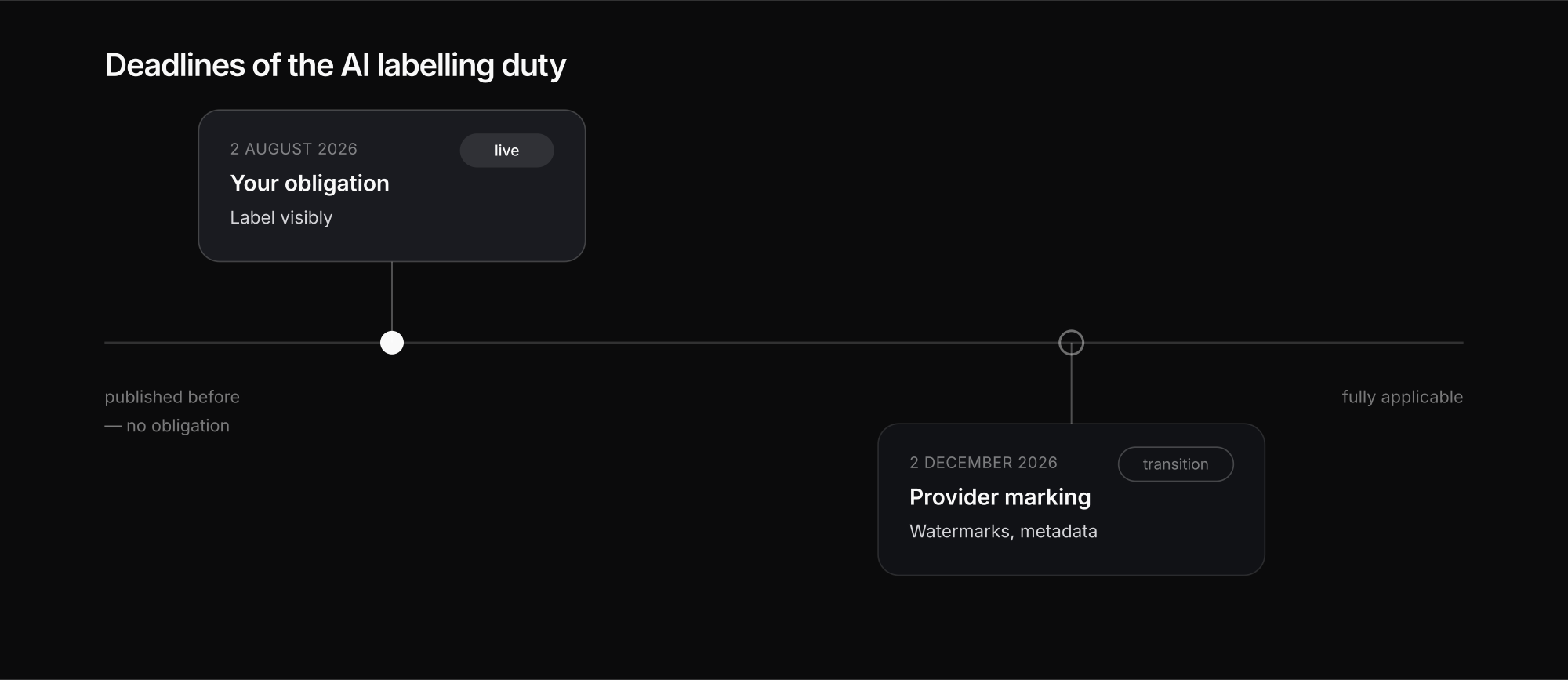
The transparency obligations under Article 50 of Regulation (EU) 2024/1689 have applied since 2 August 2026. The European Commission only finalised the accompanying guidelines in July 2026 – which explains why half-knowledge circulated for so long and reliable explanations only became available recently.
Two deadlines are worth keeping apart:
- Your obligation as a deployer – someone using AI professionally – applies since 2 August 2026.
- Machine-readable marking by the providers of AI systems (watermarks, metadata) has a transition period until 2 December 2026 for systems already on the market before that date.
Content you published before 2 August 2026 does not have to be labelled retroactively. The Commission recommends it voluntarily, but under the current guidelines it is not mandatory.
Do I have to label AI images? The deciding question
The obligation does not depend on *whether* AI was involved, but on how realistic the result looks. The legal text talks about deepfakes – and means considerably more than fabricated videos of politicians.
It covers AI-generated or manipulated images that realistically depict persons, objects, places, entities or events and could therefore appear falsely authentic. The Commission gives the example of a real photo of an empty flat that is realistically furnished using AI – that too can require a label.
In practice, three questions get you most of the way:
- Does the image show a real or plausibly real person, object or situation?
- Could a viewer mistake it for a genuine photograph?
- Was it substantially generated or altered by AI?
Three times yes means: label it. For clearly artistic, cartoon-like or obviously exaggerated depictions there is more room – but for photorealistic advertising I would not skip it.
AI-generated, AI-edited or AI-assisted?
Not every use of AI triggers the same obligation. This distinction is the most practically important part of the whole rule:
| Case | Example | Label? |
|---|---|---|
| Fully generated | Product shot entirely from Midjourney | Yes |
| Realistically manipulated | Real product against a generated landscape | Yes, label when in doubt |
| Person replaced or created | An AI model wearing your product | Yes |
| Location changed | A shoot made to look like it happened elsewhere | Yes |
| Generative expansion | Background extended via Generative Fill | Case by case, usually yes |
| Retouching | Distracting object removed, skin smoothed | Generally no |
| Technical optimisation | Denoising, sharpening, colour grading, upscaling | No |
| Organisation | Tagging, search, sorting | No |
The dividing line runs between changing the message and improving the image. If AI only raises the technical quality of a genuine photograph, no labelling obligation arises. As soon as it creates the content or shifts the reality shown, it does.
AI disclosure examples and wording
The law does not prescribe fixed wording. The information must be clear, distinguishable, intelligible and perceptible – at the latest on first exposure to the content. These have proven useful:
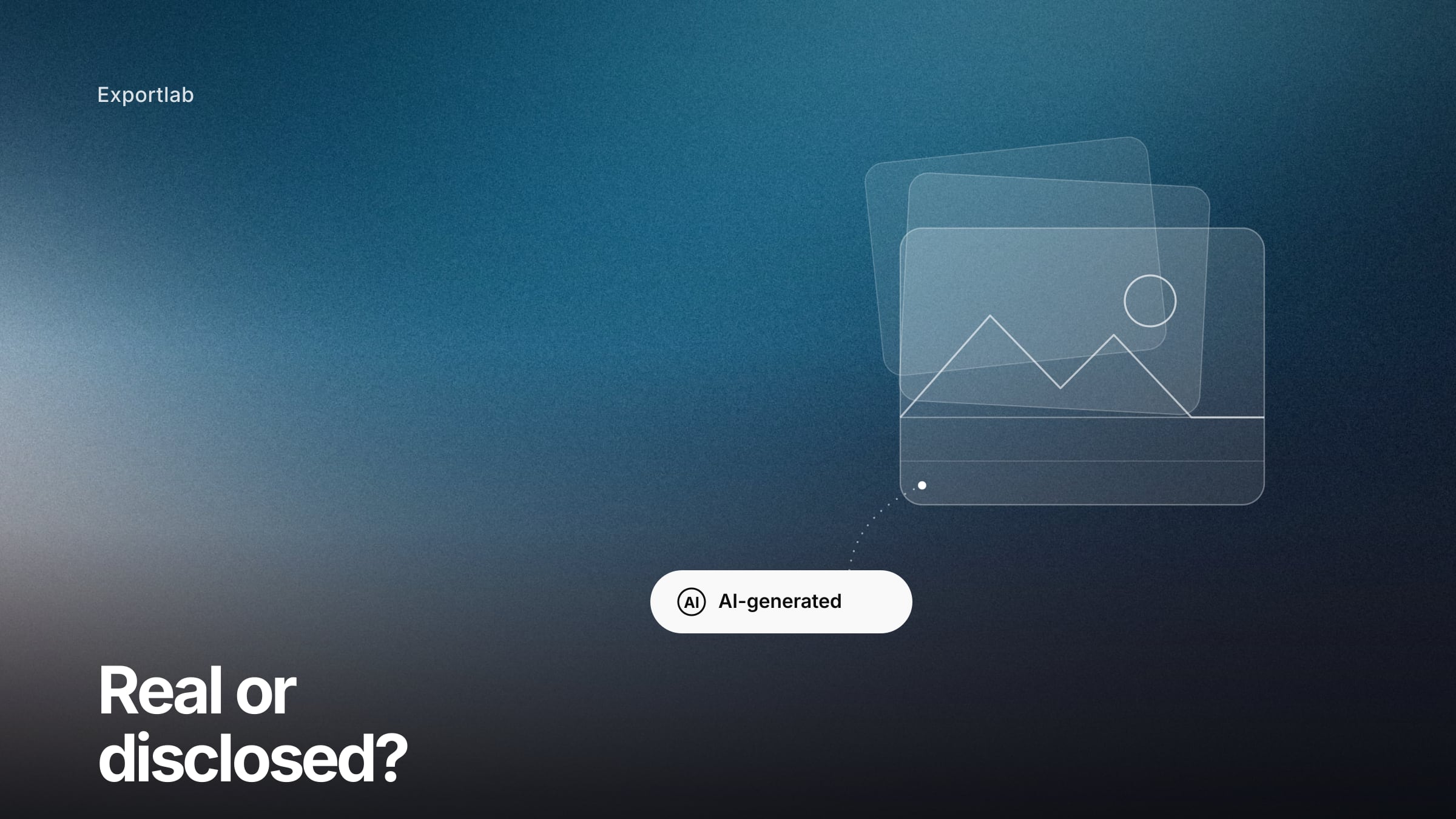
- AI-generated – for fully synthetic images
- Created with AI – equivalent, slightly softer variant
- Edited with AI – when a real photograph was the basis
- Partly created with AI – for hybrids, e.g. a real product against a generated background
- Image: AI-generated (Midjourney) – naming the tool reads as especially transparent
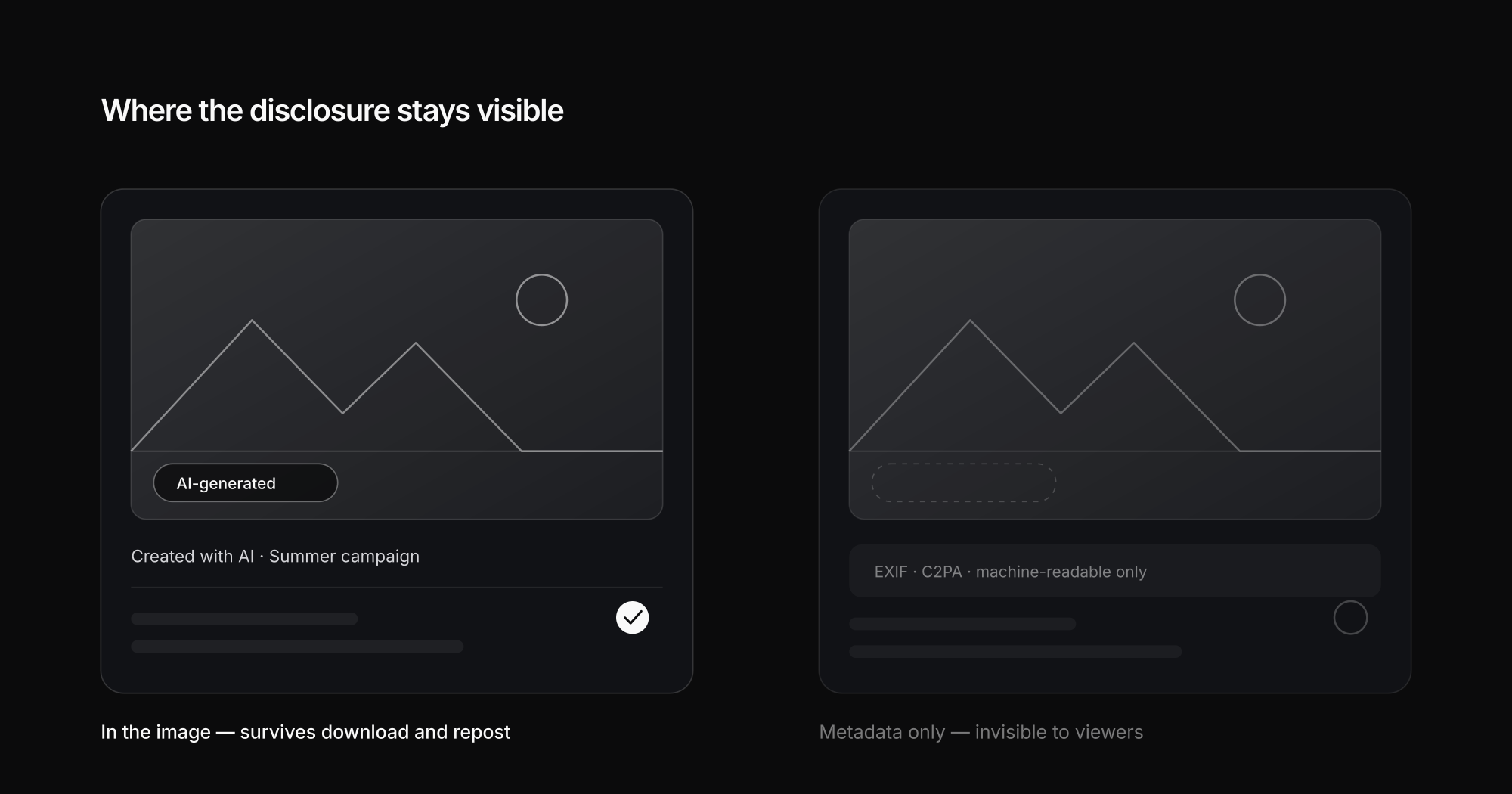
What does not suffice: invisible metadata only, a note solely in the imprint, a disclosure hidden behind "show more" or buried among twenty hashtags. The label has to be where the image is seen.
The EU now provides its own icons for labelling AI-generated content. Using them is voluntary – the labelling obligation itself is not.
AI labelling on Instagram and social media
On social media two layers meet that are often confused: the legal obligation under the AI Act and the platform rules of Instagram, TikTok or LinkedIn. Platform labels are house rules, not law.
So is the Instagram label enough? On its own it is risky. It appears with varying prominence depending on the view, sometimes triggers automatically via metadata – and disappears the moment someone downloads your post or reuses the image.
The safer approach combines:
- a small visible note in the image itself that survives resharing,
- a disclosure at the start of the caption, not after the line break,
- plus the platform label wherever it is offered.
The first point matters most: a note burned into the file survives every repost. The Commission explicitly recommends embedding the disclosure so it stays visible on download or sharing.
What this means for photographers and agencies
For client work the obligation has an inconvenient side effect: you need to know which file has which status. With five images that is trivial; with five hundred across three editing rounds it is not.
A pragmatic workflow looks like this:
- Set a status as soon as an image is created: no AI, AI-assisted, partly AI-manipulated, or fully AI-generated.
- Keep the originals. The untouched shot is your evidence that a genuine basis existed.
- Separate editing states instead of overwriting files – so it stays visible what changed when.
- Tell clients when you use AI on their material. That belongs in the brief anyway.
- Add the label before delivery, not only when posting.
This is exactly where a platform helps that keeps originals, versions and final deliveries cleanly apart. In Exportlab you keep track of every version of an image per project, and the client portal documents which version the client actually approved. For shots with identifiable people, consent applies on top – we covered that in detail in the model release contract.
What happens if you don't comply?
Breaches of the transparency obligations can be penalised with up to 15 million euros or 3 % of worldwide annual turnover. Those are ceilings for the most serious cases; for small and medium-sized businesses proportionality has to be taken into account.
Realistically, the bigger risk for freelancers lies elsewhere: in warnings from competitors and in clients who feel misled. A visible label is ultimately also a trust signal – especially in a market where AI imagery is becoming ubiquitous.
FAQ
Do I have to label AI images I post privately?
The deployer obligations under Article 50 apply to professional and commercial use. Purely private posts generally fall outside them. As soon as you monetise regularly, run ads or work for clients, you count as a deployer – the boundary is fluid, so label when in doubt.
Is AI labelling mandatory on Instagram?
The legal obligation applies regardless of platform, so it applies on Instagram too. Meta's own AI label does not automatically satisfy it, though: it can be lost on download or repost. A note in the image plus a disclosure at the start of the caption is safer.
Do I have to label retouched photos?
Classic retouching – skin, removing distracting objects, colour correction – generally does not trigger a labelling obligation as long as the message of the image stays the same. Once you generate or realistically alter people, places or scenes, it is a different matter.
Does this apply to images from before August 2026?
No. Under the Commission's current guidelines, content published before 2 August 2026 does not need to be labelled retroactively. It is recommended voluntarily, but not required.
How do I label AI-generated video?
The same logic applies as for images: noise reduction, colour correction or automatic subtitles are uncritical. If a person, place or event is realistically created or substantially altered, the disclosure belongs at the start of the video. Cloned voices of real people should be labelled as well.
Conclusion
Since August 2026, labelling AI images is no longer a matter of style but an obligation for everyone publishing images professionally – with a clear trigger: as soon as an image looks realistic enough to pass as a genuine photograph, it needs a visible disclosure. Pure retouching and technical optimisation stay outside it.
The practical effort lies less in the label itself than in traceability: knowing which file is original, edited or generated. Anyone already managing editing states and client approvals properly has done most of the work.