

How to Make a Mood Board That the Client Actually Signs Off On
Making a mood board is quick: gather a dozen images, lay them out, done. The real question is whether the board decides anything afterwards — or whether you end up debating on the shoot day anyway, because "bright and friendly" meant something different to everyone in the room.
That is where useful and decorative mood boards part ways. A useful mood board is not a collection of pretty pictures but an agreement document: it records what the client and the photographer settled on before anyone unpacks a camera. This article covers what belongs on it, what doesn't, which tool suits which situation, and how a pile of references becomes something you can point back to later.
Why mood boards are needed at all
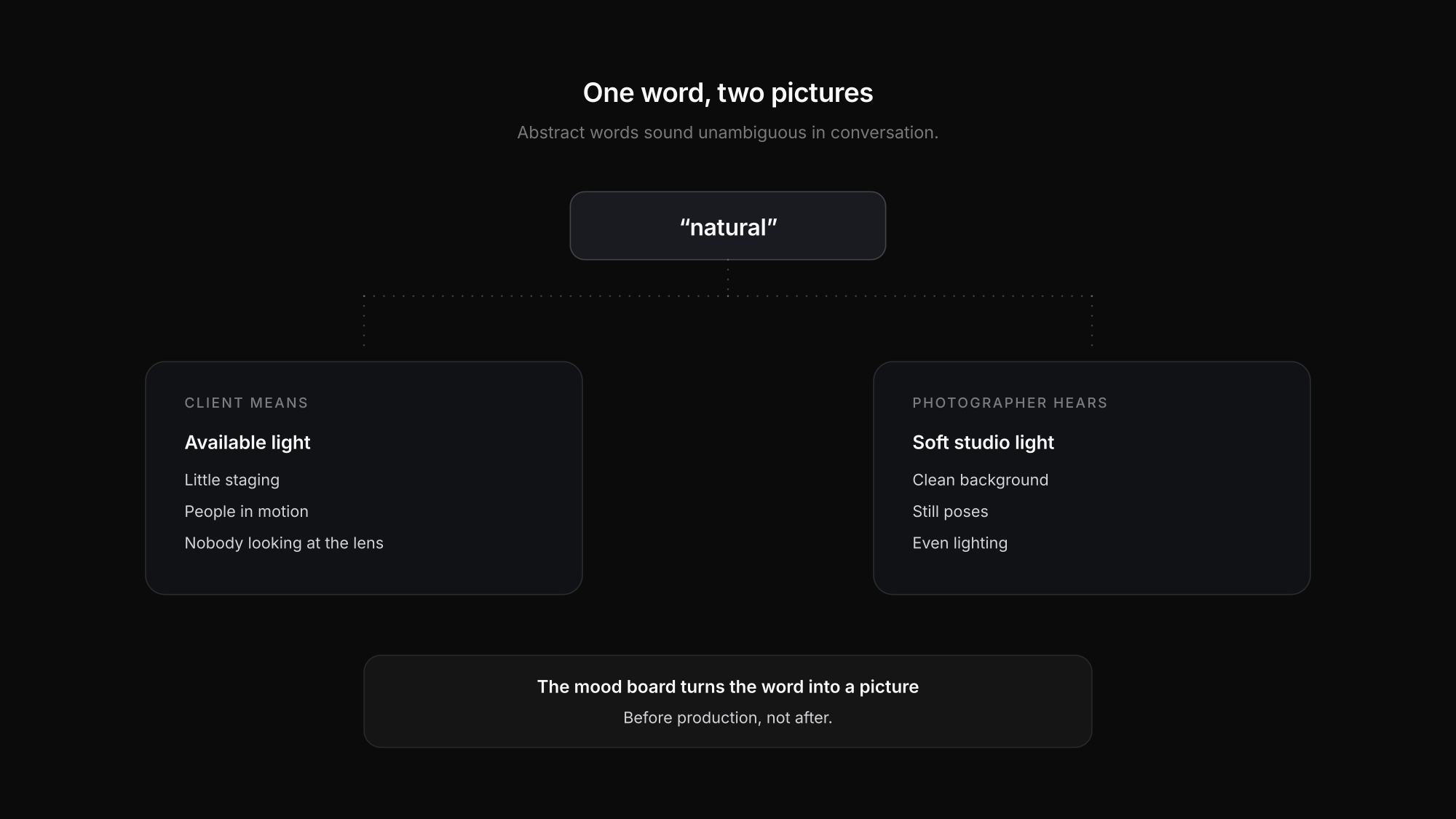
The problem is not taste, it is language. Clients describe images with abstract words: natural, premium, modern, authentic, not too posed. Every one of those works in conversation and falls apart in production.
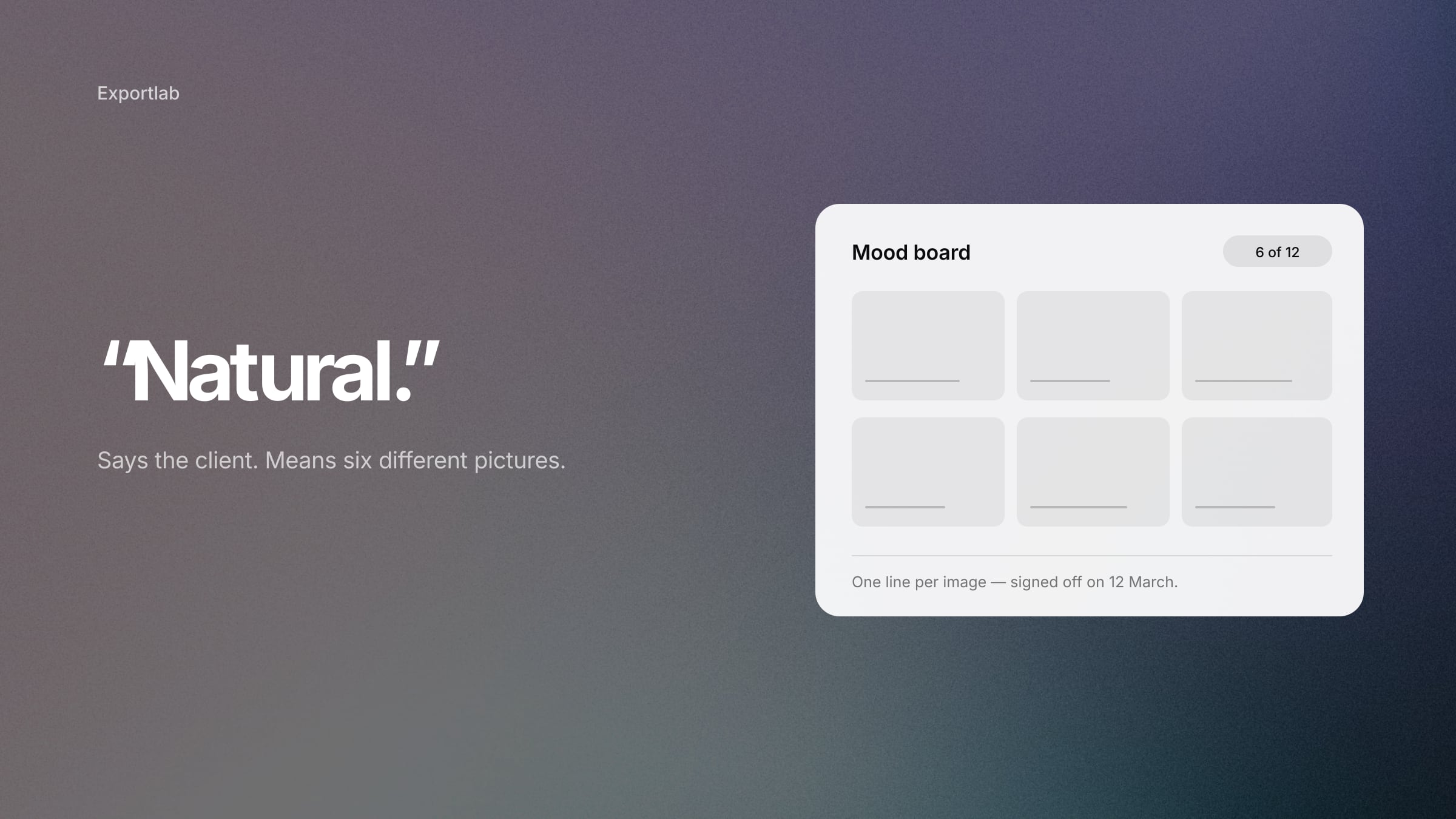
"Natural" means available light, little staging and people in motion to one person. To another it means soft studio light, a clean background and nobody looking at the lens. Both used the same word and pictured something else.
A mood board translates words into images before anything is produced. That is its only job, and it is the measure of whether it is any good.
What belongs on a mood board
A board that carries a decision shows more than nice images. These layers earn their place:
- Light and mood. The most important layer, because it is the hardest to put into words. Hard or soft, backlit or evenly lit, time of day.
- Framing and perspective. Close or wide, eye level or above, centred or off-axis.
- Colour. A palette of three to five colours says more than ten reference images where the colour happens to be incidental.
- People and posture. Posed or observed, looking at the lens or past it, group or single.
- Location and props. Where it is shot, what is in frame, how tidy it is.
- Styling. Wardrobe, make-up, details — where relevant, otherwise leave it out.
- Notes on the images. The underrated part: one line next to each reference saying *what exactly* is meant by it.
That last point makes the biggest difference. A reference without a comment is ambiguous — the client may mean the framing while you read the colour grade. "For the backlight, not the location" ends the ambiguity in five words.
What does not belong on a mood board
Most guides list what to include. The opposite direction is often more useful:
- Sixty images. A board with sixty references says nothing, because it makes no choice. Ten to fifteen is usually enough. If everything is on it, nothing has been decided.
- Images with no discernible reason. If nobody can say why a reference is there, it comes off.
- Contradictions with no note. Three images in harsh midday sun and three in soft golden hour are not a mood board, they are an unresolved question. If both are wanted, the board has to say which part of the shoot each applies to.
- A competitor's campaign to recreate. As a reference for light or visual language, someone else's image is fair game. As a template to reproduce one to one it gets awkward — legally, and because the result is at best the second version of something that already exists.
- Technical instructions. Focal lengths, apertures and lighting diagrams belong on the shot list, not the mood board. The board settles the *what*, not the *how*.
Mood board, shot list, schedule: which does what
Three documents that get confused constantly, although they answer different questions:
| Document | Answers | Created | Audience |
|---|---|---|---|
| Mood board | What should it look like? | before the job is confirmed, with the client | client and team |
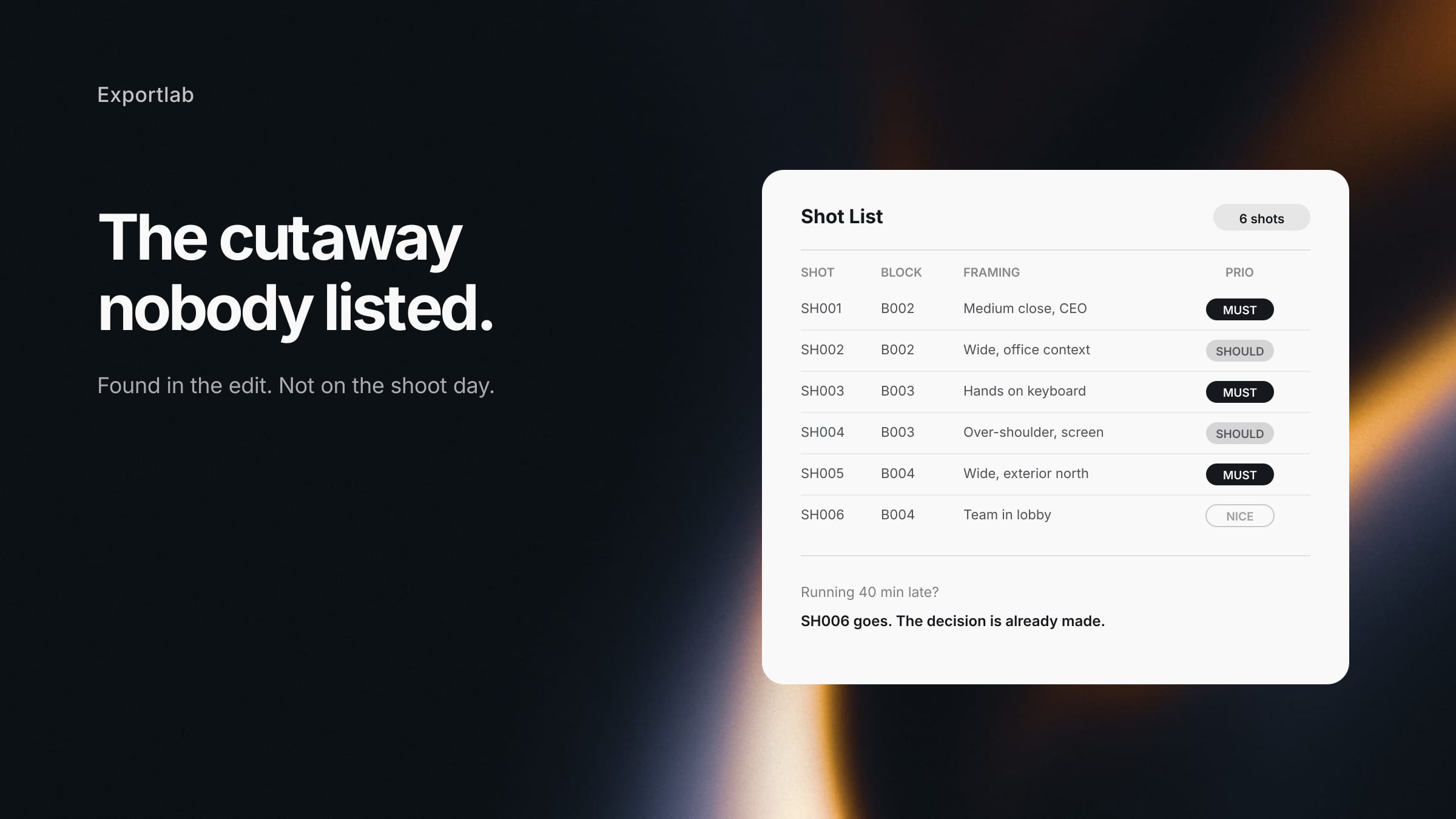
| Shot list | What exactly gets filmed? | after confirmation | camera and edit |
| Shooting schedule | When and where does it happen? | before the shoot day | the whole crew |
The order is not accidental. The mood board settles the direction, the shot list turns it into individual shots, the schedule spreads them across the day. Writing a shot list without an agreed mood board means planning shots for a visual concept the client has not confirmed.
What to make a mood board with
The tool question usually gets answered by how nice the interface is. The more useful question is what the job needs — above all, whether the client's agreement is still traceable afterwards.
| Tool | Strength | Weakness on a paid job |
|---|---|---|
| Fast collecting, enormous pool | Public or account required, no versions, comments scattered | |
| Canva | Layout and colour palette, looks good | Sign-off happens in link comments, the agreed state is hard to pin down |
| Milanote | Free canvas, notes beside images | Client needs access, often too much for a one-off client |
| PDF by email | Anyone can open it, the state is fixed | Changes create version 2, 3, 4 — eventually nobody knows which one counts |
| Shared folder | No barrier, everyone gets in | No order, no comments, no sign-off |
There is no winner here, only a fit. Pinterest is right for the first sweep. For the version the client signs off on, a dated PDF often beats a board that can still change afterwards.
The point where all five are equally weak: none of them records who agreed to which state, and when. Which is precisely why the mood board exists.
From mood board to sign-off
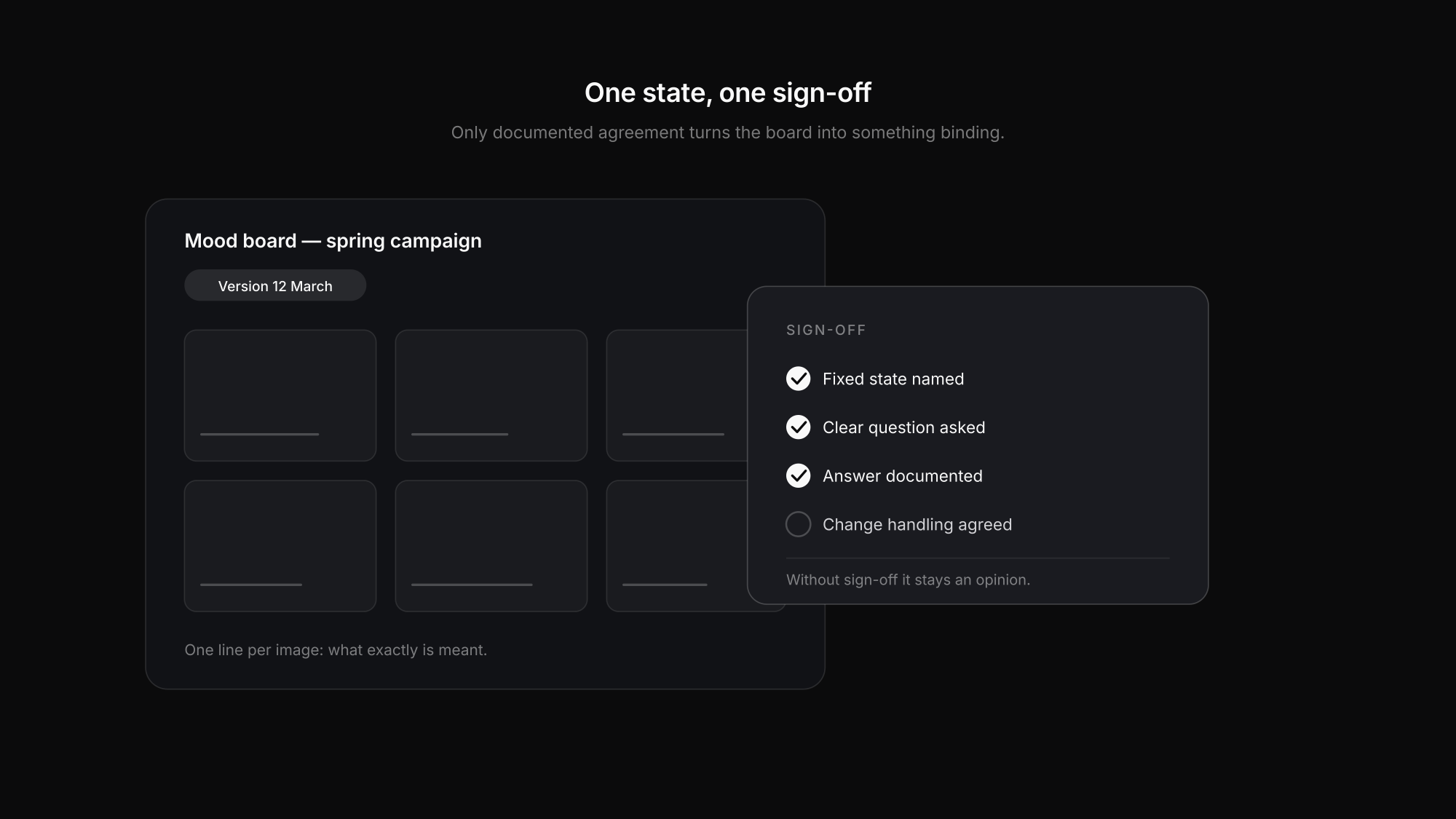
A mood board without a sign-off is an opinion. Only documented agreement turns it into something both sides can rely on.
It does not have to be formal. It needs four things:
- A fixed state. Not "the board" but "the version from 12 March". A board that keeps moving after approval is not a basis for anything.
- A clear question. Not "what do you think?" but "does this work as the direction for the shoot?". The first invites detail critique, the second gets you a decision.
- A documented answer. An email saying "yes, go ahead" is plenty — it just has to stay findable and refer to the state.
- A named way of handling changes. What happens if something is added after sign-off? Usually: new version, new approval, and for larger changes an adjustment to the proposal or the timeline.
Collecting the brief from the client
A mood board rarely starts from nothing. Usually the client supplies material: a logo, brand colours, existing images, sometimes a style guide — and often a handful of references they saw somewhere.
That return flow is the sticky part in practice. Images arrive by email, the logo through WeTransfer, the references as screenshots in a chat, and three days later someone asks about the typeface.
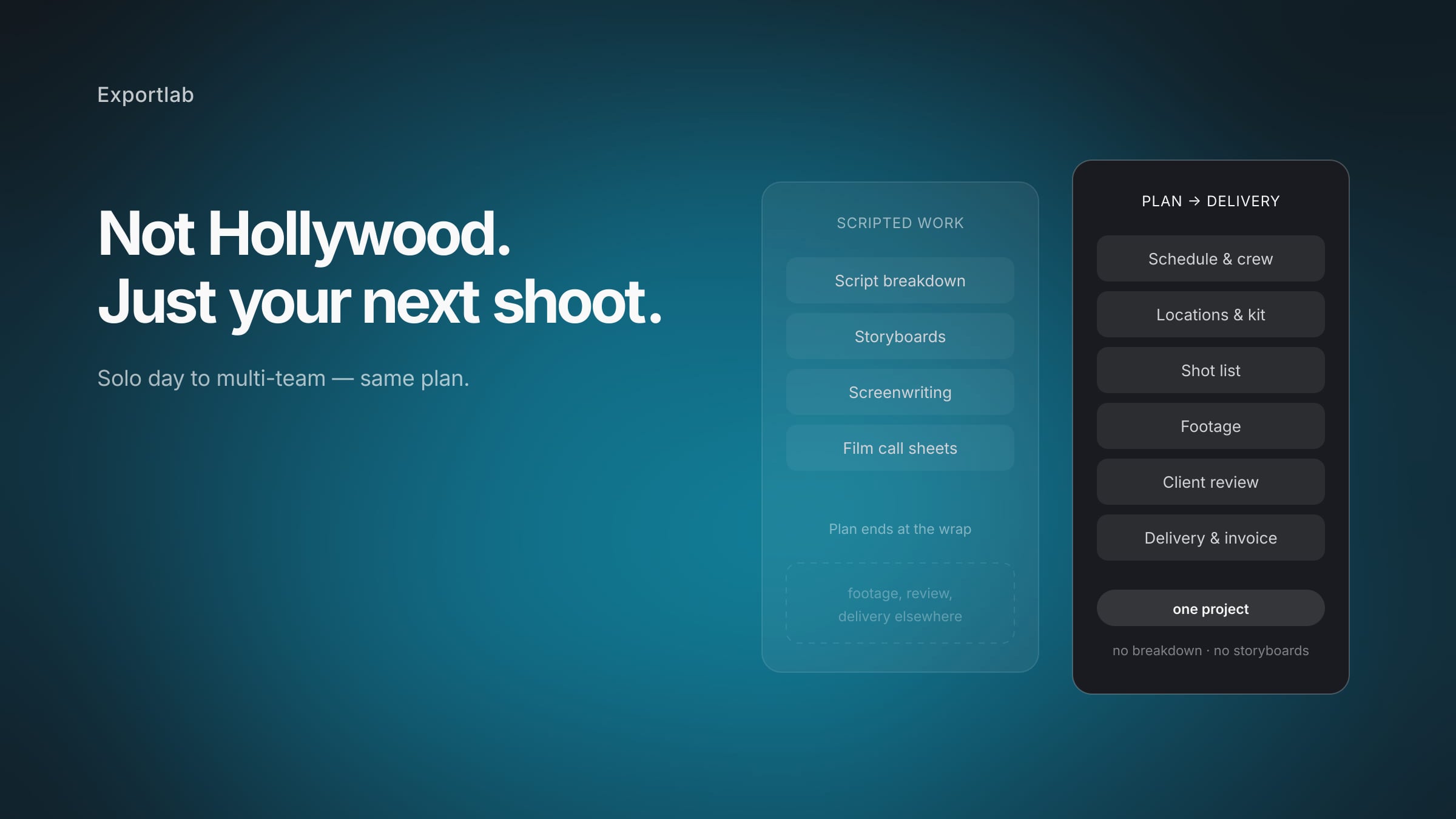
In Exportlab that runs through asset collections: you create a collection, share it with the client, and they upload brand material and references straight into it — without needing an account. You can attach questions the uploader has to answer, for instance what the images will be used for or what mood is wanted. The return flow lands in one place instead of four inboxes.
You still build the board itself wherever you like to design — Exportlab is not a mood board editor. What it removes is the collecting before and the filing after: the agreed board sits with the project, alongside the contract, the gallery and the eventual images, rather than in an email thread.
Common mood board mistakes
Made too late
If the mood board comes after the proposal, the price was already calculated against a visual concept nobody confirmed.
Images with no words
Without a note, nobody knows whether the reference is there for the light, the colour or the pose.
No fixed state
A board that keeps changing after sign-off cannot evidence anything later.
Everything thrown in
Sixty references are not a selection. If it is all on there, nothing has been decided.
Agreed only with your contact
Whoever signs the board off has to be allowed to decide. Otherwise the critique arrives later, from someone else.
Not available on set
A mood board sitting in an inbox does not help during the shoot. It belongs where the schedule is.
FAQ: making a mood board
How do I make a mood board?
Collect broadly first — references heading in the right direction, without filtering. Then cut down to ten or fifteen images and group them by layer: light, framing, colour, people, location. Write one line beside each image saying what is meant by it. Finally, get an explicit sign-off on that state.
What is a mood board?
A curated set of visual references that makes a planned visual language concrete: light, colour, framing, mood. It describes the direction, not the individual shots — those live on the shot list.
How do I make a mood board for free?
Pinterest for collecting, Canva for layout, Milanote for a free canvas with notes — all three have free tiers that are enough for a mood board. For the version the client signs off on, an exported dated PDF is often the sturdier choice, because the state cannot then change unnoticed.
How many images should a mood board have?
Ten to fifteen suits most shoots. Fewer than six leaves too much open, more than twenty stops being a selection. What matters is not the count but whether each image answers a question.
What is the difference between a mood board and a shot list?
The mood board settles how it should look — light, colour, mood. The shot list records what gets filmed, with framing, priority and the number of versions. The board comes before confirmation and addresses the client; the list comes after and addresses camera and edit.
Does a small shoot need a mood board too?
The smaller the budget, the less room there is for a misunderstanding. A two-hour portrait shoot often needs five references with one line each — but they should be agreed beforehand rather than assembled on location.
Conclusion
Making a mood board is not about collecting nice images. It is about making an expectation unambiguous before it costs money. The images are the means; the decision is the point.
Three things separate a decorative board from one that holds: a real selection rather than a collection, a line beside each image saying what is meant, and a fixed state the client has explicitly agreed to. After that the shot list translates the direction into individual shots and the shooting schedule spreads them across the day.