

Photography Business Expenses: What You Can Deduct and How to Keep the Receipts
Business expenses are the part of running a photography business that gets postponed longest — until the tax return is due and a shoebox of faded thermal receipts lands on the desk. Which is unfortunate, because this is exactly where it gets decided how much of your revenue you actually keep.
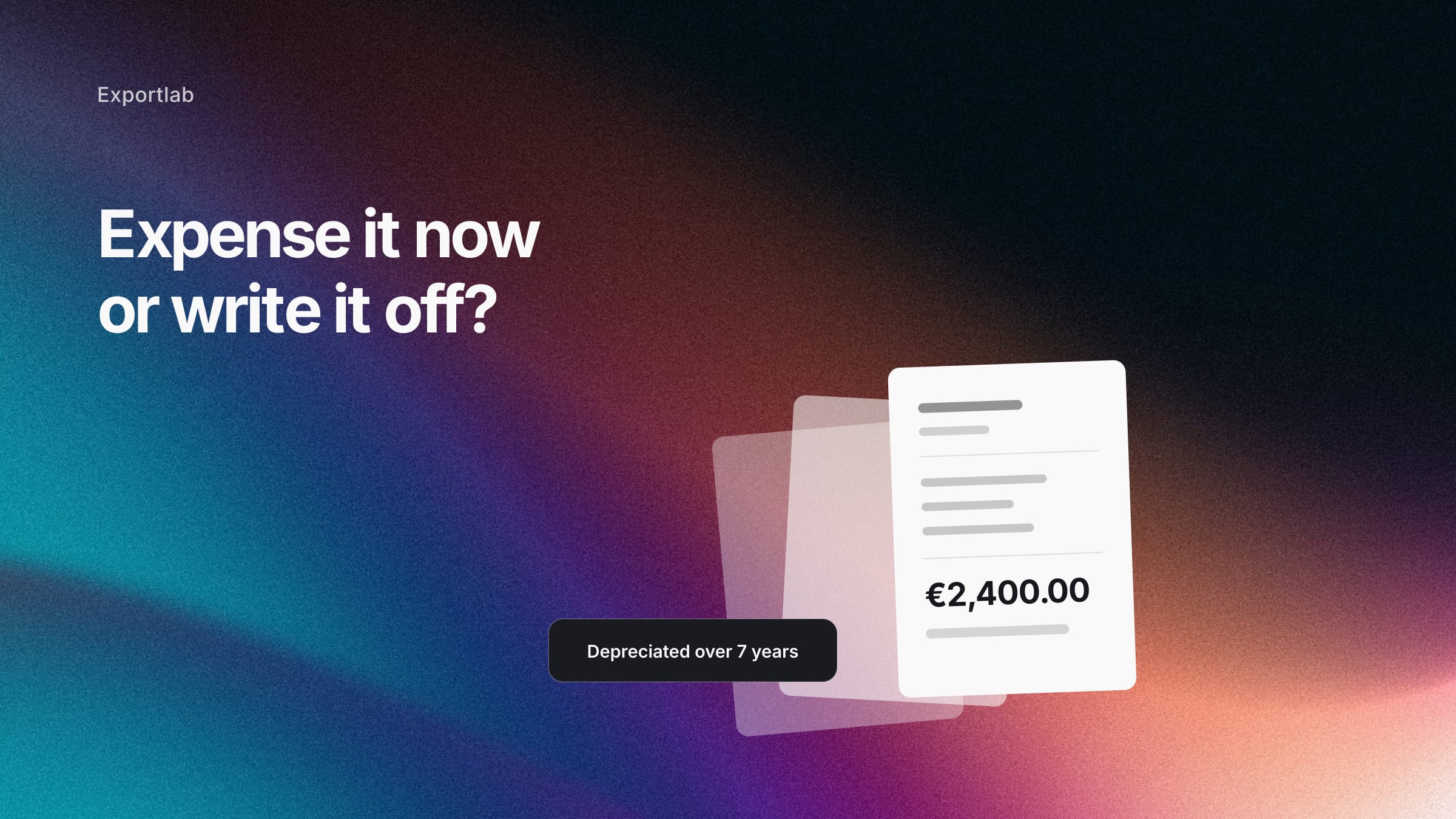
This article covers what photographers and videographers can deduct, why a €2,400 camera usually is not written off in a single year, and how to file receipts so they are still findable months later. Treat it as orientation, not tax advice: the thresholds and rules below vary by country, and what applies to you is a question for your accountant.
What photographers and videographers can deduct
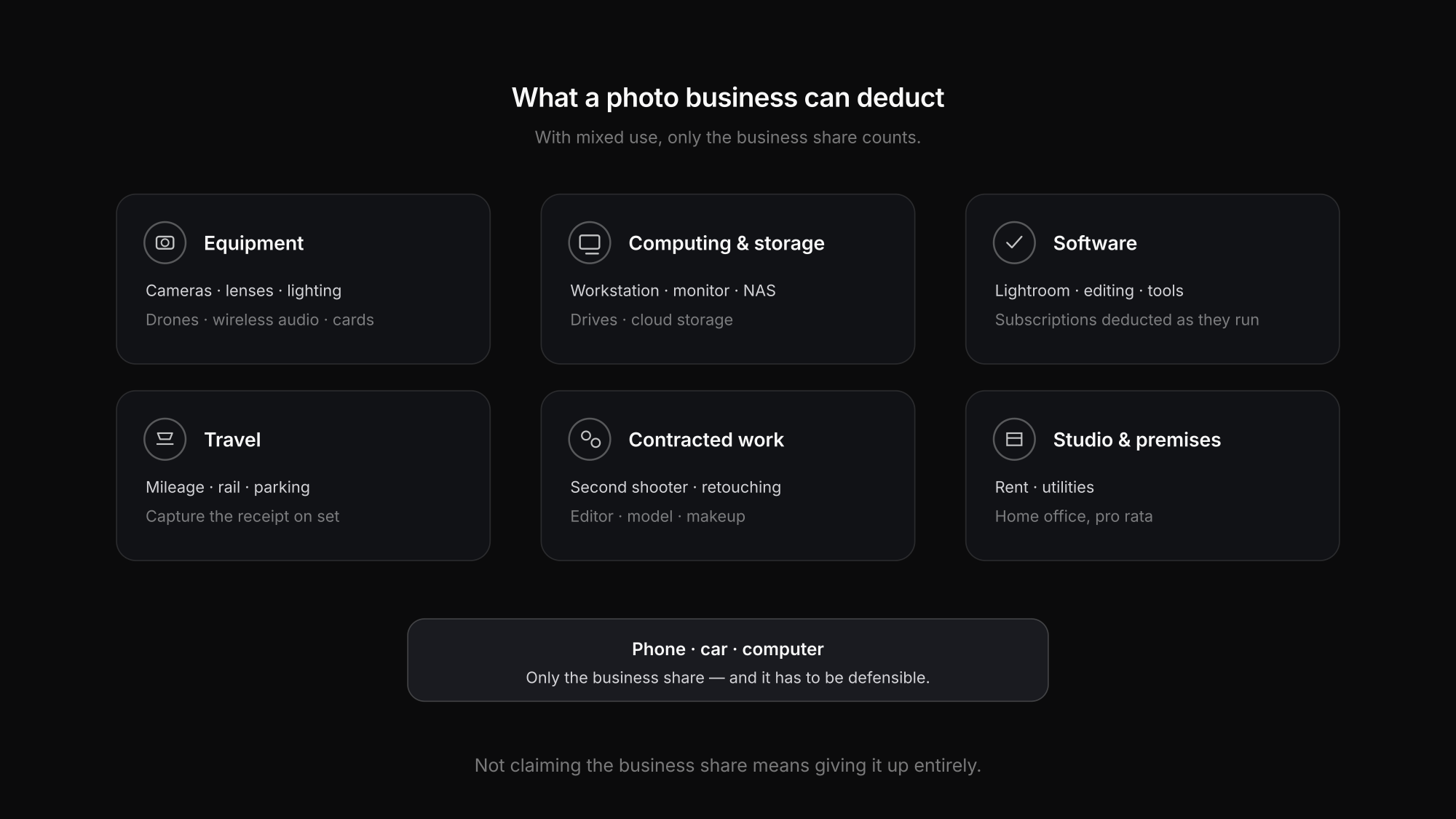
A business expense is a cost incurred for the business. For a photo or video operation, that covers more than most people claim:
- Gear — cameras, lenses, tripods, flashes, lighting, gimbals, drones, wireless audio, memory cards
- Computing and storage — workstations, monitors, calibration, external drives, NAS, cloud storage
- Software and subscriptions — Lightroom, Photoshop, editing suites, gallery and project tools
- Studio and premises — rent, utilities, or a proportion of a home office where the rules allow it
- Travel — mileage or actual costs, train tickets, parking at a location
- Professional development — workshops, books, online courses, association fees
- Marketing — website, domain, portfolio, print, advertising
- Contracted work — second shooter, assistant, retoucher, editor, model and makeup fees
- Insurance — professional liability, equipment cover
- Professional services — accountant, legal advice
Mixed-use costs: only the business share counts
The phone, the car, the computer — plenty of things get used both privately and for work. Only the business proportion is deductible, and you need to be able to justify how you arrived at it. Claiming a device as entirely professional when it demonstrably runs your private life too is the line item that gets struck first in a review.
The reverse costs money as well: not claiming the business share at all means giving it up entirely.
Expensed now, or written off over time
This is the mistake that catches this audience most often, because the invoice for a camera looks like every other invoice.
Above a certain value, a piece of equipment that can be used independently is not deducted in the year you bought it. Instead its cost is spread across its useful life — depreciation. Below that threshold, it is deducted immediately.
| Purchase | Typical treatment |
|---|---|
| Memory card | Expensed immediately |
| Lens, lower value | Usually expensed immediately |
| Camera body, several thousand | Depreciated across its useful life |
| Studio workstation | Depreciated across its useful life |
Both the threshold and the useful life depend on where you are taxed. In Germany the immediate-deduction limit sits at roughly €800 net, and photographic equipment is typically depreciated over seven years; the UK, the US and other jurisdictions use entirely different systems, some of which allow far more to be written off immediately. Depreciation also usually starts pro rata from the month of purchase, so a camera bought in October yields only a few months in its first year.
The practical point survives the differences: booking an expensive camera as a single expense, when your jurisdiction requires it to be depreciated, is an incorrect return — and the error only surfaces when it is inconvenient.
Receipts are the actual bottleneck
No receipt, no expense. This is the part that has to survive scrutiny, and the reason a spreadsheet on its own is not enough.
Three failure modes show up constantly:
- Thermal paper fades. The fuel receipt and the parking ticket from a shoot day are often illegible a year later.
- Receipts disappear. The catering receipt is in a jacket pocket; the lens invoice is in an old inbox.
- Nothing is attributable. A receipt for €89 — but for what? Nobody remembers twelve months on.
The workable answer is to capture the receipt at the point it exists, at the till rather than at year end. Retention rules still apply; how long you must keep records, and in what form, is set by your jurisdiction.
Capturing receipts where the job already lives
That is what expense tracking in Exportlab is for — sitting next to the client, the project and the delivery, because most costs arise on a job rather than in isolation. You can see where it fits in the feature overview.
The flow is deliberately short:
- Photograph or upload the receipt, in batches. Reading runs in the background while you carry on working.
- Supplier, amount, date and a suggested category are extracted — with a confidence value per field. Duplicates are flagged before an extraction is paid for.
- You check it and book it. Nothing is booked from an extraction alone: a machine reading of an amount is a suggestion, not a fact.
- If a receipt is missing, create the entry by hand and attach the document later. Every row shows whether proof exists.
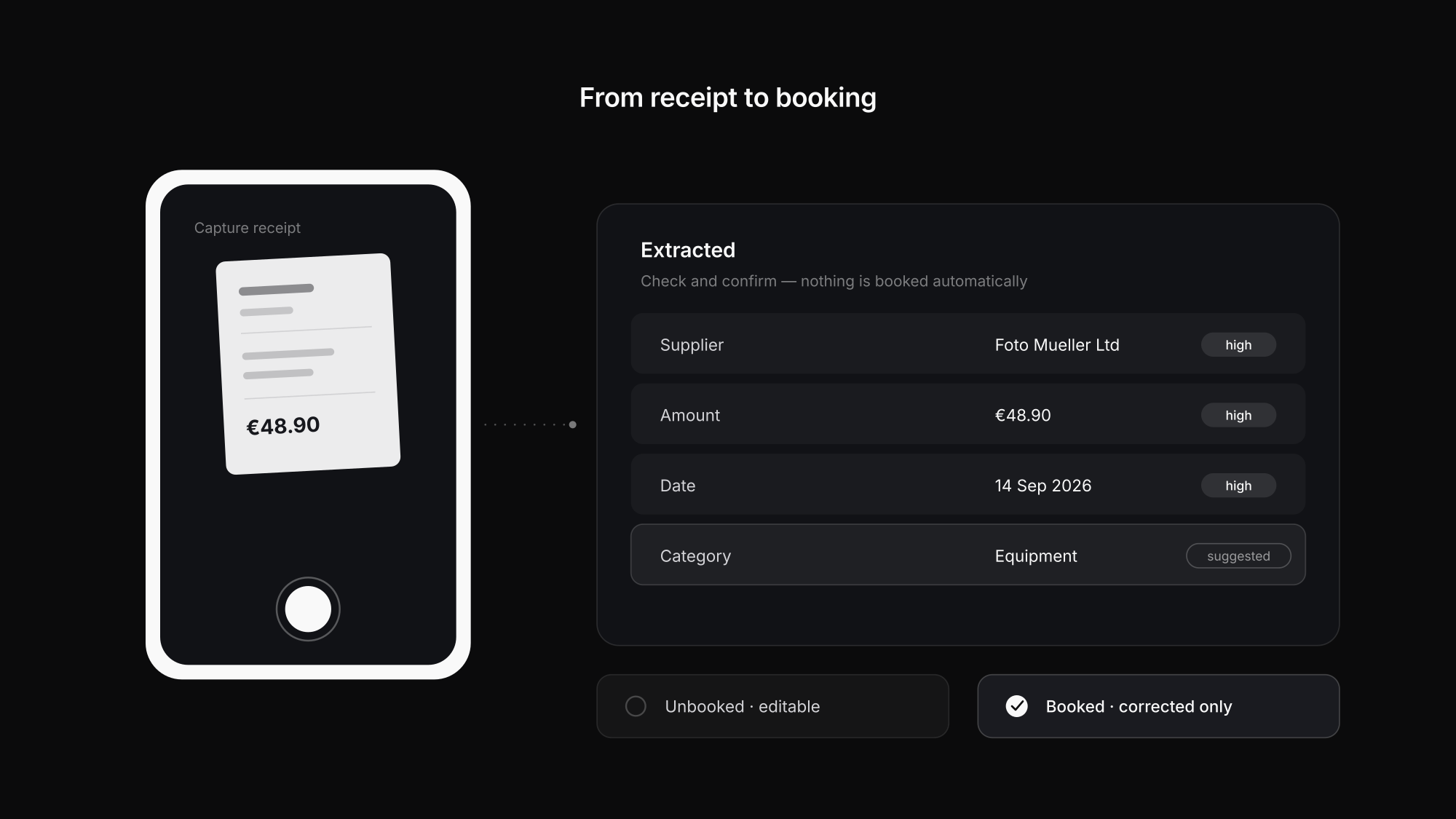
An entry starts unbooked, which means editable and deletable — the state for something unfinished, typically a cost whose receipt has not arrived. Booking makes it final: from then on it is corrected rather than edited, a correction needs a reason, creates a new entry, and leaves the original visible as superseded. That trail is what makes the records defensible.
Categories come from a country profile pinned to the tax year, carrying the line of the tax form each amount maps to. Custom categories are supported, but always attached to a built-in one: "drone accessories" still gets reported under equipment.
Two things Exportlab deliberately does not do: it is not tax advice, and it files nothing with any authority. Expenses is also in beta and enabled per workspace.
Expense mistakes that cost money
Expensive gear deducted in one year
Above your jurisdiction's threshold it is depreciated, not deducted. The receipt looks like any other, so the error goes unnoticed.
Small amounts never recorded
Parking, crew coffee, consumables. Individually trivial, collectively a meaningful sum across a year.
Private share not separated
Phone, car and computer get mixed use. Without a defensible business proportion the whole item becomes contestable.
Receipt with no attribution
€89, but for what? Anything you cannot attribute at year end tends to quietly drop out.
Thermal receipts not digitised
Fuel receipts fade. A receipt nobody can read is, in practice, no longer proof of anything.
Year closed with open entries
Closing out while entries are unfinished produces a final-looking result that is wrong by exactly what was forgotten.
Closing the year
What matters at the end is that the numbers are complete. A running result across the year helps more than a reckoning in spring: you see monthly what came in and what went out, and can act before the year is over.
To hand over to an accountant you need three things: a year summary with totals by month and category, a journal with every individual entry, and the original receipts. Those are exactly the three exports Exportlab produces — as a PDF, a CSV and a ZIP archive with checksums.
Before closing, check the entries with no receipt attached. They are the single most common reason an item gets struck later.
How the income side fits alongside this is covered in the post on the photography invoice; for the calculation that comes before it, photography pricing covers rates and packages, and if you are just starting out, starting a photography business covers the groundwork.
FAQ: Photography business expenses
Can I deduct the full cost of my camera?
The full cost is deductible, but often not in a single year. Above your jurisdiction's threshold for immediate deduction, a camera is written off across its useful life — in Germany typically seven years for photographic equipment, pro rata from the month of purchase. Other countries set different thresholds and some allow much more upfront.
What can photographers write off?
Gear, computing and storage, software subscriptions, studio or premises costs, travel, professional development, marketing, contracted work such as a second shooter or retoucher, insurance and professional fees. The test is whether the cost was incurred for the business; for mixed use, only the business proportion.
Is a photo of a receipt enough?
Digital receipts are generally accepted where the retention requirements are met, and the specifics vary by country. For thermal paper, capturing digitally is often safer than keeping the original, because those receipts fade. Confirm the requirements that apply to you with your accountant.
What is the difference between an expense and depreciation?
An expense reduces your profit in the year it was paid. Depreciation spreads the cost of a long-lived asset across several years. Which applies depends on the value of the item and the threshold set by your tax jurisdiction.
Do I need to track expenses if I earn very little?
Yes. Small-business or simplified VAT schemes affect how you handle VAT, not how you determine profit. Income and expenses still have to be recorded, and those expenses still reduce what you are taxed on.
Conclusion
Handling photography business expenses well is less about tax expertise than about routine: digitise the receipt when you get it instead of hunting for it in spring, check the depreciation threshold on every significant purchase, and set a defensible business share on mixed-use costs.
The least friction comes from capturing receipts where the job already sits. How Exportlab handles that, along with the running result and the year-end exports, is in the feature overview — and the income side is covered in the photography invoice.