

Photography Invoice: What to Include, and Why Usage Rights Belong on It
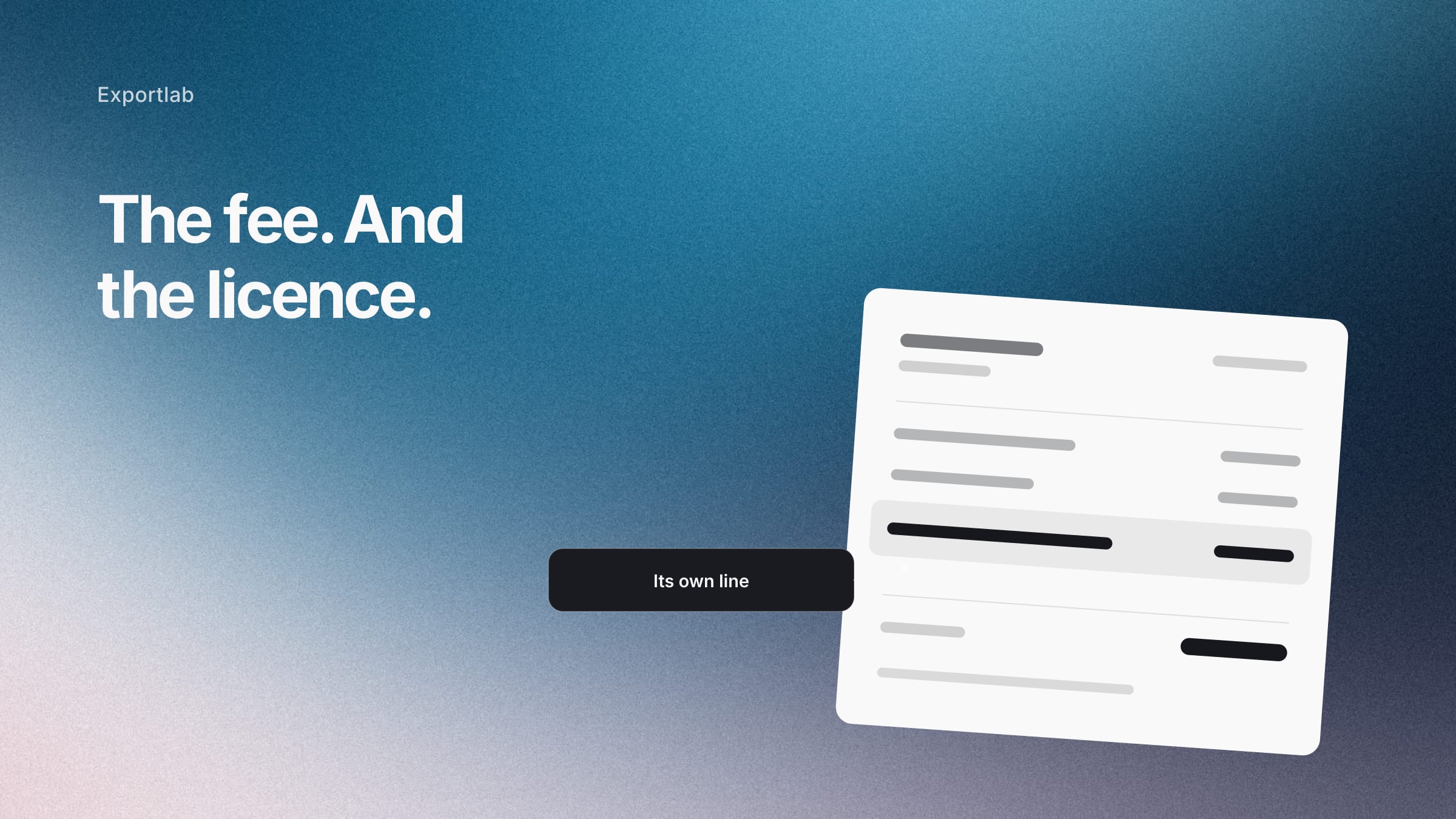
A photography invoice differs from almost every other invoice in one respect: you are not only selling time, you are also selling permission to use the images you made. That position is missing from most generic invoice templates — and it is exactly the one that decides whether you can renegotiate when a client reuses the photos a year later.
This article covers what belongs on the invoice, how to separate the fee from the licence, and which billing habits quietly cost photographers money. It is orientation, not legal or tax advice — the rules that apply to you depend on where you work, so check the specifics with your accountant.
The line items a photography invoice needs
Most invoicing guidance stops at company details and a total. For photography work, the structure of the line items is what matters, because each one answers a different question.
| Line item | What it covers | Why it stands alone |
|---|---|---|
| Shoot fee | Preparation, shooting day, travel time | Time-based, delivered once |
| Post-production | Culling, retouching, export | Volume-based, scales with image count |
| Usage rights | Purpose, duration, territory, exclusivity | Reusable, and negotiable later |
| Expenses | Travel, studio rental, permits, talent | Passed through, often at cost |
Beyond the items themselves, an invoice generally needs your business name and address, the client's details, a tax or VAT number where one applies, an invoice date, a unique sequential invoice number, a description of the work, the date the service was delivered, and the amounts with whatever tax treatment applies. The exact requirements are set by the country you invoice from.
Invoice numbers: unique, not necessarily unbroken
A common misreading. The number has to be unique and must never be reused — but you can run separate number ranges, such as 2026-WED-001 for weddings and 2026-CORP-001 for commercial clients. What you should not do is reuse a number, or silently edit an invoice that has already gone out and keep the same number on it.
Usage rights belong in their own position
Copyright in the image stays with you. What the client receives is a licence — and its scope is whatever you define it to be.
If everything sits in one line that reads "photo shoot, flat rate", the invoice says nothing about what the client may do with the pictures. When those pictures turn up in a billboard campaign next year, you have no basis to charge for it. Not because the law is against you, but because nobody wrote down what was agreed.
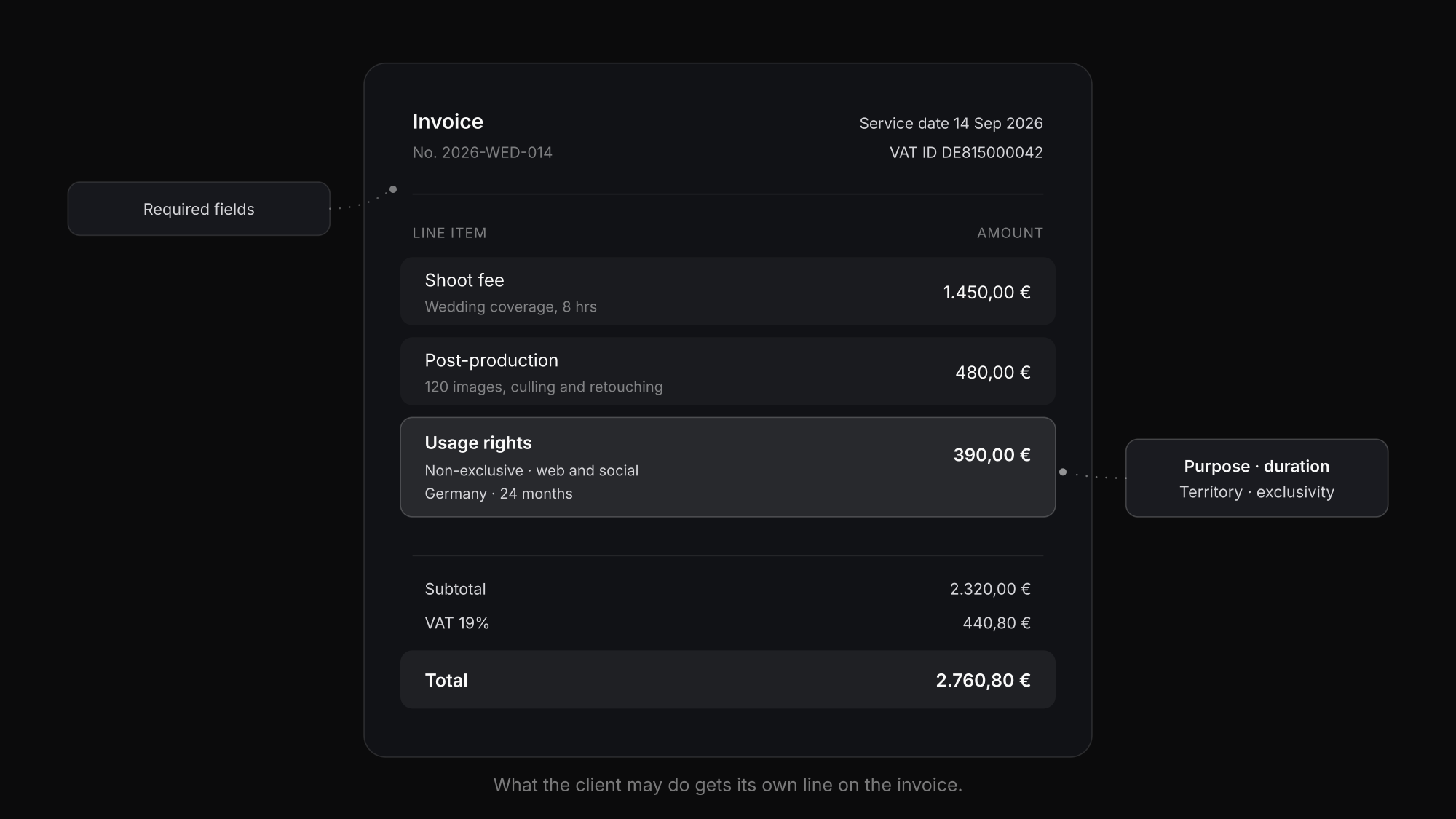
A usable usage-rights line names four dimensions:
- Purpose — internal use, website, social media, print, advertising
- Duration — perpetual, 12 months, the campaign period
- Territory — one country, a region, worldwide
- Exclusivity — non-exclusive or exclusive
Written out, that becomes something like: *"Non-exclusive licence, client website and social media, Germany, 24 months from delivery."* Unambiguous, and both sides know what was bought. The same scope belongs in the agreement before the shoot, which is what the post on creating a photography contract covers.
Billing mistakes that cost photographers money
No usage rights on the invoice
Without its own line, nothing documents what the client may do. Every later reuse becomes an argument with no paper behind it.
Service date missing
For a shoot this is the shooting day, not the invoice date. It is a required field in most jurisdictions and the one most often left blank.
Expenses folded into the fee
Travel, parking, permits and talent are easier to defend as separate positions than as an unexplained increase in your day rate.
No payment terms
Without a stated due date you fall back on whatever the statutory default is. A concrete date on the invoice measurably shortens how long you wait.
Editing an invoice after sending
A sent invoice is cancelled and reissued, not overwritten. Otherwise your records and your client's records stop matching.
Deposits not deducted
If you took a deposit, the final invoice has to subtract it — otherwise the same amount gets taxed twice.
E-invoicing is becoming the default in Europe
If you invoice businesses in Germany, one change matters. Since January 2025 every German company has to be able to receive structured e-invoices. The obligation to issue them is being phased in through 2028, with small-business exemptions.
Two points that get confused constantly:
- A PDF emailed to a client is not an e-invoice. The requirement means a structured format such as ZUGFeRD or XRechnung, following the European standard EN 16931.
- It applies to B2B only. A wedding shot for a private couple is B2C, and nothing changes there. A brand film for a company is B2B.
Similar mandates are rolling out across the EU on different timelines, so if your clients are companies, this is worth tracking in the countries you invoice into.
Invoicing where the project already lives
An invoice needs the same facts that already sit on the job: the client, the delivery period, the images you handed over, the licence you agreed. Retyping those into a separate accounting tool is where the address ends up outdated and the service date stops matching the shoot.
In Exportlab, invoices are written next to the client, the project and the delivery. The flow:
- Write a draft — line items, quantities and per-line tax rates. While it is a draft, everything stays editable.
- Run the check — validation lists every blocking problem at once, instead of surfacing them one at a time.
- Issue it — the invoice takes its final number and its content freezes as an immutable snapshot. From here it is a record, not a document.
- Send it — as a PDF, ZUGFeRD or XRechnung, generated from exactly that snapshot.
- Record payments — as separate events, which makes partial and over-payments ordinary states rather than errors.
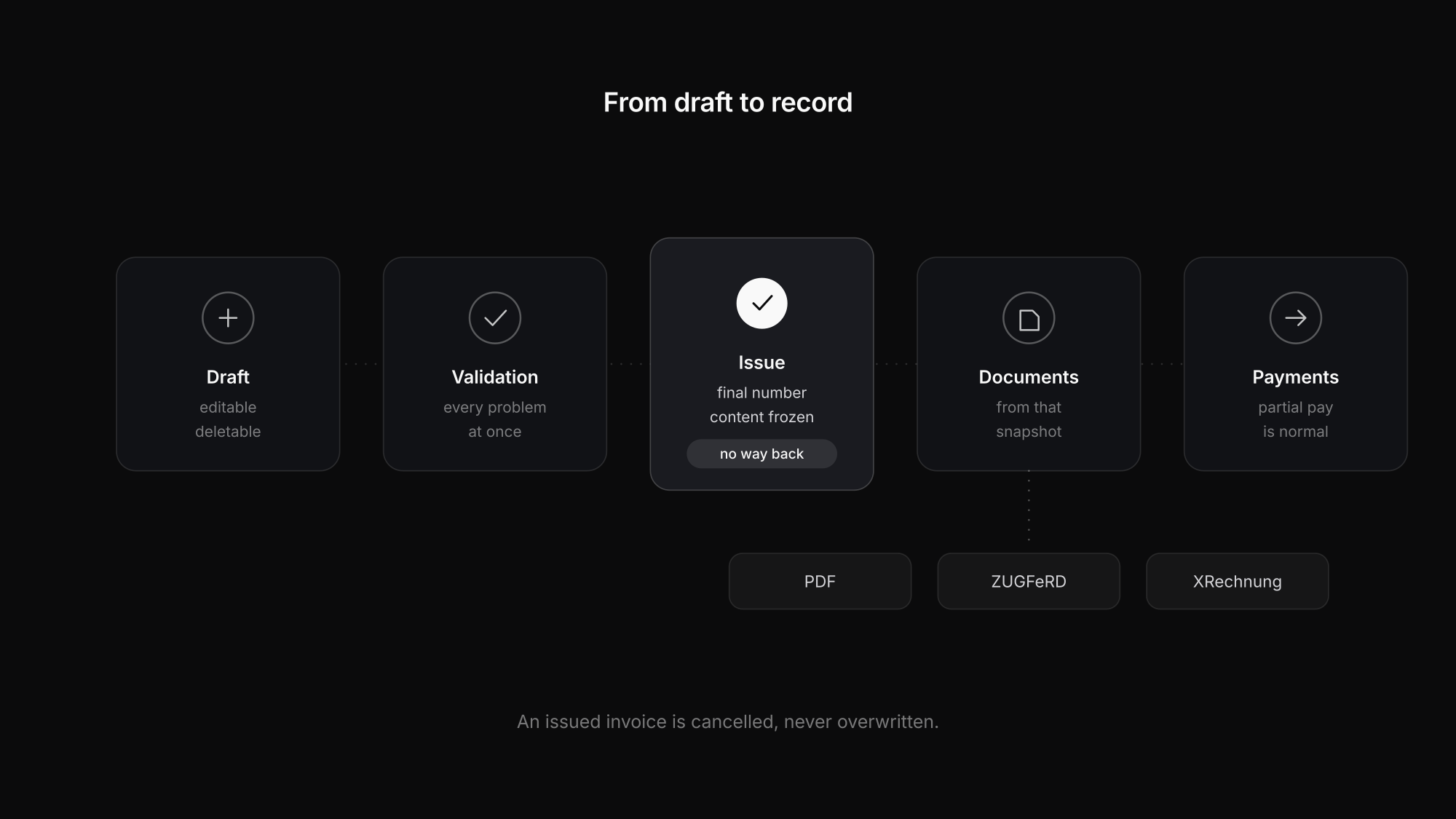
Issuing is deliberately a point of no return: an issued invoice can be cancelled but never edited or deleted, and the cancellation is recorded as its own act. That is what makes a number sequence worth trusting.
Two limits worth knowing up front: invoicing is currently a closed pilot for named workspaces rather than a generally available feature, and Exportlab produces the file — transmitting it to a government portal is not part of it.
FAQ: Photography invoices
What should a photography invoice include?
Your business details and the client's, a tax or VAT number where applicable, the invoice date, a unique sequential number, a description of the work, the date the shoot took place, and the amounts with the relevant tax treatment. Beyond the formalities, split the fee, the post-production, the usage rights and any expenses into separate line items.
Should usage rights be a separate line on the invoice?
Yes, in practice. Nothing legally forces you to itemise the licence, but unless purpose, duration, territory and exclusivity are written down, there is no record of what the client is allowed to do — and no basis for charging when the images get reused.
How do I invoice a client in another country?
The tax treatment depends on where both parties are based and whether the client is a business or a consumer. Cross-border B2B work inside the EU often shifts the VAT liability to the recipient, which changes what the invoice must state. This is the case to check with an accountant rather than guess.
Is a PDF invoice an e-invoice?
No. An e-invoice is a structured, machine-readable file such as ZUGFeRD or XRechnung that follows EN 16931. A PDF is a document a person reads; the structured data is what a finance system can process automatically.
Can I edit an invoice after sending it?
You should not overwrite it. The correct route is to cancel the incorrect invoice and issue a new one, which keeps your numbering intact and your records consistent with your client's. Quietly altering a sent invoice is precisely what gets flagged in an audit.
Conclusion
A photography invoice is straightforward once two things are in place: the formal fields your country requires, and a clean separation between the work you did and the licence you granted. The first protects your client's bookkeeping; the second protects your income when the pictures get a second life.
The rest is friction. Writing the invoice where the client, the project and the delivered images already are removes the retyping step — that is what invoices in Exportlab are built around. If you want the licence nailed down before the shoot rather than after it, start with the photography contract; if you are still working out what to charge, pricing your photography covers the rate and package side.