

Photography Pricing: Rates, Packages and Usage Rights
Most photography price lists are produced by copying. You check what three colleagues in your city charge, settle just below them — and two years later wonder why a full calendar leaves nothing at the end of the month.
The flaw is straightforward: you know neither their cost structure, nor their job count, nor whether they are actually profitable. You may well be copying the prices of someone with a second income.
This article shows the calculation from your own numbers — and what comes after it: package logic, usage rights, and how to handle "that's more than we wanted to spend".
Step 1: What you actually need
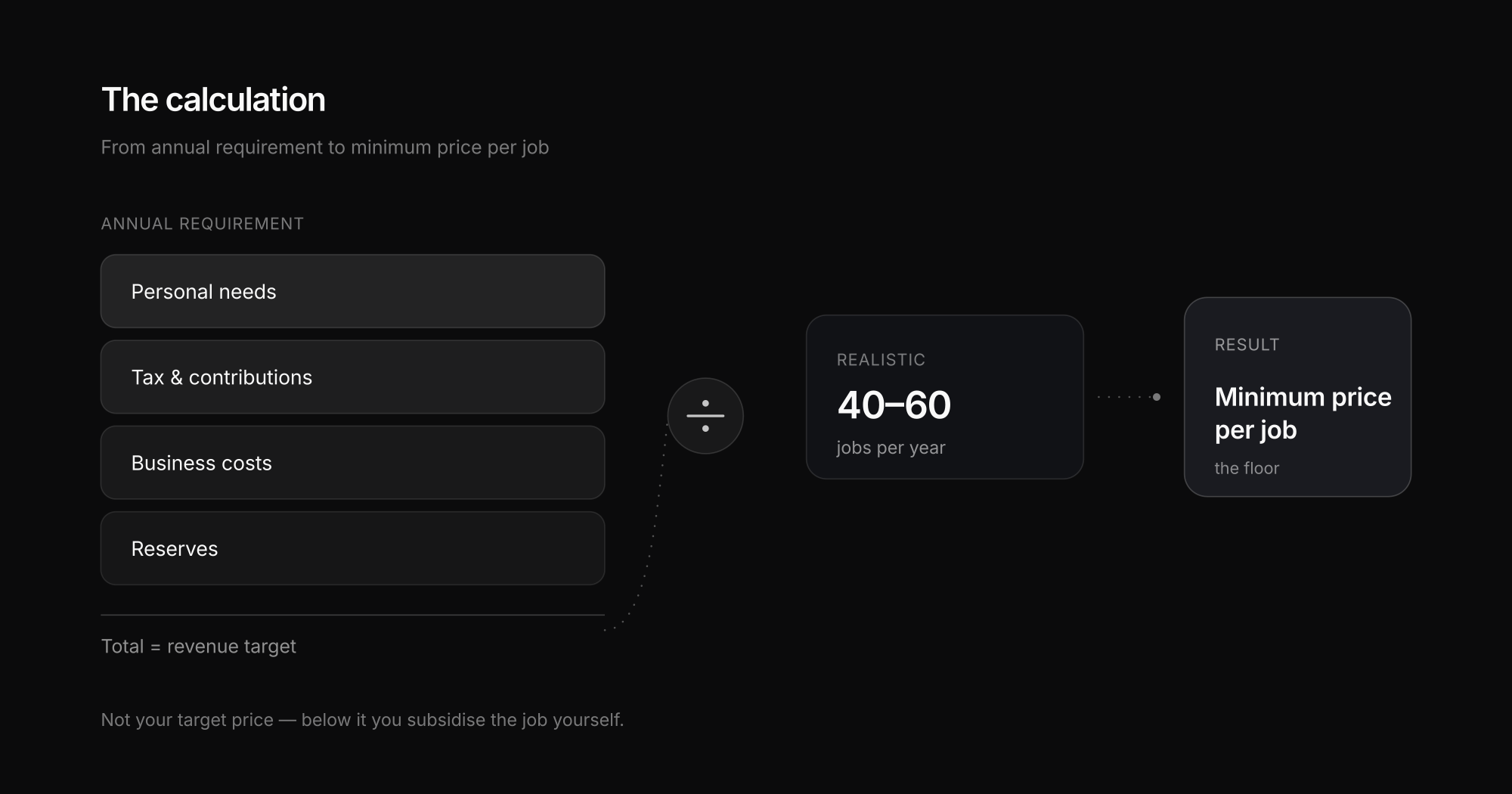
Start with the annual requirement, not an hourly rate. Four blocks belong in it:
Personal needs. Rent, living costs, insurance, pension. Net — what genuinely has to land in your account.
Tax and contributions. Income tax, social contributions, health cover where you carry it yourself. Depending on your situation, an uplift of 30–45% on the personal figure.
Business costs. Equipment and depreciation, software subscriptions, insurance, website, travel, training, accounting, marketing, studio rent if you have it.
Reserves. For replacing gear, quiet months and sick days. Self-employment comes with no sick pay.
The sum of those four is your annual revenue target. For most solo photographers it lands considerably higher than first assumed.
Step 2: How many jobs are realistic?
This is where the second big error happens. A year has roughly 250 working days in theory — but a job occupies far more than its shooting day.
One hour of shooting carries two to four hours of unpaid work, depending on genre: answering the enquiry, writing the quote, scheduling, travel, import, culling, editing, delivery, invoicing, chasing payment. On top of that sits acquisition, bookkeeping, the website and training — work belonging to no single job.
For many solo photographers, 40 to 60 jobs a year is realistic. Planning for 150 is planning a year that does not exist.
Annual revenue target divided by realistic job count = minimum price per job. That is the floor, not the target. Quote below it and you are subsidising the job from your own substance.
Step 3: From minimum price to package price
A bare hourly rate is hard for clients to judge and works against you: the more efficient you get, the less you earn. Packages solve both.
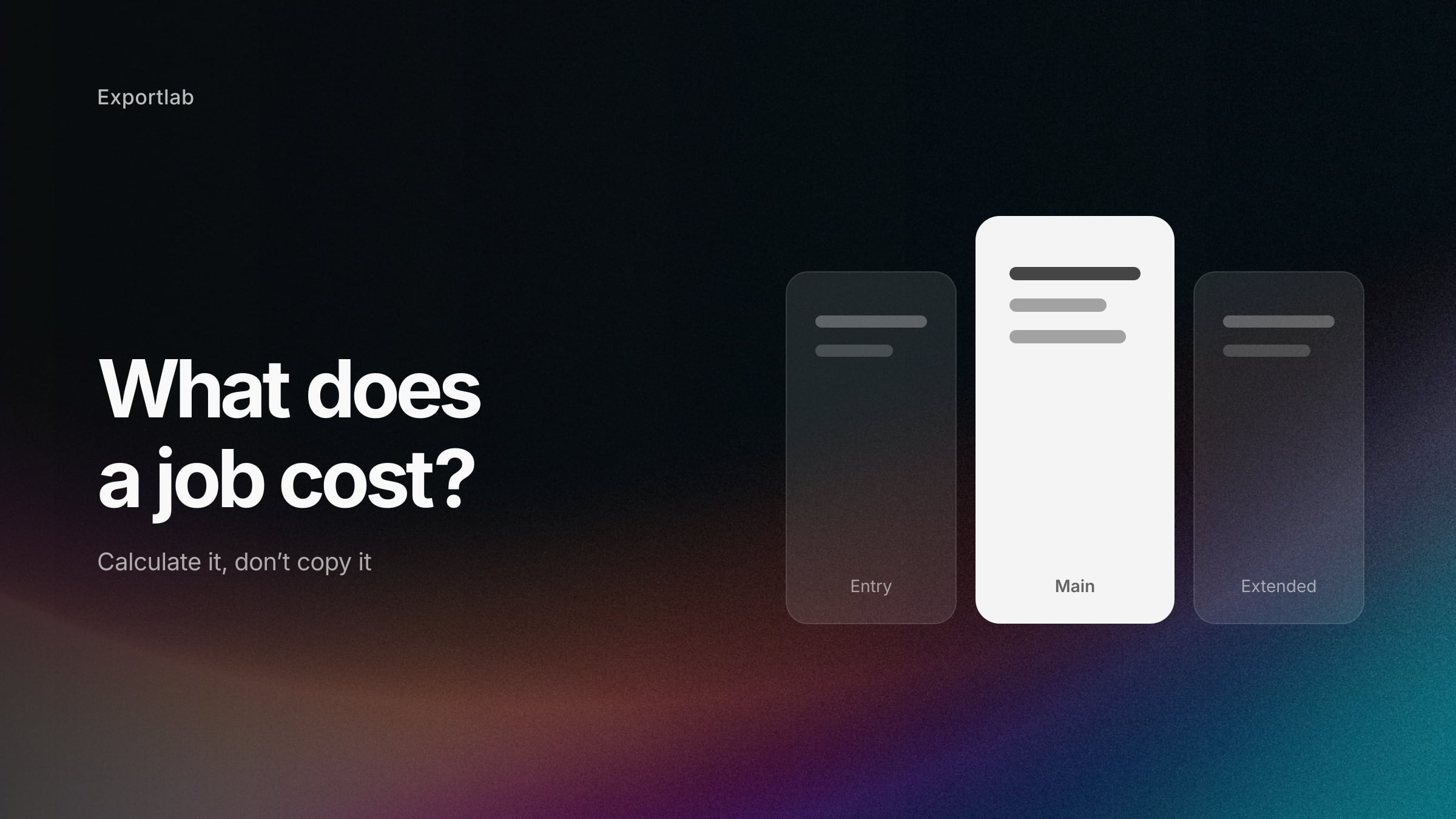
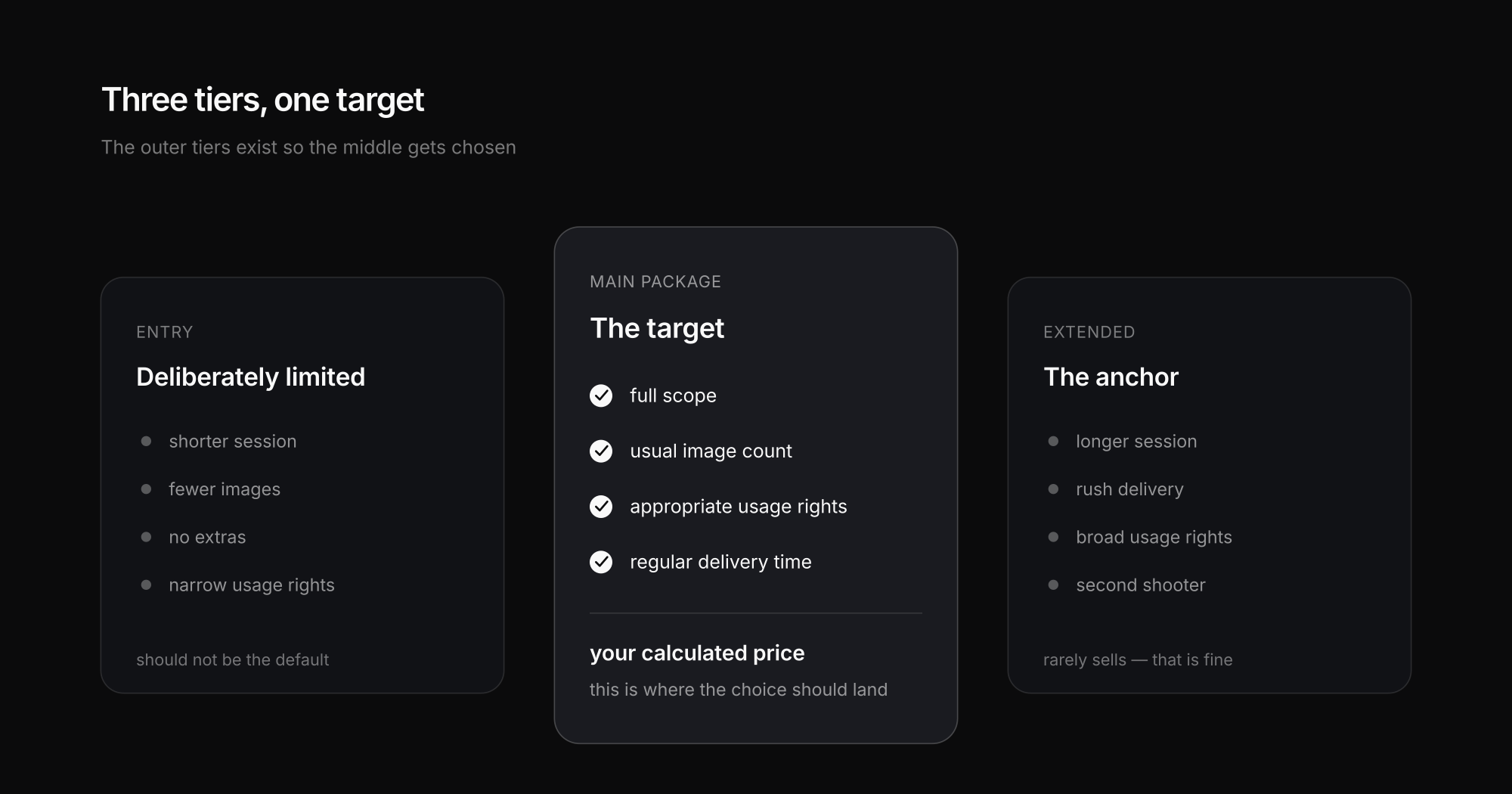
A three-tier structure works well, because most people pick the middle option when given three:
- Entry package — deliberately limited, so it does not become the default. Fewer images, shorter duration, no extras.
- Main package — the actual target. Your calculated price lives here, and this tier should look the most attractive.
- Extended package — noticeably larger and more expensive. It sells rarely, but it makes the main package look sensible.
What separates the tiers matters. Varying only the image count invites arithmetic ("80 instead of 40 images for twice the price?"). Better differentiators are duration, scope, usage rights, depth of retouching or delivery time.
Add-ons that genuinely pay
- Rush delivery. When a job disrupts your queue, a premium is justified.
- Extended usage rights. The most important lever in commercial work (see below).
- Additional retouching. Complex work as its own line item rather than silently included.
- Second shooter or assistant. Passed through, not paid out of your own margin.
Step 4: Usage rights — the underrated price factor
In private work this barely matters; in commercial work it decides the price. Copyright generally stays with you; what you sell is a licence. And licences are not all worth the same.
Three dimensions determine the value:
- Scope: social media only, or website, print, advertising, billboards?
- Duration: one year or perpetual?
- Territory: local, national, worldwide?
A product shot for a local café's Instagram and the same shot for a nationwide ad campaign differ enormously in value — while the work of taking it is identical. Leave usage rights unnamed in the quote and you give away exactly that difference, while probably transferring more than you intended.
In practice: scope of use belongs in every commercial quote and every contract. How to record that cleanly is covered in creating a photography contract.
Handling price conversations
"That's more than we wanted to spend"
Do not discount — offer a smaller package. The price stays, the scope shrinks. Otherwise clients learn that your prices are negotiable.
Ask what is behind it
"Too expensive" often means "I don't understand what I'm getting". Explaining the process and the work involved reduces how often you have to argue about numbers.
Do not hide your prices
A price range on the website reduces enquiries but improves them. The real time sink is enquiries that evaporate after the first quote.
Review prices annually
Costs rise and so does your experience. Leaving prices untouched for three years means earning less in real terms every year.
What else affects the calculation
Two factors work indirectly but noticeably on your margin:
Process efficiency. The less time each job spends in coordination, selection and delivery, the more jobs fit into a year — or the more time you keep at the same job count. When clients mark their own favourites in a gallery instead of sending image numbers over chat, that often saves more than an hour per job. Across 50 jobs a year, that is a full working week.
Payment discipline. Deposits at booking and payment before delivery are standard practice, not rudeness. Tools like Exportlab sell packages directly in the booking flow, so payment is settled before the work starts.
FAQ: Photography pricing
How do I calculate my hourly rate as a photographer?
Not from a previous salary, but backwards: annual needs plus tax plus business costs plus reserves give your revenue target. Divided by a realistic number of jobs, that gives your minimum per job. An hourly rate can be derived from there — though package prices usually work better for clients.
Why are packages better than hourly pricing?
Because hourly pricing punishes efficiency: work faster and earn less. Packages sell an outcome rather than time, are easier for clients to compare, and allow a tiering in which the middle option becomes the default choice.
What should I charge as a beginner?
Enough to cover your costs plus the unpaid hours — even at the start. Starting too cheap is the most common mistake, because raising prices later is hard and your early clients are precisely the ones who leave when you do. Two or three deliberately chosen portfolio shoots are defensible; more than that is not.
Do I have to put prices on my website?
It reduces the number of enquiries and improves their quality. Without a price range you get more first contacts, many with entirely different expectations. A starting price ("from X") is a good compromise if you do not want to commit to fixed figures.
How do I handle discount requests?
Reduce the scope instead of the price: shorter session, fewer images, narrower usage rights. That keeps your price structure intact. Discount once and you renegotiate on every subsequent job — and get recommended as "the cheap one".
How often should I adjust my prices?
Reviewing once a year is a good rhythm. Costs rise and so does your experience. Prices unchanged across several years mean steadily falling real income.
Conclusion
Sustainable prices do not come from looking at competitors but from an honest calculation: what do you need, how much work really sits inside a job, and how many jobs can you handle in a year? The result is often uncomfortable at first — which is exactly what makes it useful.
The rest is structure: three packages instead of one number, usage rights as their own price factor, and a process that consumes fewer unpaid hours per job. Set that up properly once and you will find yourself arguing about price far less often.