

How to Start a Photography Business: Setup, Pricing and the First Clients
The camera is rarely the problem. Photographers who go self-employed almost never fail on technique — they fail on everything that surrounds the shooting: registration, pricing that does not hold, clients who pay late, and a delivery process that eats hours every week.
This guide walks the steps in the order they actually come up, and is honest about the part most guides skip: how much unpaid work sits behind every paid hour.
Decide what kind of business you are running
Before any paperwork, one decision shapes everything else: what you actually sell. "I photograph everything" is the hardest position to sell from, because it gives nobody a reason to recommend you specifically.
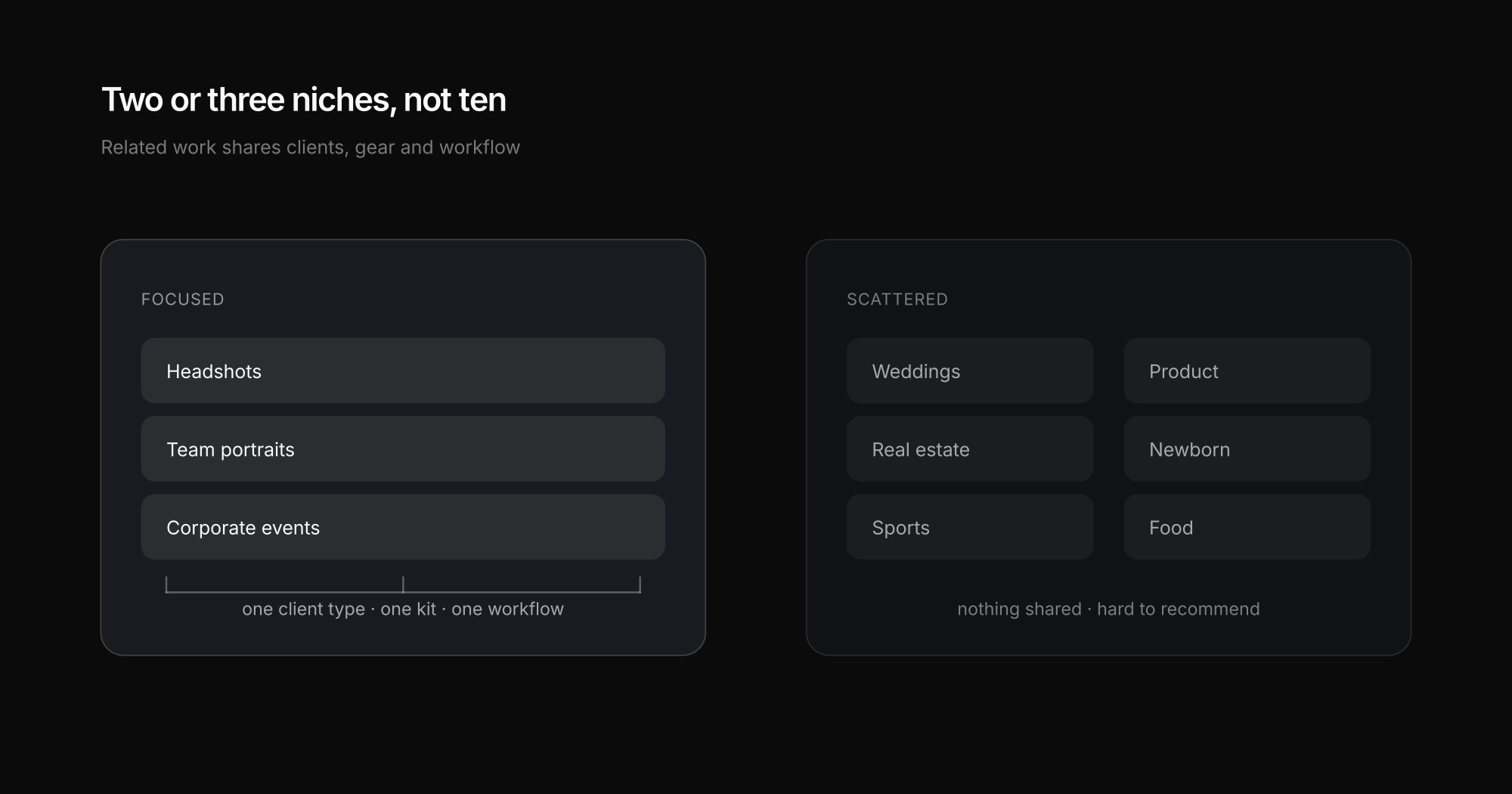
Two or three related niches work far better than ten unrelated ones. Headshots and team portraits belong together — the same clients, the same gear, the same workflow. Weddings and product photography do not; they need different equipment, different pricing and different marketing.
The practical test: could someone describe what you do in a single sentence to a friend? If not, the positioning is still too broad.
The setup steps
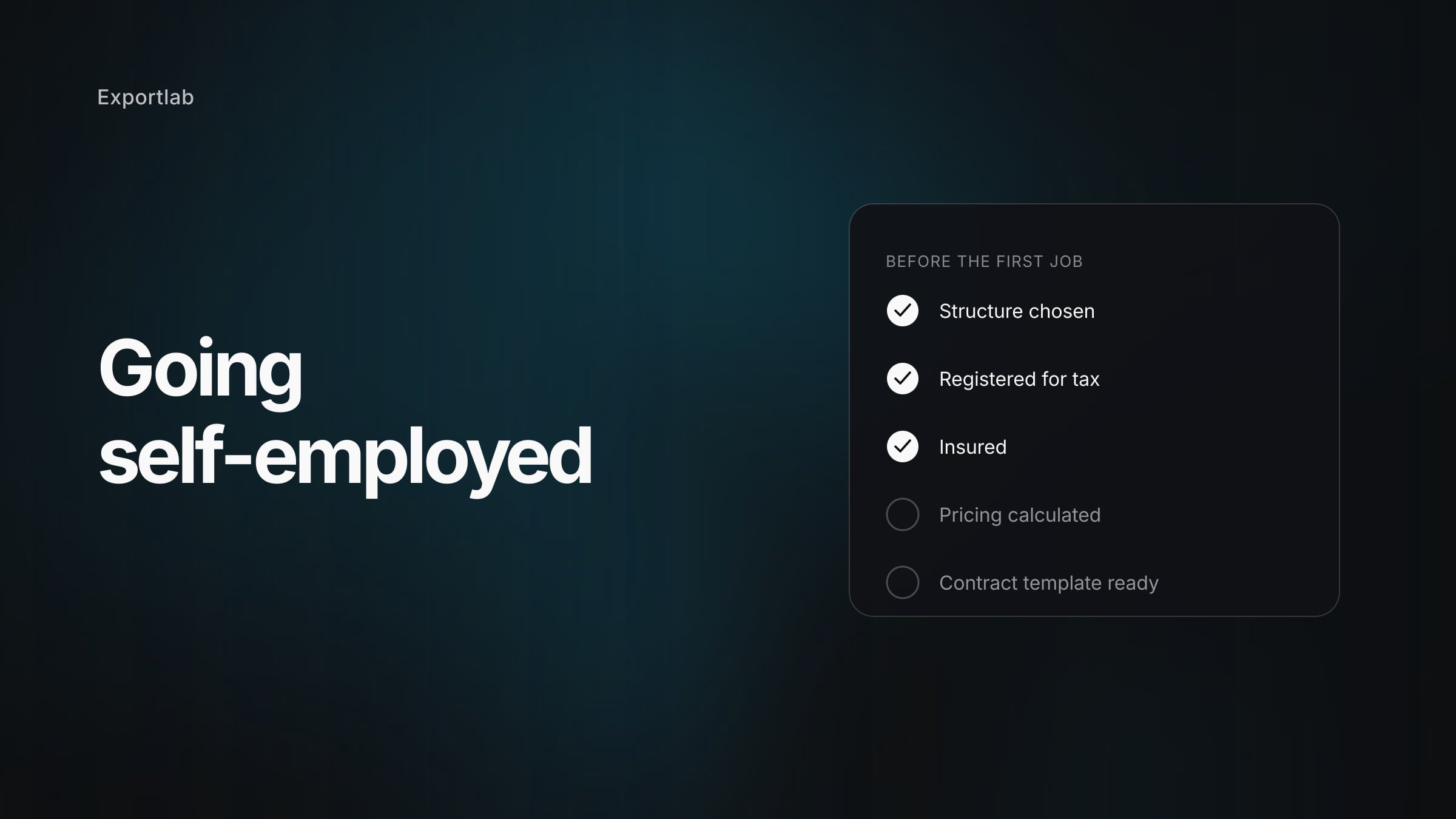
1. Choose your legal structure
Most photographers start as a sole trader (sole proprietorship) because it is the simplest and cheapest to register. A limited company or LLC costs more and adds accounting duties, but separates your personal assets from business liability — which matters as soon as you work in other people's venues with expensive equipment.
2. Register with the tax authority
Whatever the structure, you register the activity for tax. This is also where you decide, in many countries, whether you charge VAT or sales tax from the start or fall under a small-business exemption. That decision has a real consequence: exemptions mean simpler invoices, but usually no input-tax deduction on the camera, lenses and computer you are buying right now.
3. Separate your money
A dedicated business account is not a legal requirement everywhere, but it is the single change that makes bookkeeping bearable. Mixed accounts turn one hour of year-end admin into a full day.
4. Get insured
Three policies matter: public liability (someone trips over your light stand, you damage a venue), equipment cover (theft and damage, often cheaper than expected), and health cover where it is not provided by the state — as a self-employed person you carry it yourself.
5. Set aside tax from day one
Income tax arrives later, and in the second year often twice at once — the balance for last year plus an advance for this one. Putting aside 25–35% of every invoice from the first job is what prevents that from becoming a crisis.
Pricing: the most common reason businesses fail
The classic mistake is deriving an hourly rate from a previous salary. It fails because paid shooting time is only a fraction of your working hours.
Work backwards instead:
- What do you need per year? Living costs, pension, tax, reserves.
- What does the business cost? Gear and depreciation, software, insurance, website, travel, training.
- How many jobs are realistic? Be honest: 40–60 jobs a year is a full year for many solo photographers.
- Divide the total by the jobs. That is your minimum per job — not your aspirational price.
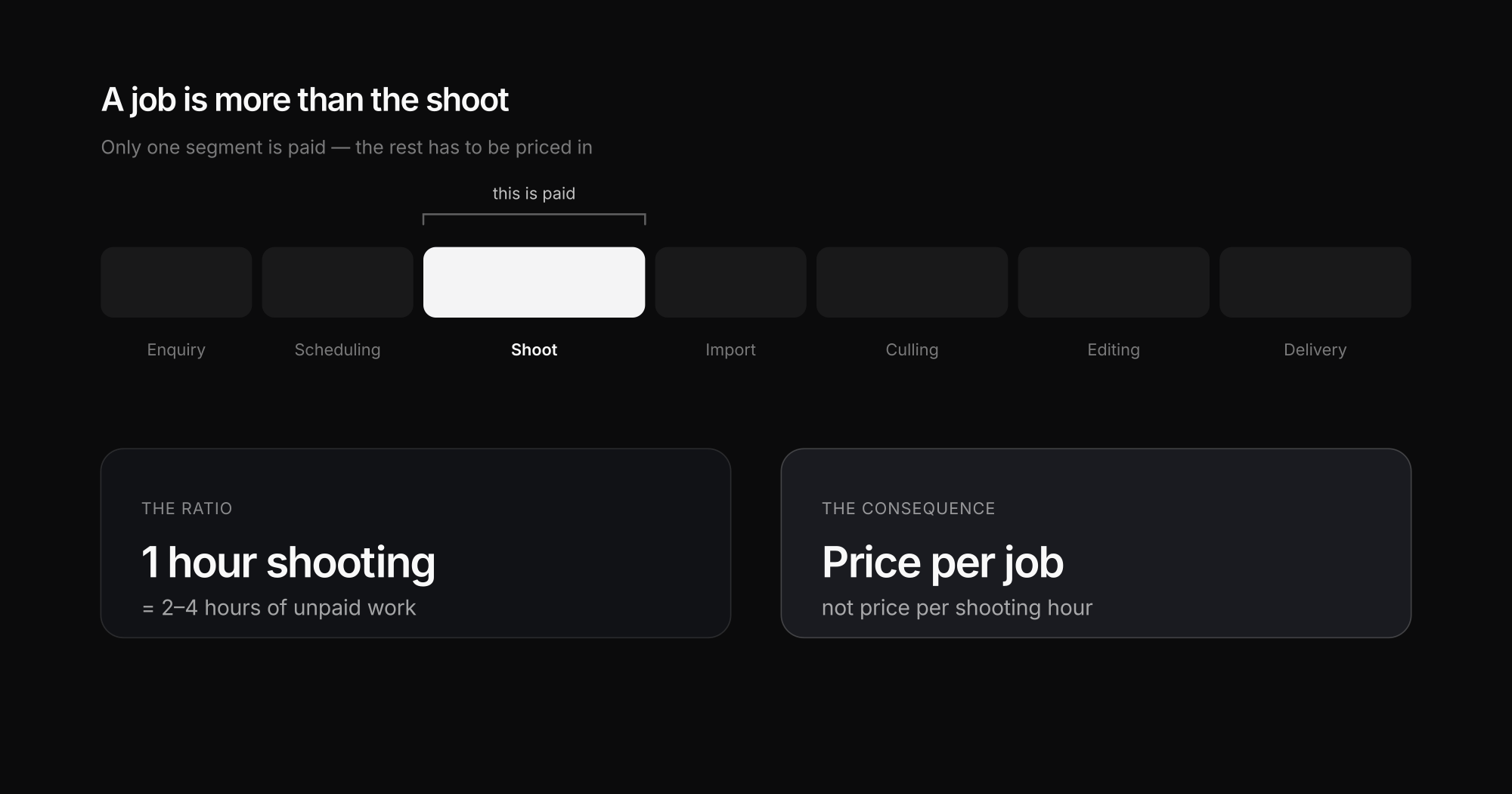
The factor almost everyone underestimates: one hour of shooting carries two to four hours of unpaid work, depending on genre — answering enquiries, scheduling, travel, import, culling, editing, delivery, invoicing, chasing payment. Price only the shooting hour and you are structurally working below cost.
Turning that into concrete package prices is covered in photography pricing.
Contracts and legal basics from the start
Always in writing, even for friends
Verbal agreements can be valid, but they are nearly impossible to prove in a dispute. A short, clear contract beats a long one nobody reads — scope, date, price, usage rights, cancellation terms.
Spell out usage rights
Copyright generally stays with you; what you transfer is a licence. For what, how long and where: those three points belong in every contract, otherwise a social media shoot quietly becomes a nationwide billboard campaign.
Model releases for recognisable people
As soon as people are identifiable and the images will be published, you need documented consent. What belongs in one is covered in the model release guide.
Take a deposit
A 20–30% deposit at booking filters out non-committal enquiries and protects you against late cancellations. In wedding photography it has been standard for years.
You do not have to build these from scratch — creating a photography contract covers setting up templates once and signing them digitally per job.
Getting the first clients — and keeping them
Early clients rarely arrive via Google. They come through people who know you, local visibility, and work that is easy to recommend.
- A Google Business Profile does more locally than any Instagram post: searches for "photographer" plus a city surface the map with reviews first.
- Partnerships with venues, agencies, estate agents or salons produce recurring work instead of one-off clients.
- A tight portfolio — 15 strong images beat 60 average ones. How to do that without building a full website is covered in photographer portfolios.
The part that decides whether they book you again
Clients judge you on more than the images. They judge the process around them. A job where the client never knows when anything is coming, and finally receives an expired download link, rarely gets recommended — even when the photos are good.
Which is why it pays to set this up properly at the start rather than retrofit it later:
- Deliver through a proper gallery instead of a transfer link with an expiry date — the options are compared in delivering photos to clients.
- Let clients mark their own favourites instead of collecting filenames over chat.
- Keep contracts, releases and files on the same project so nothing disappears into email threads.
Exportlab bundles those steps into one workspace — gallery, client portal, contracts and model releases on the same job, hosted in the EU. For the first few jobs any tidy solution will do; what matters is that the process is the same every time instead of reinvented per client.
Common early mistakes
Starting too cheap
Raising prices later is harder than starting high and discounting deliberately. Enter at the bottom of the market and you get exactly the clients who leave when you raise rates.
Doing everything yourself
Bookkeeping, website, editing, marketing — at some point an hour of an accountant's time costs less than the three hours it takes you.
No reserves for tax
The second year commonly brings a back payment and an advance payment together. Without 25–35% of each job set aside, that is precisely when it hurts.
Working without a contract
The one client who does not pay, or who suddenly uses the images in advertising, costs more in money and stress than every contract would have cost in time.
FAQ: Starting a photography business
Do I need a qualification to work as a professional photographer?
In most countries, no. Photography is not a regulated profession, so there is no mandatory licence or diploma. Training helps with skill and client confidence, but it is not a legal prerequisite for going self-employed.
How much does it cost to start?
Registration itself is usually modest — often under 100 in most currencies for a sole trader. The larger early costs are insurance, any accounting advice, and gear. Starting with equipment you already own is the normal path; buying a full kit before the first paid job is the common way to start in debt.
How many clients do I need to make a living?
That follows from your pricing, not the other way round. Calculate your annual requirement including business costs, then divide by a realistic number of jobs — for many solo photographers 40–60 a year is already a full schedule.
Should I start part-time?
For most people, yes. It removes the pressure to accept underpriced work while you build a portfolio and reputation. Check three things: any secondary-employment clause in your contract, your obligation to register the activity even at small revenue, and the threshold at which authorities treat the work as your main occupation.
What should I charge for my first jobs?
Enough to cover your costs plus the unpaid hours around the shoot. Working for free "for the portfolio" is defensible for two or three deliberately chosen shoots — beyond that it mainly attracts clients who will never pay properly.
Do I need a website to start?
Not immediately. A Google Business Profile plus a well-curated portfolio link often produces more early enquiries than a full website, and takes an afternoon rather than a month.
Conclusion
Starting a photography business has two very different halves. The formal one is manageable: pick a structure, register for tax, separate your accounts, get insured. That is an afternoon's preparation.
The second half decides whether it lasts: pricing that accounts for the unpaid work, contracts that protect you, and a process you run the same way on job forty as on job one. Photographers who get that part in order early reach the point where photography pays the bills considerably faster.