

SEO for Photographers: Getting Found Without Paying an Agency
SEO guides for photographers usually fail in the same place: they list thirty tactics without saying which ones do anything in the first few months. The result is afternoons spent writing alt text while the one measure that actually produces enquiries stays undone.
This guide sorts by impact rather than completeness. And it is honest about timing: SEO rarely shows visible results for photographers before three to six months. If you need bookings next week, calling three venues will serve you better.
The order that actually matters
Photography SEO differs from ordinary website SEO in one respect: your clients search locally and visually. Almost nobody searches "wedding photographer" without a place attached, and many searches start in Google Images rather than ordinary web search.
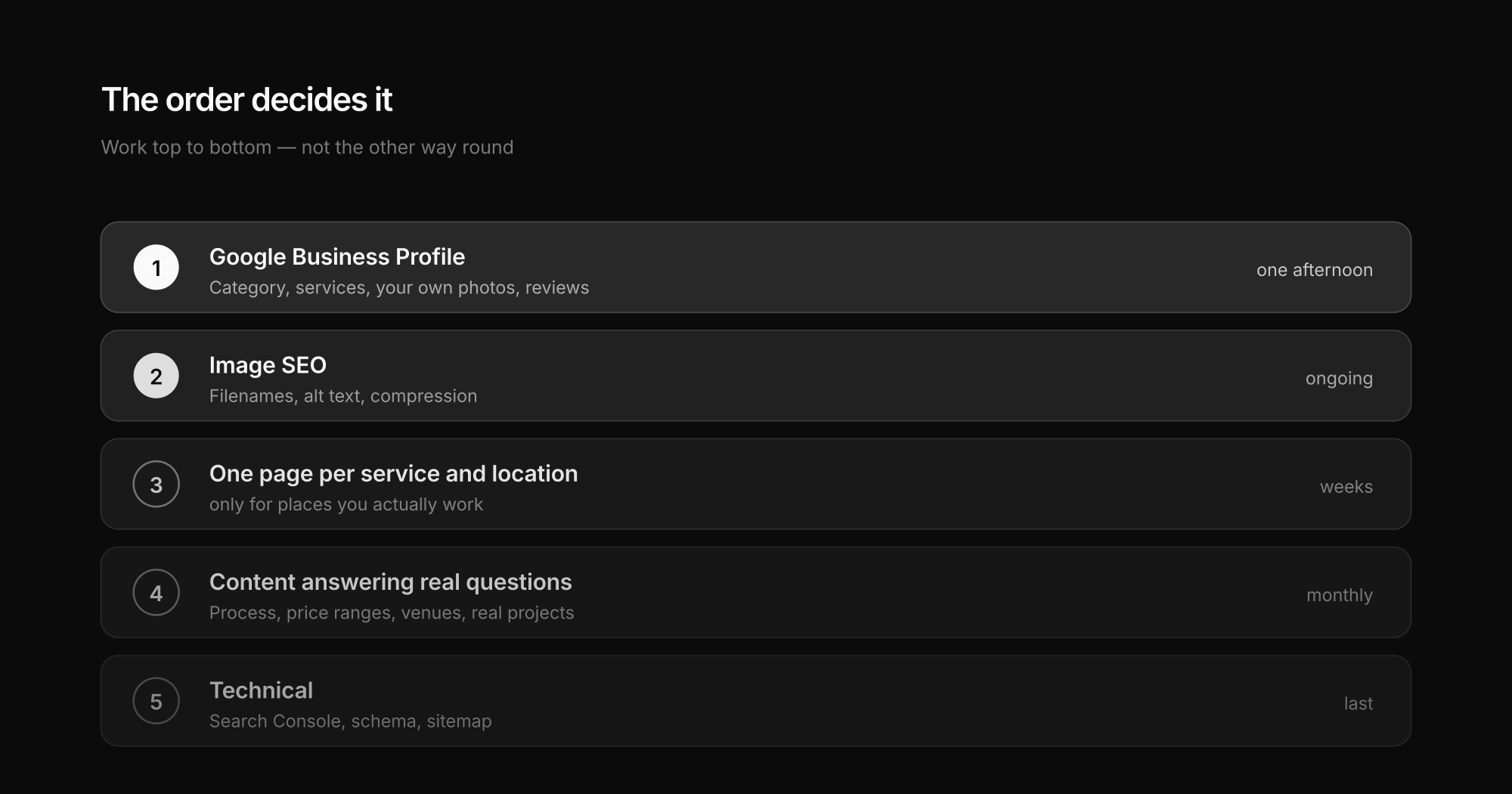
That produces a clear priority:
- Google Business Profile — by far the biggest lever for local enquiries.
- Image SEO — filenames, alt text, load time. On a photography site this is not a detail, it is the main content.
- One page per service and location — instead of one page trying to be everything at once.
- Content that answers real questions — process, pricing, locations.
- Everything technical — schema, sitemaps, Core Web Vitals.
Reverse that order and start with schema markup, and you are optimising a page nobody finds.
1. Google Business Profile: the biggest lever
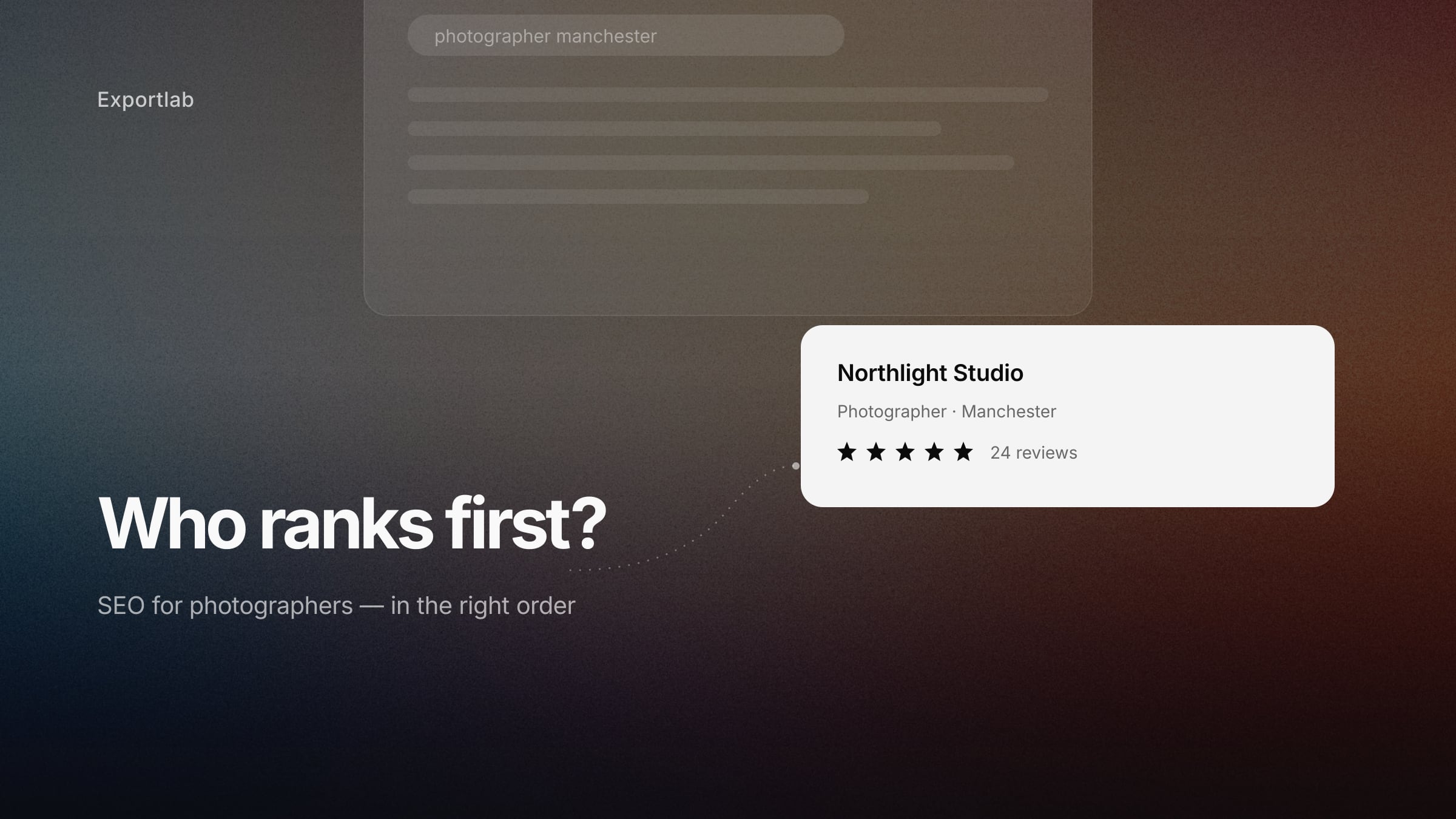
For local searches it is not your website that decides, but the map block above it. Someone searching "photographer Manchester" sees three listings with reviews first — and usually clicks there.
What counts:
- Completeness. Category ("Photographer", plus subcategories such as "Wedding photographer"), services, service area, hours, phone number, website.
- Reviews. Ask actively after every job — ideally right after delivery, when people are happiest with their images. Twenty genuine reviews beat any keyword optimisation.
- Your own photos in the profile. It sounds obvious, but it is the most common omission: photographers do not populate their own profile.
- Replies to reviews. Including the critical ones, factually and briefly.
That is an afternoon of setup and ten minutes per job afterwards. No other SEO step has a better effort-to-effect ratio.
2. Image SEO: your main content is visual
On a photography site, images are not decoration — they are the content. But Google can only interpret them if you help.
Filenames before upload
IMG_4827.jpg says nothing. wedding-photographer-manchester-town-hall.jpg does. You can set this as an export preset in Lightroom or Capture One, so it costs no extra time.
Alt text that describes rather than stuffs
Good alt text describes what is visible and mentions context in passing: "Couple's first dance in the courtyard at Bensberg Castle". Bad alt text stacks keywords: "wedding photographer Manchester Leeds York cheap photographer". The latter no longer works, and it is additionally useless for anyone using a screen reader.
Take load time seriously
Photography sites are nearly always too slow because uncompressed images get served. For web display, long edges around 2,000 px and modern formats like WebP are generally enough. A portfolio that takes six seconds on a phone loses visitors before the first image appears — and load time is a confirmed ranking factor.
3. One page per service and location
The most common structural mistake is the everything-page: a "Services" page covering weddings, business portraits and product photography at once, for three cities. That page ranks properly for none of them.
Better is a dedicated page per relevant service-and-location combination — but only for places you actually work, with real content: sample work from there, specific venues, process, price range. Twenty near-identical pages for twenty suburbs are the opposite of this, and get recognised as exactly what they are.
4. Content that answers real questions
Process explanations
"What happens during a headshot session?" gets searched before booking. Describing it honestly removes uncertainty — and ranks for a question with buying intent.
Location guides
"Getting married at X registry office" or "photo locations in Y" are searches with local relevance and little competition. As a photographer you know these places better than any travel blog.
Price transparency
Pages with price ranges rank for "cost" searches and filter out mismatched enquiries at the same time. No pricing on the website means more enquiries, but considerably worse ones.
Real projects instead of stock topics
One documented job with location, process and images beats ten generic guides — because only you have those images.
What does not work: generic posts like "10 tips for better photos". Large sites have ranked for those for years, and even if you rank, it produces no enquiries from your city.
5. Technical work — important, but last
Once the four points above are in place, these are worth doing:
- Set up Search Console and submit a sitemap. Without that tool you are guessing.
- Schema markup for local business and services — helps Google classify you.
- HTTPS, clean URLs, mobile rendering. Usually handled by modern site builders.
- Do not hide images in lazy-load containers that Google does not render.
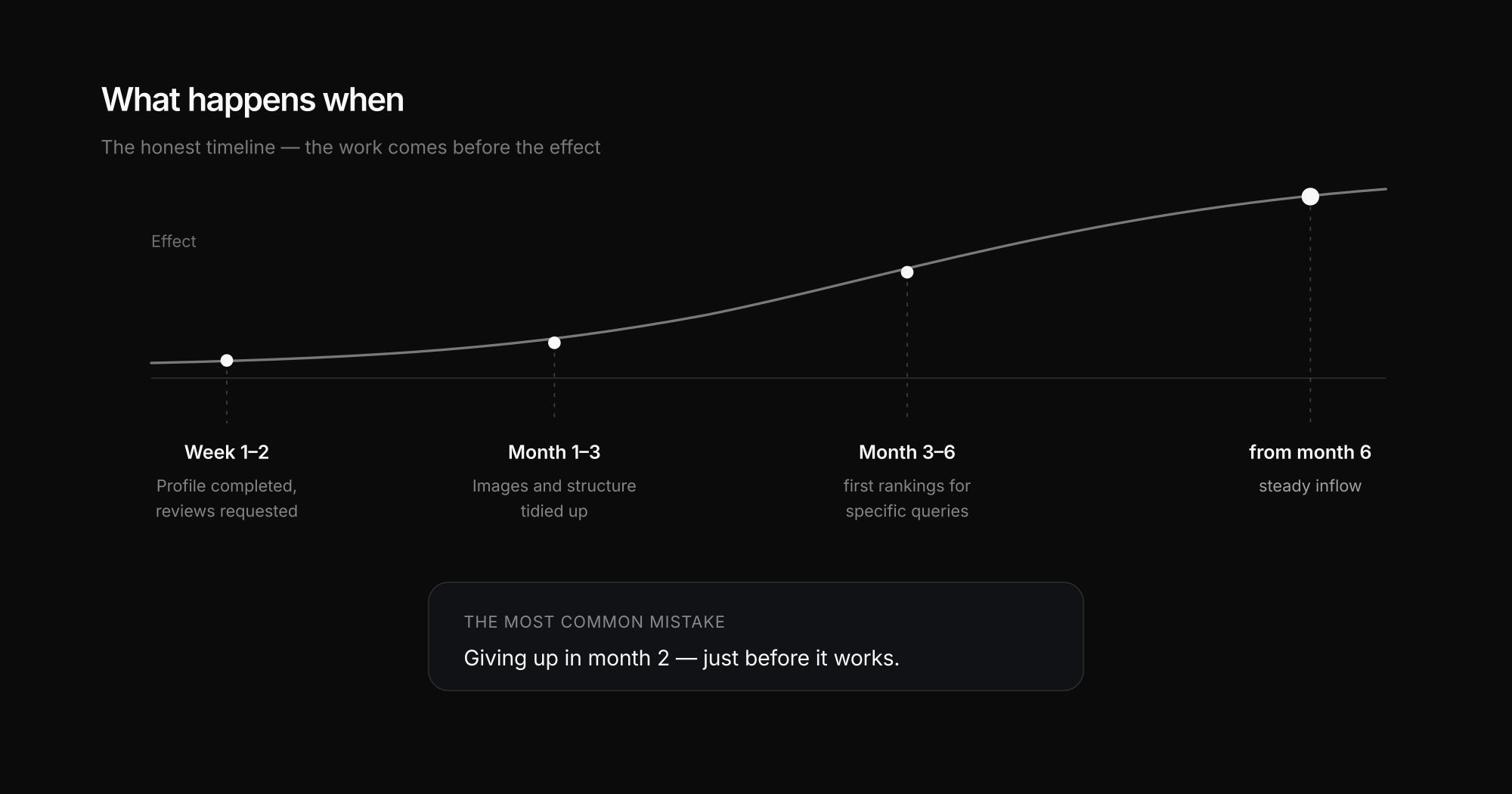
The honest timeline
Most guides leave this out because it does not sell well:
- Week 1–2: Business Profile completed, first reviews requested. Early effects in local search genuinely can appear this fast.
- Month 1–3: Images and site structure tidied, two or three serious pieces of content published. Google starts re-evaluating.
- Month 3–6: First rankings for long, specific queries. Short competitive terms ("photographer" plus a major city) take considerably longer.
- From month 6: With real content added regularly, this turns into a steady inflow.
Give up in month two and you have invested the work without ever harvesting it. That is the most common reason photographers say SEO does not work.
Common mistakes
Stacking keywords
"Photographer Manchester Leeds York cheap professional" does more harm than good today — and reads as untrustworthy to humans.
Only maintaining Instagram
Instagram brings visibility but no Google rankings. Publish exclusively there and you are invisible for "photographer" plus city.
Uploading uncompressed images
The most common technical cause of poor rankings among photographers: 8 MB JPEGs straight from the camera in the portfolio.
Giving up too early
Three months is not a test. Seeing no results after eight weeks is seeing exactly what was to be expected.
FAQ: SEO for photographers
How long does SEO take for photographers?
First effects through the Google Business Profile can appear within weeks. Rankings for specific queries usually take three to six months, and competitive local terms six to twelve. If you need bookings sooner, work referrals and partnerships in parallel.
Do I need my own website to rank well?
For local visibility the Google Business Profile matters more than any website — it ranks in its own right. A website is still worthwhile because it lets you explain services, process and pricing. What matters is not the platform but that content is indexable and the site loads fast.
Which matters more: image SEO or local SEO?
For commissioned photographers, local SEO — buying intent is highest there. Image SEO mainly pays into Google Images, which is more relevant for stock and editorial work than for wedding or business photography. Ideally both, in that order.
Should my client galleries appear in Google?
No. Delivered galleries contain private images and often people who never consented to publication. They should stay out of the index via noindex or password protection. SEO concerns your public portfolio, not client delivery.
Is an SEO agency worth it for photographers?
Usually only once the basics are in place and time is scarcer than money. Business Profile, image naming and site structure are things you can handle yourself — and they are the highest-impact steps. An agency charging four figures a month to do precisely those basics is not a good deal.
How often do I need to blog?
Consistency beats volume. One good, specific post a month does more than ten thin ones in a week followed by a year of silence. Documented real jobs are worth more than generic advice topics.
Conclusion
SEO for photographers is less complicated than it looks — but it is uncomfortable, because the effect arrives later than the work. The order decides it: Google Business Profile and reviews first, then clean images and a clear site structure, then content that answers real questions. Technical work last.
Follow that order and stay with it for six months and you get something Instagram does not deliver: people actively looking for a photographer in their city, who find you while doing it.