

Shutter speed for video: the 180-degree rule and when to break it
There is one setting that separates footage which looks like video from footage which looks like film, and it is not the camera. It is shutter speed.
The rule is simple enough to fit in a sentence: set your shutter speed to roughly double your frame rate. Shooting 24 fps means 1/48 s, 30 fps means 1/60 s. That is the 180-degree rule, and it is the default for a reason.
What most explanations leave out is the interesting part — what the number actually does to your image, and the two situations where following it blindly ruins the shot.
Where the rule comes from
Film cameras did not have a shutter speed dial. They had a rotating disc with a wedge cut out of it, spinning once per frame. When the opening passed the gate, light hit the film; when the solid part passed, the film advanced.
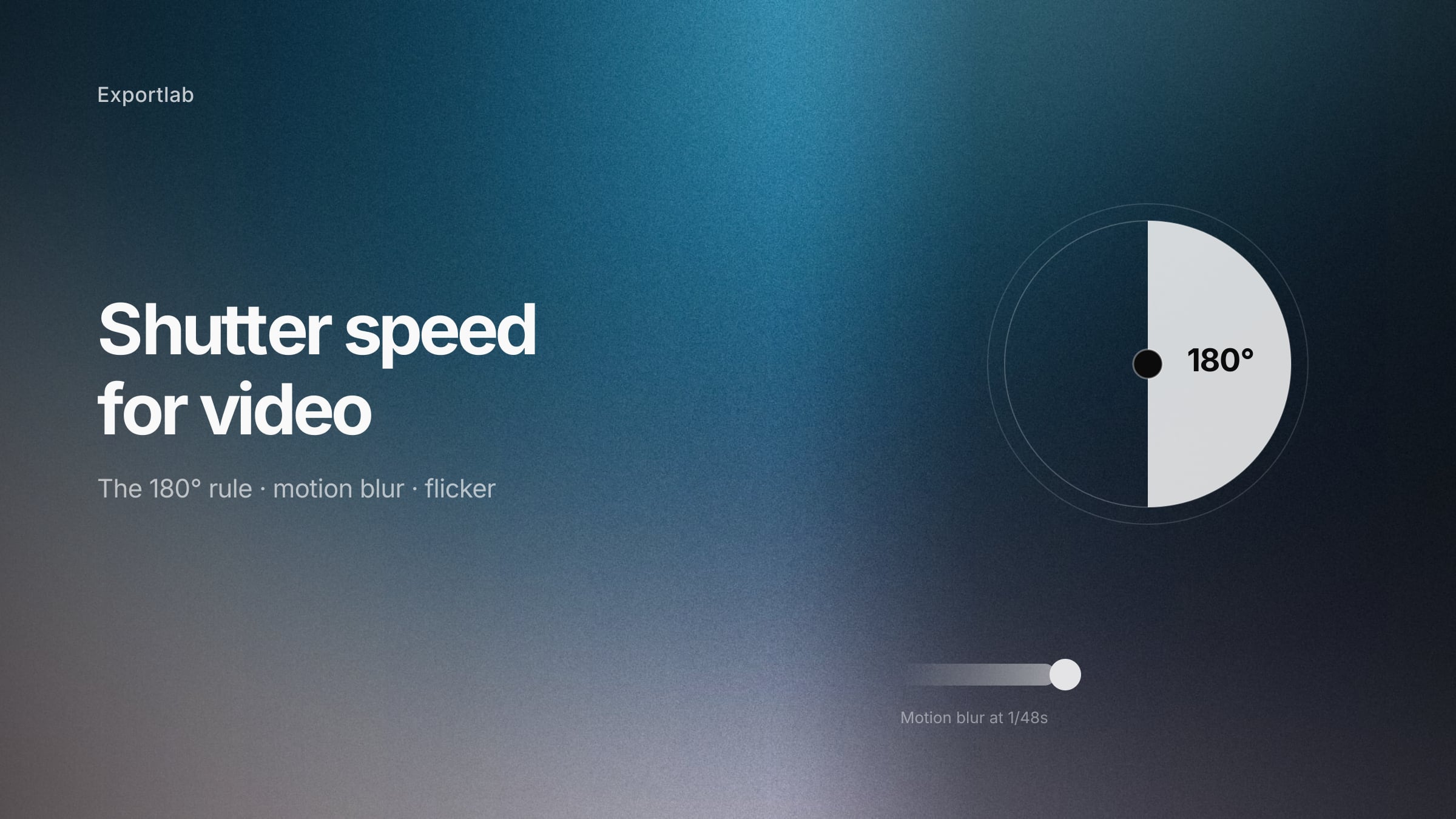
A disc with a 180-degree opening is open for exactly half of each frame cycle. At 24 frames per second, each frame lasts 1/24 s, so the film was exposed for 1/48 s. The number was a physical property of the disc, not a setting anyone chose.
Digital cameras have no disc, so we express the same thing as a shutter speed — but the terminology stuck, and cinema cameras still show you a shutter angle instead. If your camera offers that option, use it: set 180° once and the camera keeps the relationship correct automatically when you change frame rate.
Try it: frame rate, shutter speed and the blur they produce
Pick a frame rate, move the shutter, and watch two things at once: the smear behind the moving subject, and the shutter angle dial on the right. The flicker line underneath tells you whether this combination is safe under mains-powered light.
Motion blur at the current setting
The settings, if you just want the number
| Frame rate | Shutter speed (180°) | Common use |
|---|---|---|
| 24 fps | 1/48 s (or 1/50 s) | Film look, narrative, most commercial work |
| 25 fps | 1/50 s | Broadcast in PAL regions |
| 30 fps | 1/60 s | Broadcast in NTSC regions, online video |
| 50 fps | 1/100 s | Slow motion played back at 25 fps |
| 60 fps | 1/120 s | Slow motion played back at 24/30 fps, sport |
| 120 fps | 1/240 s | Strong slow motion |
Many cameras do not offer 1/48 s. Use 1/50 s — the difference is invisible, and in 50 Hz countries it also solves the flicker problem described below.
What the number actually does
Shutter speed controls how long the sensor collects light for each frame, and therefore how far a moving subject travels while the frame is being recorded. That travel is motion blur.
At 180° the blur matches what your eye expects. Consecutive frames overlap slightly in the motion they capture, so movement reads as continuous. This is the look everyone means by "cinematic", and it is genuinely just this.
Faster than 180° removes the blur. Each frame is a sharp slice, and between frames the subject jumps. Panning shots start to stutter, and fast movement looks unnaturally crisp. Saving Private Ryan used a 45-degree shutter for exactly this reason — the harshness is the point in a battle scene, and it is a terrible default for a wedding.
Slower than 180° adds blur. Movement smears, the footage feels dreamlike or drunk. Useful deliberately, distracting by accident.
Flicker: the mistake that ruins otherwise perfect footage
This is where the rule breaks, and it is the one that costs people their footage.
Anything powered directly off mains electricity does not shine continuously. It pulses at twice the supply frequency — 100 times per second in 50 Hz countries, 120 times in 60 Hz countries. Your eye smooths that out. A sensor exposing for 1/48 s does not.
If your exposure time does not cover a whole number of those pulses, each frame catches a slightly different amount of light. On playback you get flickering brightness, or rolling dark bands drifting up the image. It cannot be fixed in post.
On 50 Hz mains (Europe, most of Asia, Africa, Australia): 1/50 s, 1/100 s, 1/200 s are safe. 1/48 s is not.
On 60 Hz mains (North America, parts of South America and Japan): 1/60 s, 1/120 s, 1/240 s are safe. 1/50 s is not.
This is the practical reason most people in Europe shoot 1/50 s rather than 1/48 s at 24 fps. The 2-degree difference in shutter angle is invisible; the flicker is not.
Two things that are *not* affected: daylight, and battery-powered LEDs with proper drivers. Cheap LED panels on mains adapters are often the worst offenders, and modern LED lighting can pulse at frequencies that no shutter speed fixes — if you see banding and the maths says you should be fine, the light is the problem, not your camera.
When to break the rule on purpose
High frame rate for slow motion. At 120 fps, 180° means 1/240 s. That is often too dark indoors, and since the footage will be slowed down anyway, the extra sharpness per frame is usually welcome. Break it.
Very fast subjects. Motorsport, propellers, anything crossing the frame quickly can smear into mush at 180°. A faster shutter keeps it legible.
Not enough light. A slower shutter is one of the few ways to gain exposure without pushing ISO into noise. Going below 180° costs you blur, but blurry footage beats unusable footage — and unlike noise, nobody notices moderate blur.
Deliberate harshness. Action, tension, unease. A 45–90° shutter makes movement aggressive. Use it when the scene calls for it, not by accident.
Deliberate dreaminess. 270° or wider smears motion into something soft and unstable. Music videos, memory sequences, anything meant to feel unreal.
How this fits with ISO and aperture
Shutter speed is one of three exposure controls, but in video it is the one you should treat as fixed.
In photography, all three are yours to move. In video, shutter is locked to your frame rate by the 180-degree rule, so exposure has to come from the other two — plus a fourth tool photographers rarely need.
Aperture controls exposure and depth of field together. Opening up to gain light also shallows your focus, which may or may not be what the shot wants.
ISO is your fallback, but every camera has a point where noise becomes visible. Find yours before a paid job, not during one. Most cameras also have a second base ISO — often around 800 or higher on log profiles — that is cleaner than the values just below it.
ND filters are the answer photographers do not expect. Outdoors at 1/50 s and f/2.8, you will be badly overexposed even at base ISO, and there is nothing left to close down without ruining your look. A neutral density filter cuts light without touching anything else. A variable ND is the single most useful accessory for outdoor video, and it exists specifically because shutter speed is not available as a control.
FAQ: shutter speed for video
What shutter speed should I use for video?
Double your frame rate. At 24 fps use 1/48 s (or 1/50 s), at 30 fps use 1/60 s, at 60 fps use 1/120 s. That is the 180-degree rule and it produces natural-looking motion blur.
What is the 180-degree shutter rule?
A guideline that says your shutter speed should be roughly double your frame rate. It comes from film cameras with rotating disc shutters, where a 180-degree opening exposed each frame for half of its cycle. The resulting motion blur matches what the eye expects from real movement.
Why is my video flickering under indoor lights?
Your shutter speed does not line up with the mains frequency. Lights powered from mains pulse 100 times per second on 50 Hz supply and 120 times on 60 Hz. Use 1/50 s or 1/100 s in 50 Hz countries, 1/60 s or 1/120 s in 60 Hz countries. If banding persists with correct settings, the light itself is pulsing at a frequency no shutter speed will fix.
Should I use 1/48 or 1/50 for 24 fps?
1/50 s in Europe and other 50 Hz regions, because 1/48 s can flicker under mains-powered light. The difference in motion blur — 180° versus 172.8° — is not visible. In 60 Hz countries either works outdoors, but 1/60 s is safer indoors.
What shutter speed for 60 fps?
1/120 s follows the rule. If you are shooting 60 fps to slow the footage down later, a faster shutter is a legitimate choice — the sharper frames often look better in slow motion, and the missing blur is not noticeable at reduced speed.
Does shutter speed affect exposure in video?
Yes, but you should not use it for exposure. Because shutter is tied to frame rate, adjust aperture, ISO or an ND filter instead. Changing shutter to fix brightness changes the motion look of your footage.
What is shutter angle and should I use it?
Shutter angle expresses the same thing as a proportion of the frame cycle rather than an absolute time — 180° always means "half of each frame". If your camera offers it, use it: the relationship stays correct automatically when you change frame rate, so you cannot forget to adjust.
What happens after the shoot
Getting the shutter right means less to fix later — no flicker to fight in post, no stuttering pans to apologise for. What remains is the part every videographer knows: cutting it, showing the client, collecting their notes and delivering the final file. If that half of the job currently lives in email threads, that is the problem Exportlab exists to solve.