
Instagram alternatives for photographers: where to share photos in 2026
Instagram alternatives for photographers are becoming a common search because posting there no longer always feels like sharing photography. A carefully edited image appears between reels, trends, recommendations and ads, then sometimes disappears with little more than a few passing reactions.
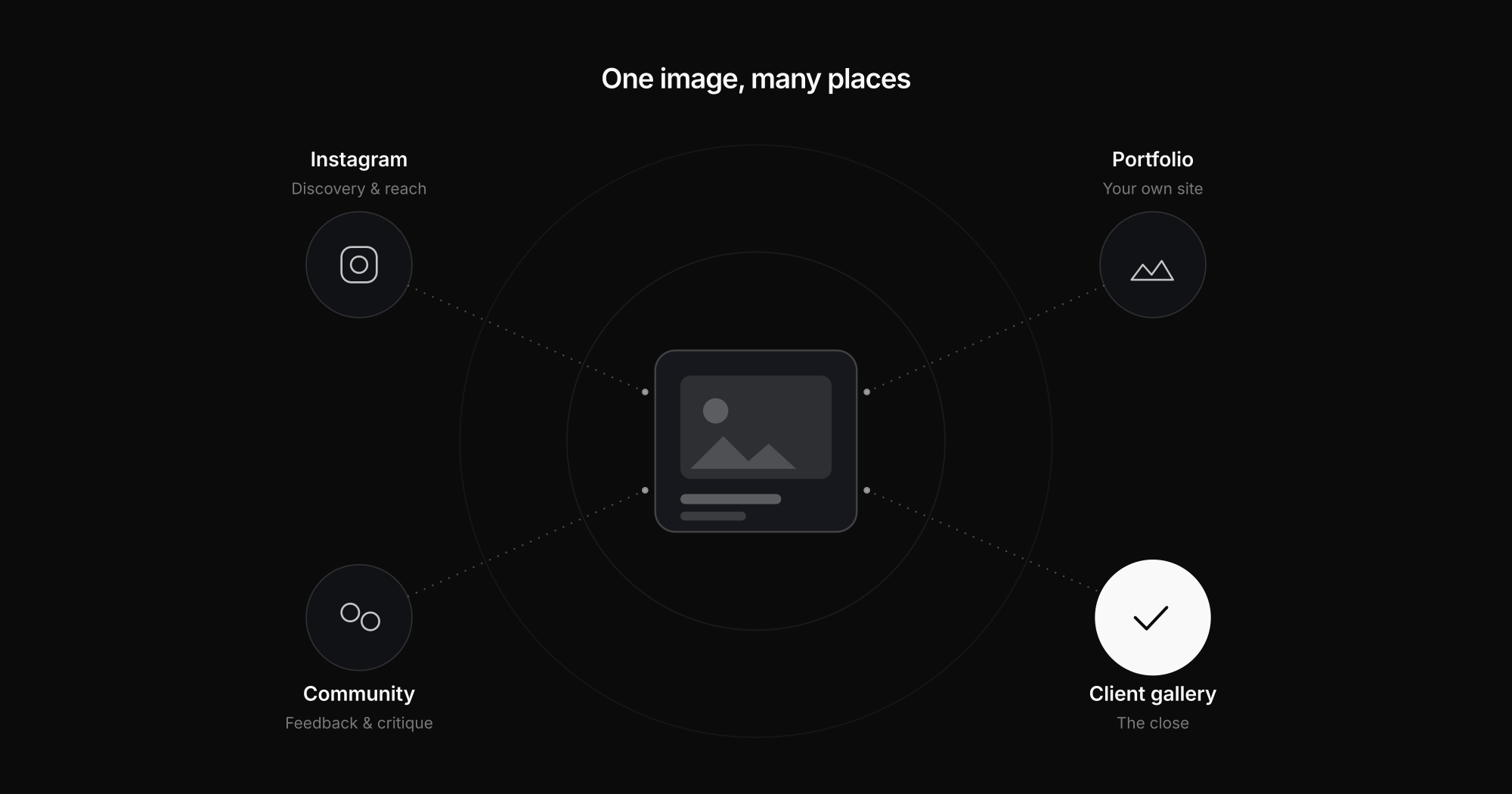
That does not automatically mean Instagram is useless or that the work is not good enough. It mostly means one platform can no longer be expected to handle discovery, serious feedback, portfolio presentation, community and client acquisition equally well. The useful question is therefore not “What is the new Instagram?” but: Which channel should do which job?
Instagram is not dead, but it is not a neutral photo portfolio
Instagram does not display every post in a simple chronological stream. Meta explains that Feed and suggested posts are ranked using signals such as previous activity, relationships, information about the post and the likelihood that someone will interact with it. The official Instagram Help Center explains how Feed works and how selected content is placed higher for individual users.
For photographers, that has two practical consequences:
- A strong photograph is not guaranteed distribution simply because it is visually good.
- Content that creates an immediate, measurable reaction is easier for a recommendation system to classify than a quiet series or a long-term documentary project.
Instagram still matters, however. Potential clients, planners, agencies, models, businesses and other creatives are already there. It remains useful for discovery, activity signals and direct contact. It is much less convincing as a calm archive, a carefully sequenced body of work or a place for detailed critique.
The best Instagram alternative depends on the goal
Discussions about photography platforms often combine very different needs. A hobbyist looking for thoughtful critique needs something different from a wedding photographer building trust with couples. A commercial studio presenting campaigns has another requirement again.
| Platform or channel | Best for | Strengths | Limitations |
|---|---|---|---|
| Discovery, networking and showing activity | Large general audience, direct messages, local and professional connections | Ranked distribution, distracting presentation, shallow feedback | |
| Glass | Photography community and thoughtful interaction | Photography-first, chronological feed, no public counts, ad-free | Paid membership and limited reach beyond photographers |
| Flickr | Themed groups, archives and discussion | Large photography archive, groups, metadata and a long-running community | Older feel and an audience made up mainly of photographers |
| Pixelfed | Decentralized photo sharing and platform choice | Federated, photography-focused, multiple servers and communities | Smaller networks and a less familiar onboarding experience |
| VSCO / 500px | Visual curation and a public photography profile | Cleaner presentation and emphasis on individual work or series | Limited client acquisition and uneven community activity |
| Personal website or blog | Portfolio, search visibility and long-term control | Your brand, your layout and no dependency on a social feed | No built-in audience; people still need a reason to visit |
| Professional client gallery | Presentation, selection and delivery | Clear context, private access, favorites and downloads | Not designed as a public discovery or community channel |
Glass describes itself as a member-supported photography community without ads or manipulative algorithms. That makes it attractive when interaction with photographers matters more than maximum public reach. Glass explains its model here.
Flickr never entirely disappeared. Its themed community groups still offer niches, challenges and conversations around particular genres. The trade-off is that the audience primarily consists of people who are already interested in photography.
Pixelfed takes a different approach. It is part of the federated social web, where independent services can communicate through ActivityPub. The ActivityPub protocol is a W3C Recommendation. This gives users and communities more choice, although decentralization does not automatically create the reach of one large centralized network.
A personal website matters, but it is not a distribution channel
The most frequent advice is: “Build a simple website.” For professional photographers, that is generally correct. A website presents selected work without unrelated reels, comments, trends or old experiments. When someone has already shown interest, a focused portfolio usually feels more credible than an unfiltered social feed.
A website does not solve discovery by itself. It is a destination, not a distribution engine. Without search visibility, referrals, press, social posts, links or direct outreach, few people will randomly arrive there.
A more useful division of labor is:
- Social media introduces people to the work.
- The website convinces them with a clear selection.
- A client gallery presents one project professionally.
- Email, a newsletter or a blog maintains the relationship over time.
Our guide to photo collaboration platforms compares gallery-first, proofing-first and all-in-one options for photographers who want to separate public promotion from client work.
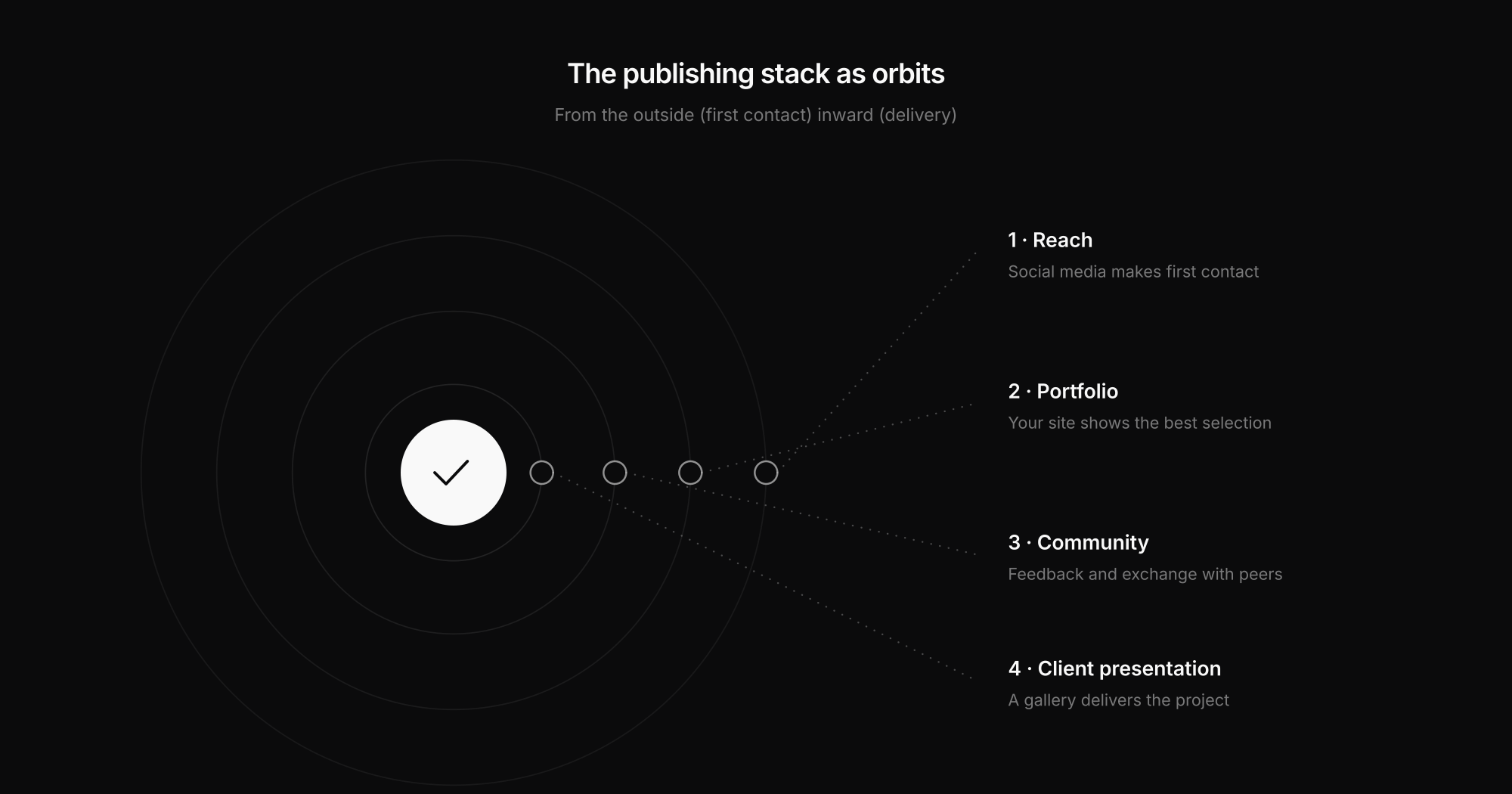
A practical platform stack for photographers
Instead of placing every expectation on the next new app, a small stack of channels usually works better. It does not need to become another full-time job. Four or five clearly defined layers are enough for most photographers.
1. Use Instagram for discovery and signs of activity
Treat Instagram as a shop window rather than a complete archive. Share current work, short series, behind-the-scenes context or specific projects. A potential client should be able to understand within seconds:
- What kind of photography you offer
- Whether you are currently active
- Where you work
- How to contact you or open your portfolio
Not every good photograph needs to become a post. The feed is a communication channel, not a complete record of your work.
2. Use your website for the strongest selection
A portfolio should not document everything you have ever photographed. It should demonstrate what you want to be hired for next. A few coherent projects are usually more persuasive than hundreds of unrelated images.
Context also matters. Was the work a campaign, wedding, editorial, event or personal project? What was the brief? A short introduction can establish more trust than another 30 photographs.
3. Use a photography community for critique and conversation
Glass, Flickr, Pixelfed or smaller genre-specific groups can handle the function Instagram often fails to provide: discussion about sequencing, composition, color, editing and long-term projects.
Set the right expectation. A community of photographers may not generate many clients. It can still improve the work, create professional relationships and make sharing feel less like dropping images into an anonymous feed.
4. Use a client gallery for the professional handoff
Clients should not have to scroll through reels, memes, personal posts and three-year-old experiments to view a finished project. Selection, feedback and delivery deserve a separate environment.
A gallery creates clear context and can combine favorites, comments, downloads and protected access. Our guides to delivering photos to clients and building a client portal for photographers explain how that workflow can be structured.
5. Build one owned channel for long-term independence
A blog or newsletter grows more slowly than a social feed, but the content lasts longer. Search visitors and new subscribers can discover a project months after publication. You also maintain a more direct relationship than you do with followers inside a platform you do not control.
What to publish where
A simple filter prevents every channel from becoming a duplicate:
- One strong image: Instagram, Glass, Flickr or Pixelfed
- A coherent series: website, blog, Flickr album or Glass profile
- Behind-the-scenes or a current update: Instagram
- A question about composition or editing: a focused critique group
- A project for a prospect: curated portfolio page
- A completed client project: protected client gallery or portal
- A long-term personal project: personal website or blog as the permanent home
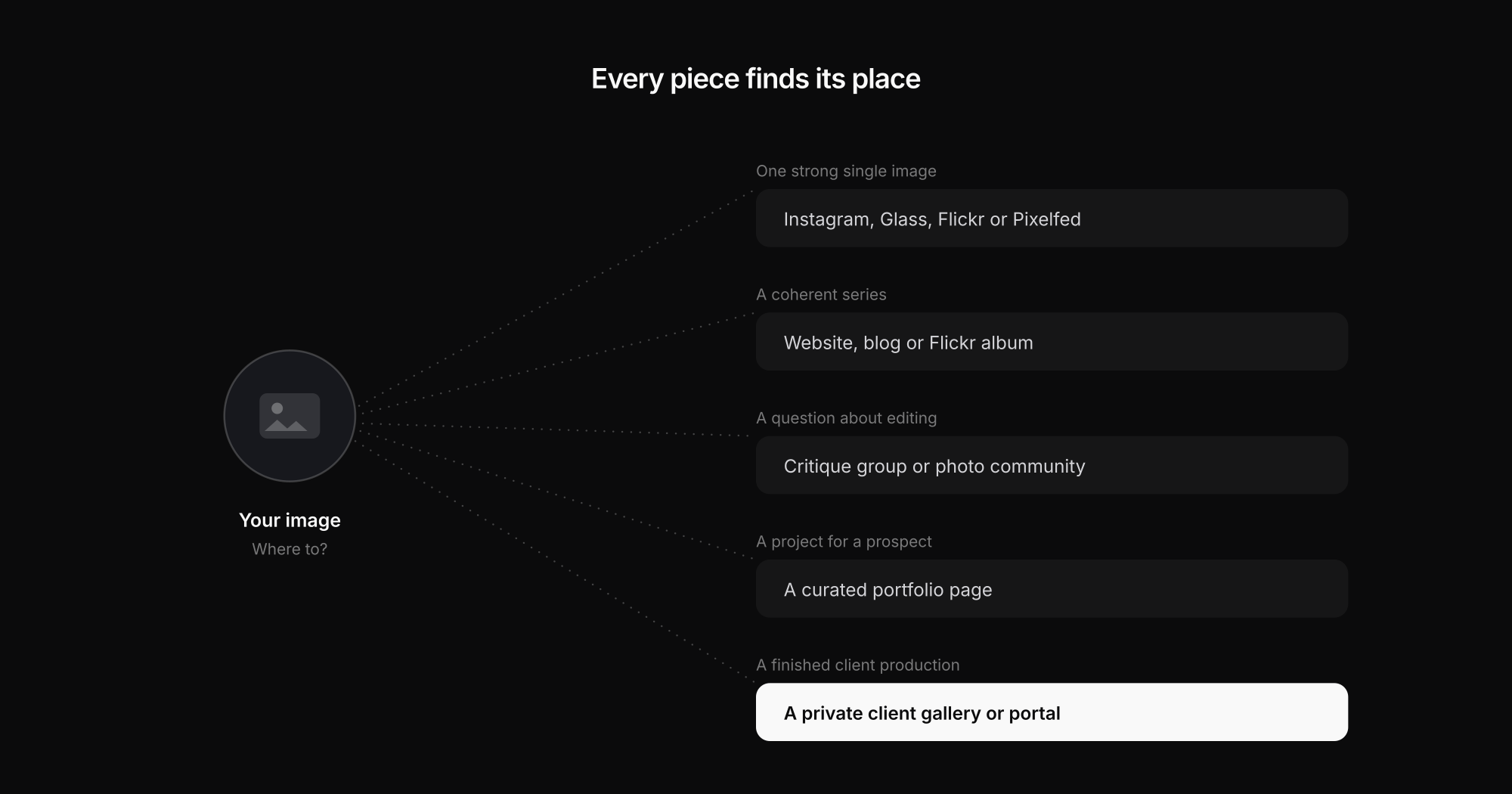
This separation also reduces pressure. A photograph with twelve likes can still be valuable as part of a series, a reference for a client, material for useful critique or a page that becomes discoverable through search later.
Measure more than likes
Professional photographers should evaluate channels according to the outcome they are meant to produce. Useful signals can include:
- Portfolio visits and website clicks
- Qualified inquiries
- Replies and direct conversations
- Returning visitors
- Newsletter subscriptions
- Detailed comments rather than generic likes
- Views of selected case studies
- Referrals and repeat clients
For hobbyists, public reaction counts are also a weak measure of photographic quality. A small group that seriously engages with a series can be more valuable than thousands of passing impressions.
FAQ
Is there a true Instagram alternative made only for photographers?
There are several photography-first platforms, but no direct replacement with Instagram's general audience. Glass focuses on community, Flickr on groups and archives, and Pixelfed on decentralized networks. A combination of channels is more realistic than one universal replacement.
Should photographers still use Instagram?
Yes, when clients, collaborators or people in the relevant location are active there. Instagram remains useful for discovery and contact. It should not have to serve as the only portfolio, archive, critique group and delivery system at the same time.
Is a personal website enough for a photography portfolio?
A personal website is valuable for professional presentation, but it does not automatically create traffic. It works best as a destination for people arriving through search, referrals, social media, press or direct outreach.
Where can photographers get honest feedback?
Smaller, focused communities usually provide more useful critique than broad public feeds. Options include Flickr groups, Glass, Pixelfed communities, local photography groups and moderated critique forums. Meaningful participation matters: photographers who offer specific feedback tend to receive better feedback themselves.
Is Instagram or a gallery better for clients?
Instagram is useful for an initial impression. A calm, branded gallery is better for presenting, selecting and delivering a specific project because it removes unrelated content and gives clients a clear route to favorites, feedback and downloads.
Conclusion
The best Instagram alternatives for photographers do not all solve the same problem. Instagram remains strong for discovery and contact, a personal website for positioning, photography communities for conversation and a professional gallery for clients. Separating those jobs reduces dependence on one algorithm and gives every photograph a more appropriate context.