

Photography Business Plan: The Numbers That Actually Matter
Most business plan templates online come from startup advisory services and are built for companies with employees, inventory and investors to court. Search for "photography business plan" as a solo photographer and you land on thirty-page documents with chapters on competitive analysis and organisational structure — for a one-person operation, mostly busywork that teaches you nothing.
The plan is still worth doing, just in a different form. It answers three questions that decide whether this works: at what point does it pay for itself? How many jobs does that take? And is that number realistic?
Do you even need one?
A formal business plan is mandatory when third parties are involved:
- Startup grants or public funding schemes, which usually require a plan and an expert assessment.
- A loan or lease for equipment, a vehicle or a studio.
- Business partners, where expectations should be settled in writing.
Without those, you do not need a formal plan — but you do need the numbers inside it. The difference: not a document for other people, but a calculation for yourself. It fits on one page.
The three numbers that count
1. Your monthly fixed costs
Everything that occurs even if you shoot nothing at all: insurance, software subscriptions, website, phone, health and pension contributions, studio rent and lease payments if you have them. Plus the monthly reserve for replacing equipment — cameras and lenses wear out, long after they are paid for.
That total is what you have to earn every month before you think about your own income.
2. Your contribution margin per job
What remains of a job after the directly attributable costs come off: travel, any assistant, storage, payment fees, props or location hire.
A job at 800 with 150 in direct costs contributes 650 towards covering your fixed costs.
3. Your break-even
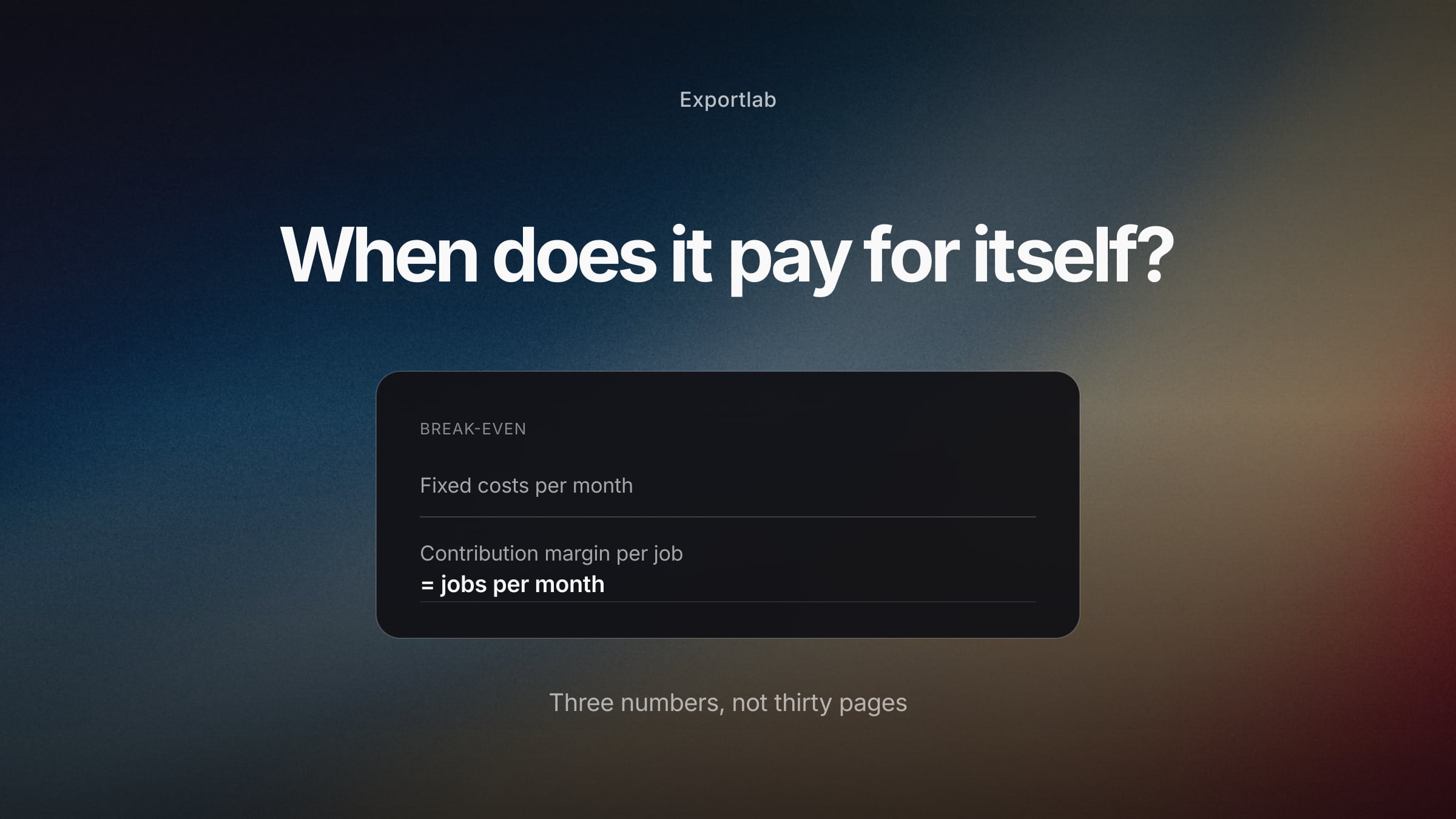
Fixed costs divided by contribution margin = jobs per month at which it pays for itself.
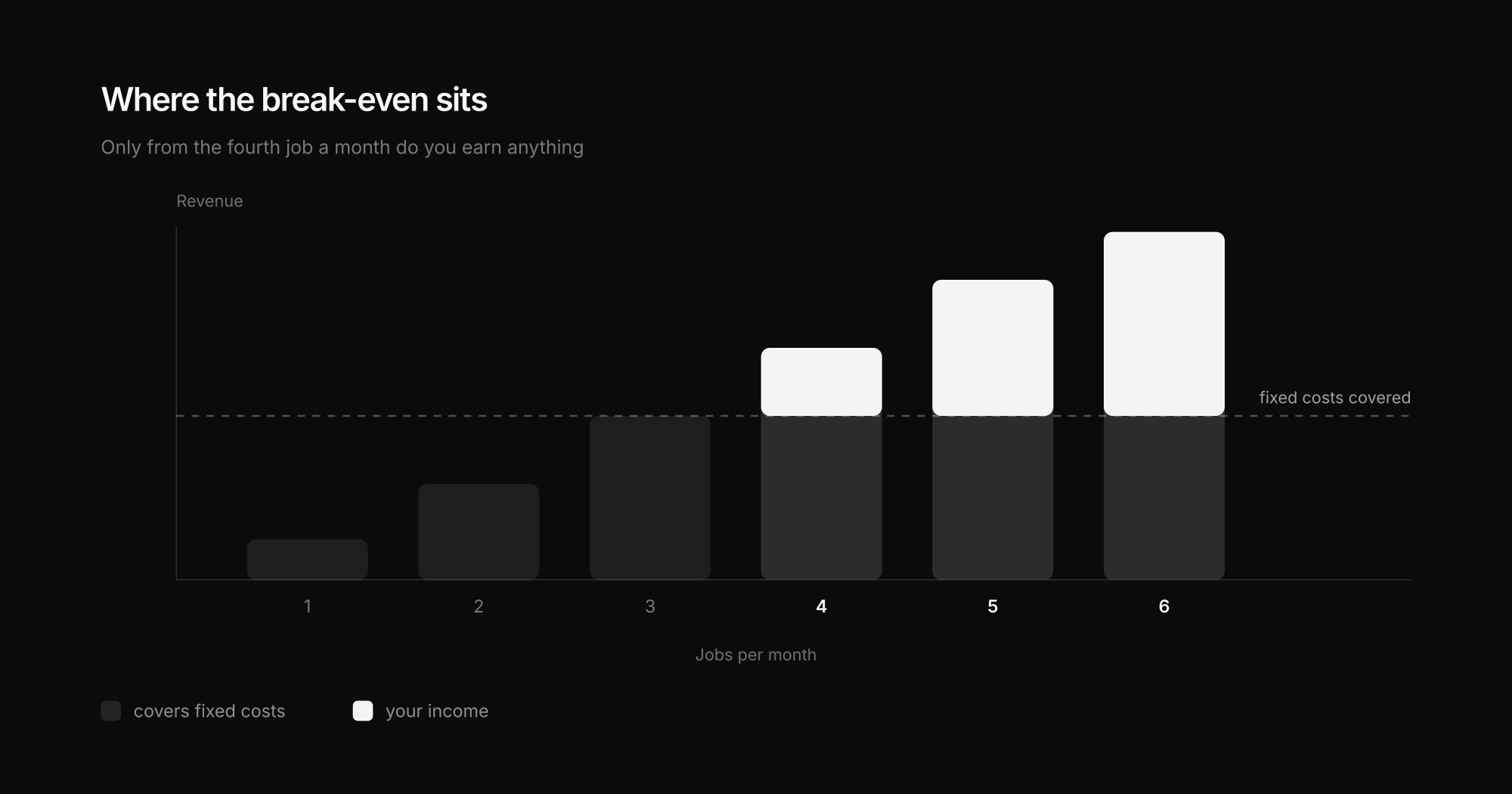
At 2,000 in fixed costs and a 650 margin, that is roughly three jobs a month just to cover costs. Only jobs beyond that contribute to your income.
That single calculation tells you more than thirty pages of market analysis — mostly because it tends to come out uncomfortably.
The reality check: does that number fit into your year?
Now comes the step optimistic plans skip. Say you need four jobs a month, so 48 a year. Is that achievable?
Check it against reality: one hour of shooting carries two to four hours of unpaid work, depending on genre. Add acquisition, bookkeeping, training and holiday. For many solo photographers the realistic ceiling sits at 40 to 60 jobs a year.
If your break-even is 48 jobs, you work the entire year just to cover costs. Something is wrong — and there are exactly three levers:
- Raise prices, so the contribution margin grows. Usually the most effective one; see photography pricing.
- Cut fixed costs, such as studio rent or subscriptions you barely use.
- Reduce effort per job, so more jobs fit into the year without the week getting longer.
What else belongs in the plan
Offer and audience in two sentences
Who books you, and for what? If that takes more than two sentences, the positioning is not sharp enough yet — and that comes back to bite you in marketing.
Price structure
Three packages with actual prices, not "prices on request". The plan forces you to commit before the first client asks.
Client acquisition, specifically
Not "social media and referrals", but: which three channels, with how much effort per week. Anything else is a statement of intent.
Investments with timing
Not just what you need, but when. Much can be rented or bought later — every purchase pulled forward extends the road to break-even.
The one-page version
If you do not need a plan for a bank, this structure is enough:
- Offer — what you provide, for whom, in which area.
- Prices — three packages with concrete numbers.
- Monthly fixed costs — the complete list, honestly.
- Contribution margin per job — averaged across your packages.
- Break-even — jobs per month, plus the annual cross-check.
- Client acquisition — three channels with weekly effort.
- Next steps — what happens in the coming three months.
Revise it once a year. What matters is less the plan itself than the variance: where were you wrong, and why?
The line item almost no plan contains
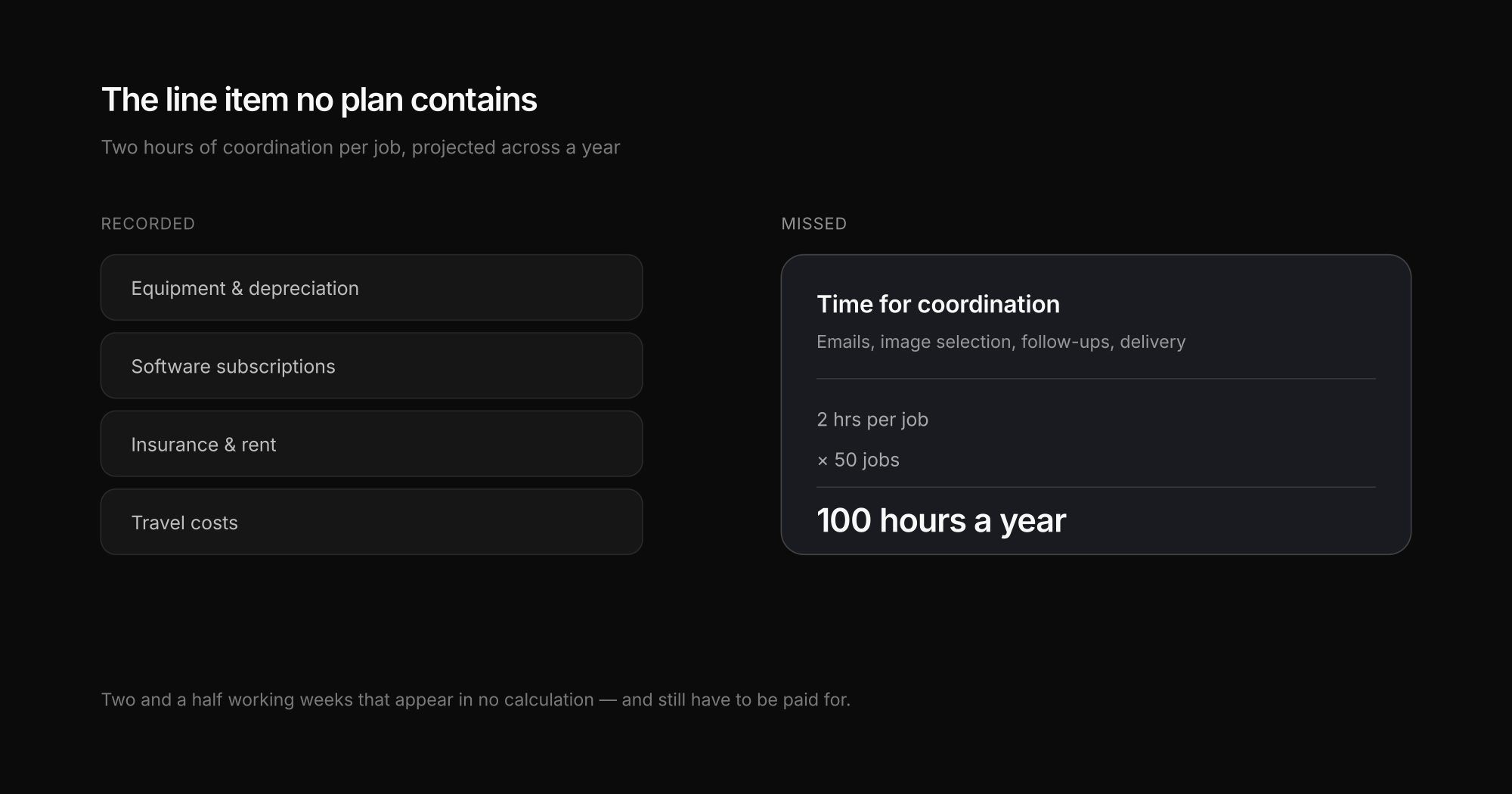
Business plans record equipment, software and rent conscientiously — and miss the largest cost block of all: your time for coordination and delivery.
Work it through once. If two hours per job go into email threads, image selection over chat, questions about progress and the delivery itself, that is 100 hours across 50 jobs — two and a half working weeks that appear in no calculation and still have to be paid for.
This is why process affects profitability: when clients mark their own selection in a gallery and can see project status instead of asking, the effort per job drops measurably. Tools like Exportlab bundle gallery, client portal and contracts in one place — not as magic, but because fewer channels simply cost less time.
FAQ: Photography business plan
Do I need a business plan as a photographer?
Only mandatory when third parties are involved — grants, loans, public funding or business partners. For yourself you need no formal plan, but you very much need the core numbers: fixed costs, contribution margin and break-even. That calculation fits on a single page.
How do I calculate break-even in photography?
Monthly fixed costs divided by the average contribution margin per job. The result is the number of jobs per month at which you cover your costs. The important part is the cross-check: is that number times twelve still realistic, given that each shooting hour brings two to four hours of unpaid work?
How long should a photography business plan be?
For a bank or a funding body, usually 10–20 pages plus financials. For your own use, one page. Length is not a quality marker — what matters is whether the numbers survive scrutiny.
What does it cost to start as a photographer?
Registration itself is minor. The relevant costs are insurance, equipment and recurring subscriptions. The biggest mistake is buying everything upfront: each purchase pulled forward extends the time to break-even.
How do I plan for seasonal swings?
Do not assume twelve identical months; estimate job counts per month based on your genre. In the strong months you set aside what the weak ones will not carry. Spreading the annual total evenly plans around reality rather than for it.
What is the most common mistake in photographers' business plans?
Over-optimistic capacity. Plans routinely assume twice as many jobs as realistic, because only shooting time gets counted and the unpaid work around it is missing. The second common error is prices set too low, which then require a great many jobs.
Conclusion
A photography business plan is not a document but a calculation with three numbers: fixed costs, contribution margin, break-even. Set them out honestly once and you see immediately whether your planned prices and planned capacity fit together — and on the first attempt, they usually do not.
That is precisely the value. It is considerably more pleasant to find that gap at the kitchen table than in your second year of trading, when the tax bill arrives and the calendar was full anyway.