

Call Sheet: What Goes On It, and What Happens When It Is Wrong
A call sheet is the single document that tells everyone on a production where to be, when, and what happens once they get there. It is one shoot day, written for the people working it — not the production overview, and not a schedule for the client.
Most call sheets contain the right information. Where they fail is the last mile: sent as a PDF at 11pm, opened on a phone in a car park with one bar of signal, already outdated because the location changed after it went out. This article covers what belongs on one, who actually reads which part, and how to keep it correct on the day.
What a call sheet is — and what it is not
The terms get used interchangeably, which is the first reason productions end up with documents nobody trusts.
| Shooting schedule | Call sheet | |
|---|---|---|
| Span | the whole production | exactly one shoot day |
| Audience | production, director, client | the crew turning up tomorrow |
| Contents | all shoot days, locations, time frames | call times, addresses, running order, contacts |
| Question it answers | "when do we shoot what?" | "where am I, when, and what happens there?" |
The call sheet is one day pulled out of the shooting schedule, plus everything the set actually needs and the schedule does not carry: parking, the nearest hospital, who to phone when the talent is late.
The sections every call sheet needs
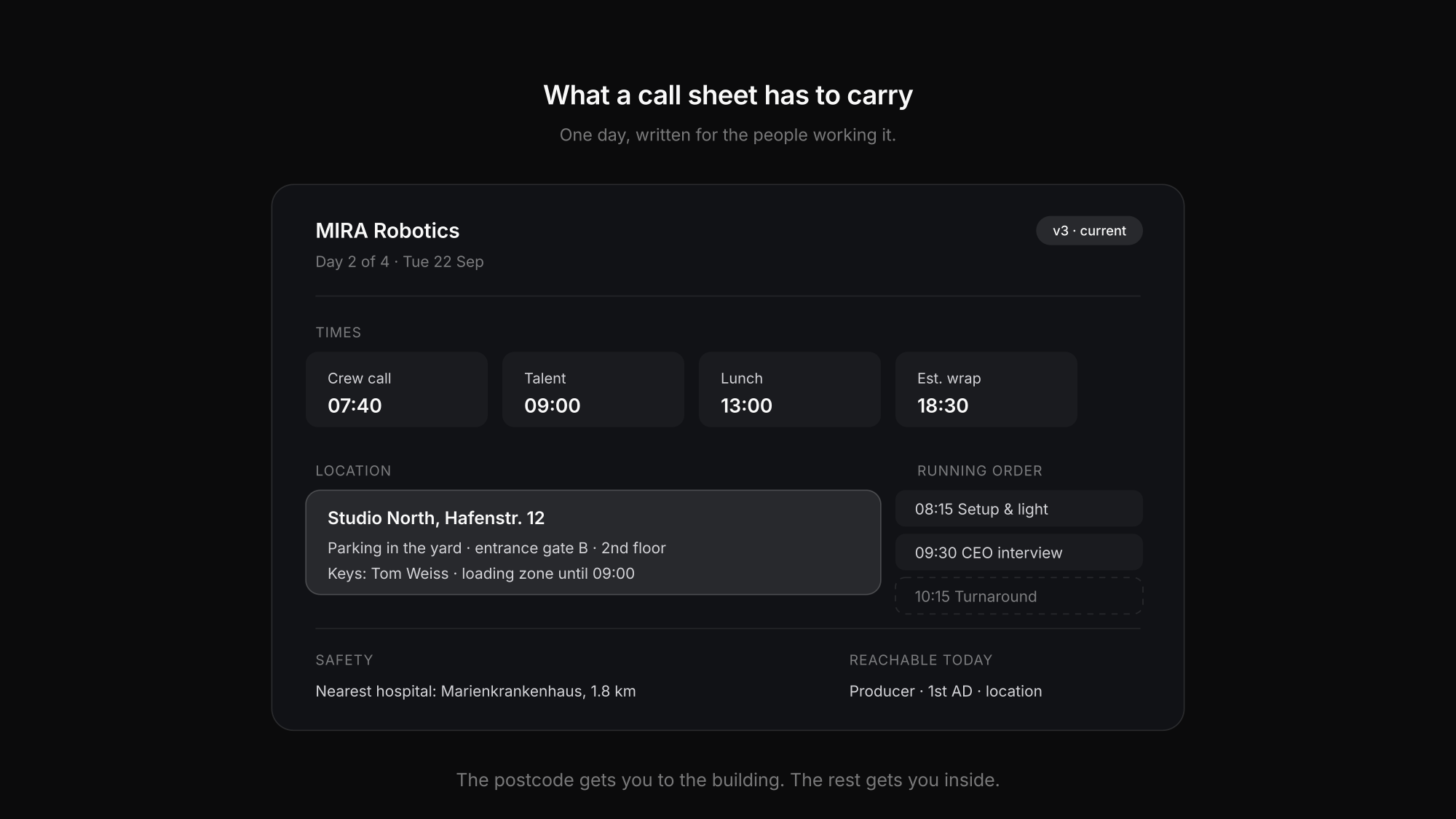
A call sheet answers the four Ws — who, what, where, when — for one day. In practice that breaks into eight blocks.
1. Header: production, day and date
Production title, shoot day number out of the total ("Day 2 of 4"), the calendar date, and the version. Put the version on it. A call sheet without one is indistinguishable from the previous version once it is printed.
2. Times that matter
General crew call, plus the times that differ from it: talent call, hair and makeup, first shot, lunch, estimated wrap. Sunrise and sunset belong here too — for exteriors they are hard constraints, not trivia.
3. Location, and how to actually get there
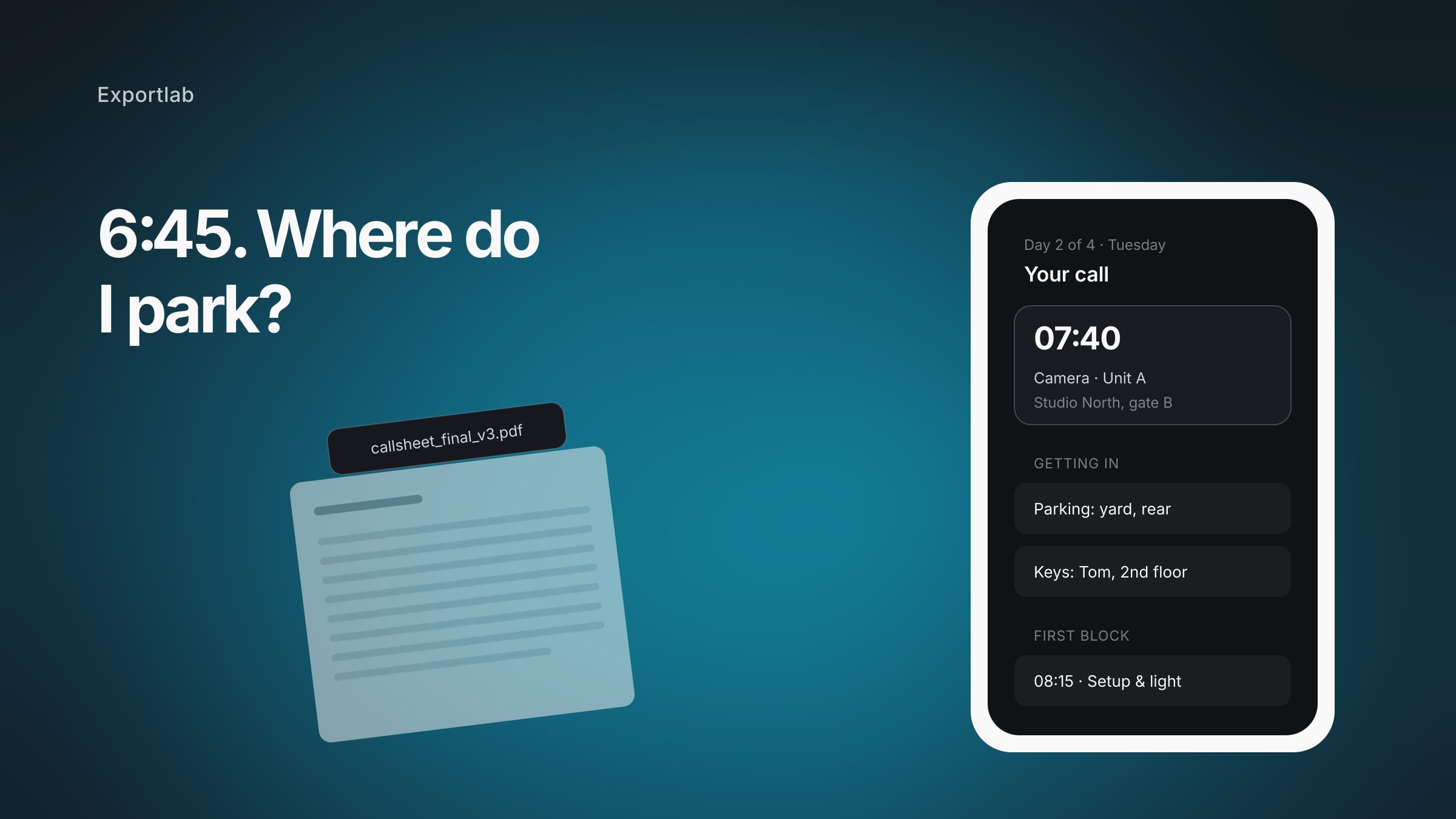
The address is the easy part. What gets forgotten is everything after the postcode: where to park, which entrance, which floor, whether there is a loading zone, and who has the key. A crew standing outside a locked building at 7am is the most expensive kind of delay, because everyone is already on the clock.
4. The running order
The blocks of the day in sequence, each with a duration, a location and the unit that shoots it. Turnaround and travel appear here as their own entries — if they are not on the sheet, they still happen, just at the expense of whatever comes next.
5. Who is on the day
Crew by role with their call time, and talent with theirs. Names and roles, not a full contact database — a call sheet that lists everyone's personal details is a data-protection problem you do not need. Contact details belong to the handful of people who actually get called.
6. Key contacts
Producer, first AD, location manager, client contact. Two or three numbers that are genuinely reachable during the shoot beats a list of fifteen that nobody answers.
7. Safety and logistics
The nearest hospital with its address, any site-specific hazards, and what the weather is expected to do. Catering and dietary requirements go here too — for a day that runs from 6am to 8pm, lunch is a scheduling item, not a detail.
8. Notes
Whatever is specific to this day: a noise restriction until 9am, a client visiting after lunch, a permit that only covers a particular hour.
Why the PDF sent the night before stops working
The content is usually fine. The distribution is where it breaks, for three reasons.
- It is already out of date. Something changes between sending and shooting on almost every production. The PDF cannot change with it, so the corrected version arrives as a second attachment — and now two documents are circulating.
- It is unreadable where it is read. Nobody opens a laptop on set. A dense A4 layout on a six-inch screen means pinching and scrolling to find one call time.
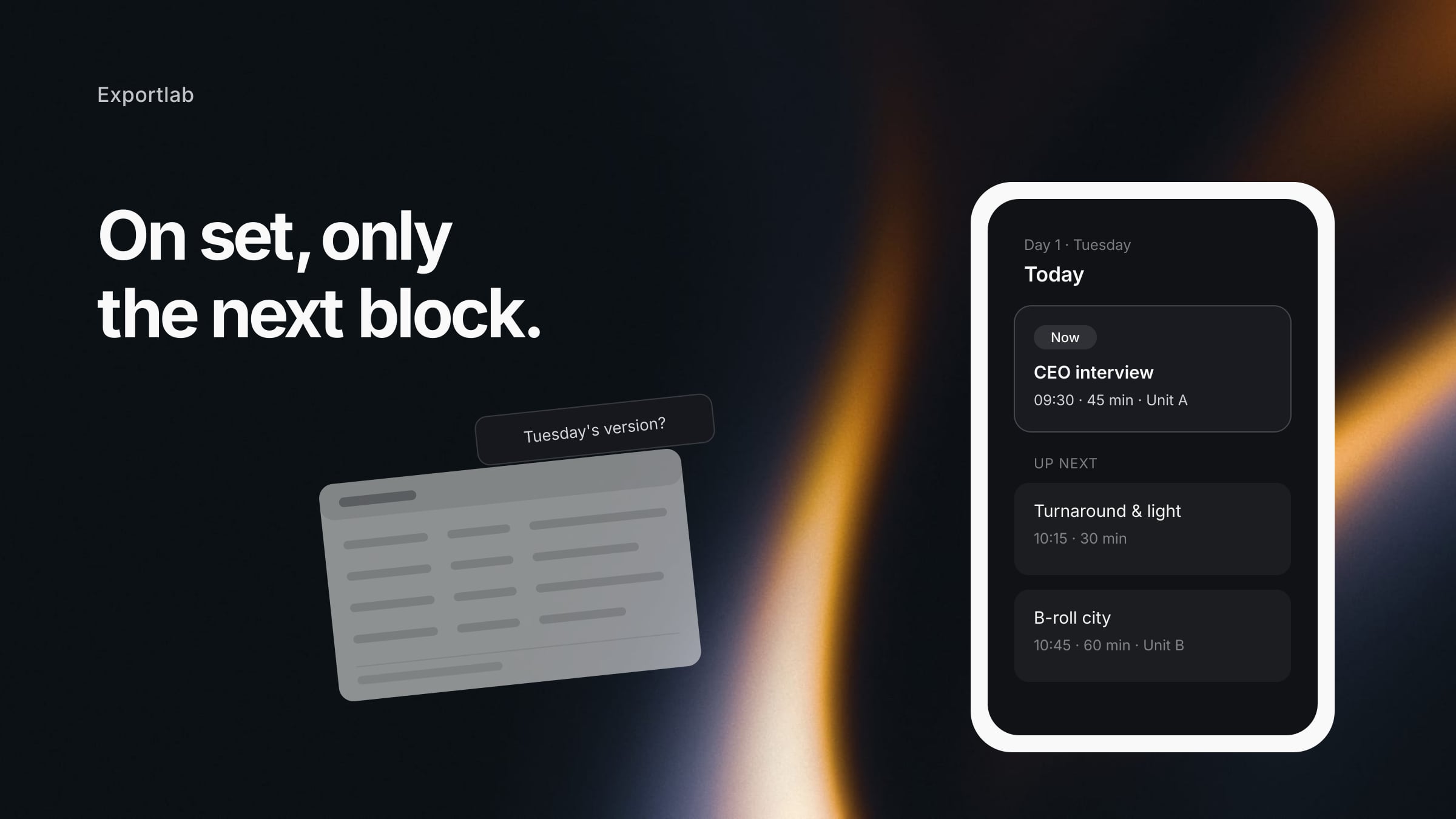
- Everyone gets everything. The camera unit needs its next two blocks, not the full running order for three units. Every line that is not theirs is a line their own can hide behind.
Then there is the question of who should see what at all. A client does not need the crew's call times or the internal notes, and the crew does not need the client's commentary. On a single PDF, those are the same document.
Keeping the day correct while it runs
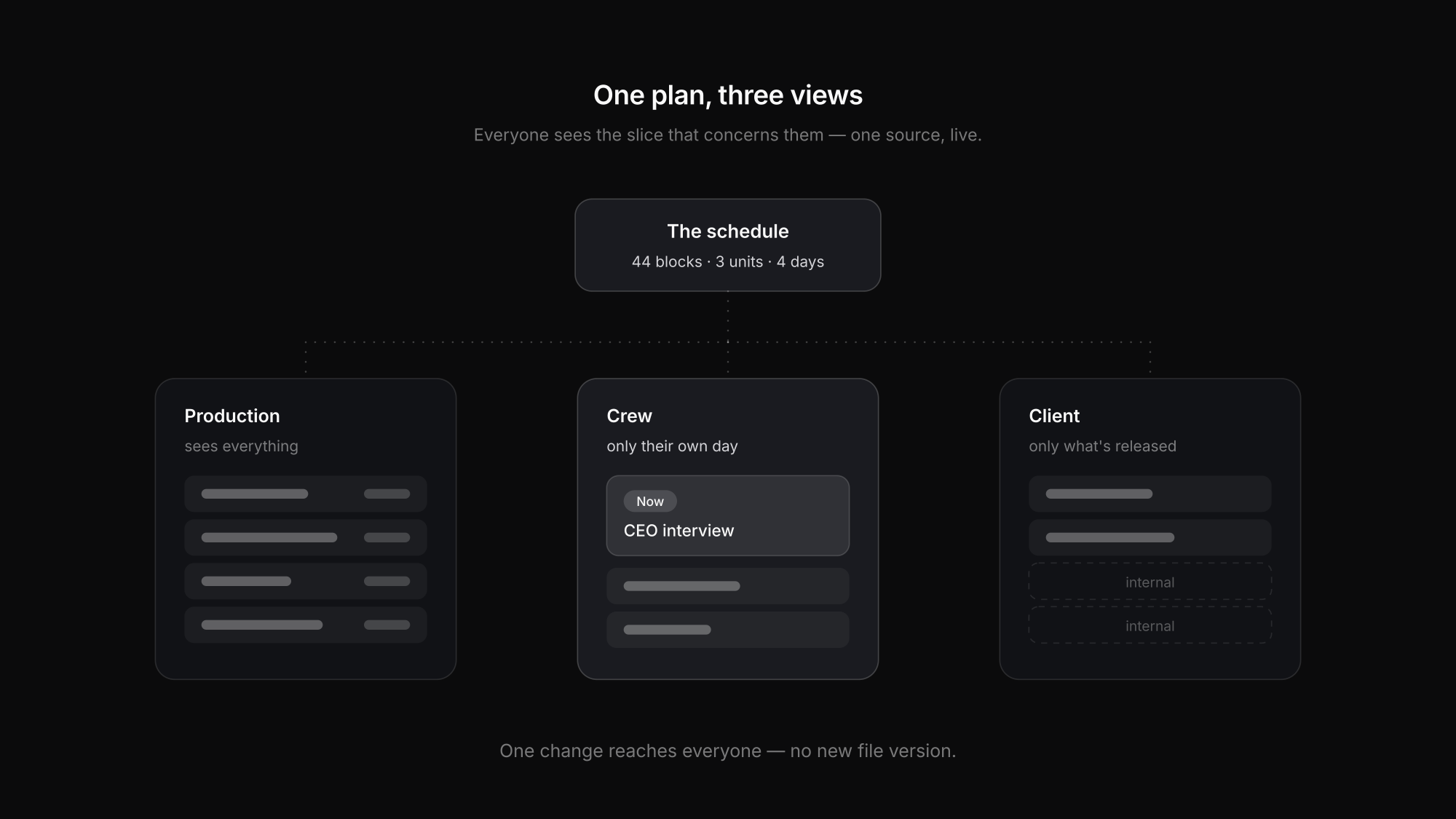
This is what production planning in Exportlab is built around: the day comes out of one live plan rather than a file, and each person sees the part that concerns them.
- Crew join by invitation link — no account required, which matters when half the crew is freelance and on the job for one day.
- Each person sees their own day, not the master plan with every unit on it.
- The client gets a separate link and sees only what has been released to them.
- Changes reach everyone at once, so "is this the current version?" stops being a question.
On the day itself the app shows the block running now and the one after it, for exactly the person looking at it, with the on-site checklist alongside. The day stays readable offline — which in underground car parks, rural venues and basements is the difference between a plan and a nice idea.
The scale is open-ended: one person with ten blocks from setup to wrap, or four days with three units across eight locations. Production planning is currently in beta and enabled per workspace.
Call sheet mistakes that cost the morning
No version number
Two PDFs, both called "callsheet_final". Nobody can tell which one is current, so everyone asks.
Address without access details
The postcode gets you to the building. Parking, entrance, floor and who holds the key are what actually get you inside.
Turnaround left off
Strike, relight and travel happen whether or not they are on the sheet — unplanned, they come out of the next block.
Every phone number on the page
A call sheet is not a contact database. List the people who genuinely get called, and leave everyone else's details off.
Sent too late to act on
A sheet that lands at 11pm is read by whoever is still awake. Anything that needs a response should go out earlier.
One document for crew and client
The client sees internal notes; the crew wades through client-facing framing. Neither audience is served well.
From the shoot day to delivery
The call sheet ends at wrap, but the job does not. The material has to be reviewed, cut, approved and handed over — usually taking longer than the shoot itself.
When the day and the delivery sit in the same project, that handover stops being a break: footage lands where the block was planned, video feedback attaches to the same project, and the client follows progress on a status page instead of emailing to ask. For collecting frame-accurate notes rather than emailed timecodes, the comparison of video review tools goes into more depth.
FAQ: Call sheets
What information goes on a call sheet?
Production title and shoot day, the date, call times for crew and talent, the location with parking and access details, the running order of the day, who is working it, key contacts, safety information including the nearest hospital, weather, catering, and any notes specific to that day.
What is the difference between a call sheet and a shooting schedule?
The shooting schedule covers the whole production across every shoot day. The call sheet is one day taken from it, written for the crew working that day, with the practical detail the schedule does not carry — parking, access, contacts and safety.
When should a call sheet go out?
Far enough ahead that anyone who needs to query something still can, which in practice means the day before rather than late that night. Anything requiring a response — a conflict, a missing permit, a transport problem — needs time to surface.
Who prepares the call sheet?
On larger productions the first assistant director, usually working from the schedule the production has set. On small shoots it is whoever is producing, which for a solo videographer means you.
Does the whole crew need everyone's contact details?
No, and spreading them widely creates a data-protection problem. List the handful of people who genuinely get called during the day — producer, first AD, location manager, client contact — and keep the rest out of general circulation.
Conclusion
A good call sheet is not the one with the most information on it. It is the one where the person reading it on a phone at 6:45am finds their call time, the entrance, and what happens first — without scrolling past three other units.
That is as much a distribution problem as a document problem. When the day comes out of a live plan rather than an attachment, the version question disappears and each person gets their own slice. Production planning shows what that looks like; for the structure the day is built on, start with the shooting schedule.