
How to Plan Mini Sessions: Schedule, Pricing and Delivery
Mini sessions look simple from the outside: one location, one set, twenty minutes per family, a dozen bookings in a day. The photographers who run them know where the work really sits. It's in the schedule that has to absorb a late family, in a price that still pays once you count editing time, and in the week after, when twelve families want their photos – and nobody wants to see someone else's kids in their gallery.
This guide goes through planning a mini session day in the order the work happens: what a mini session is, how to build the schedule, how to price it, how the shoot day runs, and how to deliver. Christmas minis are the running example, because that's when most photographers run them, and because the Christmas card deadline makes every mistake in the plan visible.
What a mini session is – and when it's worth running
A mini session is a short, standardized shoot that you sell many times over: same location, same set, same lighting, a fixed time slot and a fixed number of edited images. Typical numbers in photographer guides are 15–30 minutes per session and 5–15 edited images, at a price well below a full session.
The format pays off when three things are true:
- The setup repeats. A Christmas set, a pumpkin patch, a field at golden hour – you build it once and photograph it twenty times.
- The client wants a result, not an experience. Families who need a card photo want five great images, not a two-hour walk.
- You can fill the day. A mini session day with four bookings costs nearly as much setup as one with fifteen.
It's a bad fit for clients who need individual planning, such as newborns or a business with a brief. Those belong in a full session.
How to plan mini sessions: the schedule
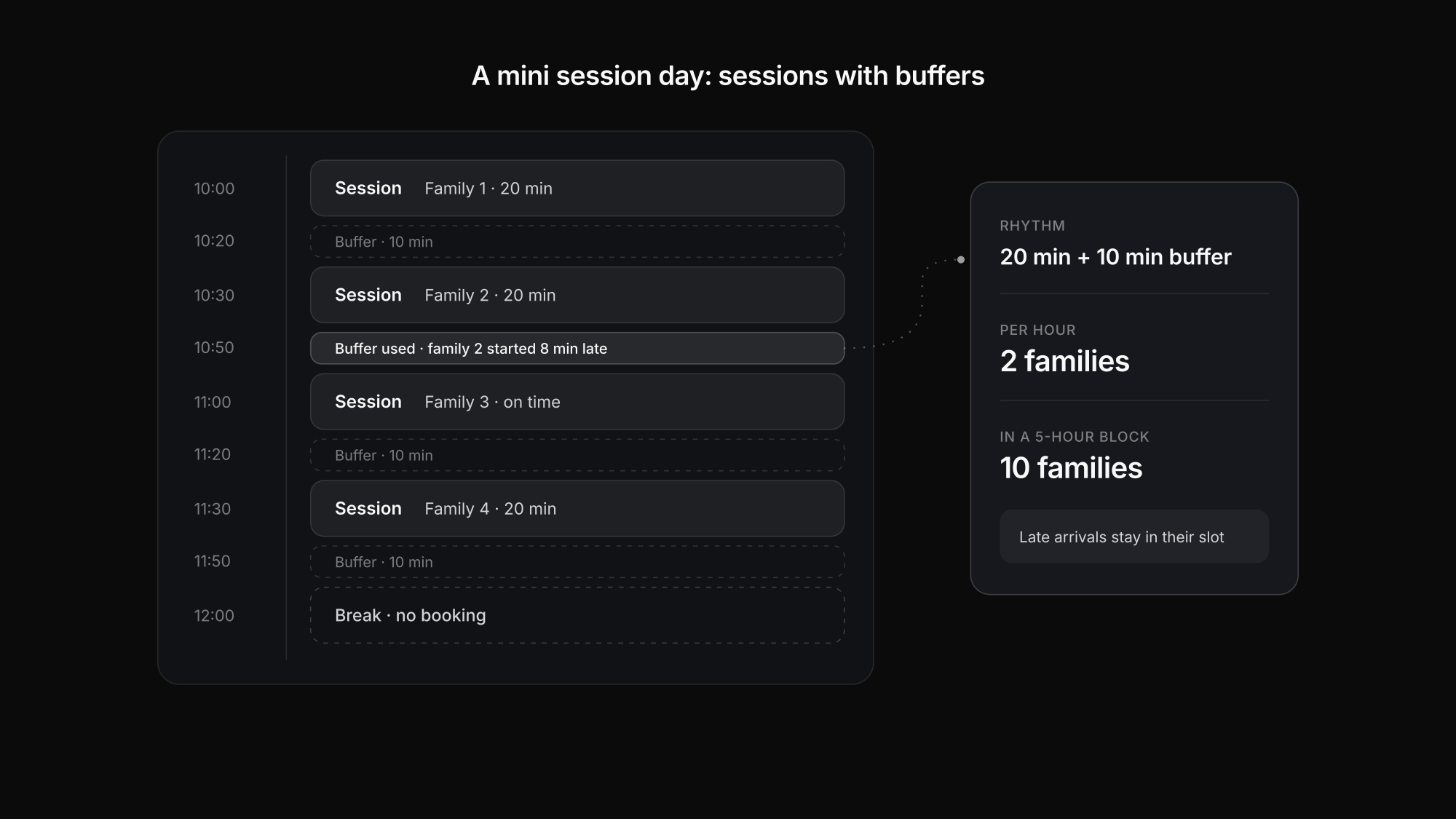
The schedule decides everything else – how many families you can book, and therefore what each one has to pay. Two numbers matter: the slot length and the buffer between slots. Without a buffer, one family that arrives eight minutes late moves the whole afternoon.
| Session length | Buffer | Slots per hour | Families in a 5-hour block |
|---|---|---|---|
| 15 min | 5 min | 3 | 15 |
| 20 min | 10 min | 2 | 10 |
| 25 min | 5 min | 2 | 10 |
| 30 min | 10 min | 1.5 | 7 |
A few planning rules that save the day:
- Plan a 5-hour block, not an 8-hour day. Little kids have a narrow good window, and so does your energy. Two shorter days beat one long one.
- Schedule the youngest kids early. Toddlers before nap time, older kids and couples later.
- Book a lunch break. One unbooked slot in the middle is cheaper than rushing the afternoon.
- Have a weather plan. For outdoor minis, name a rain date in the booking terms before anyone books.
- Cap the group size. "Up to five people" keeps a 20-minute slot realistic. Larger groups book two slots.
Mini session pricing: start from your time, not from a ratio
Advice on mini session pricing tends to use ratios – a quarter of your full session price, two thirds of it, half. The ratios contradict each other because they skip the part that decides profitability: how much of your time a single family actually costs. The shoot is the smallest part.
A realistic time budget per family:
- Shooting incl. buffer: 20–30 minutes
- Culling and editing 8–10 images: 40–60 minutes
- Gallery, delivery and messages: 15–20 minutes
- Booking, reminders, payment admin: 10 minutes
That's roughly 1.5 hours per family, even when the session itself lasts 20 minutes. Add the costs of the day, split across all bookings – set and props, location fee, marketing, payment fees.
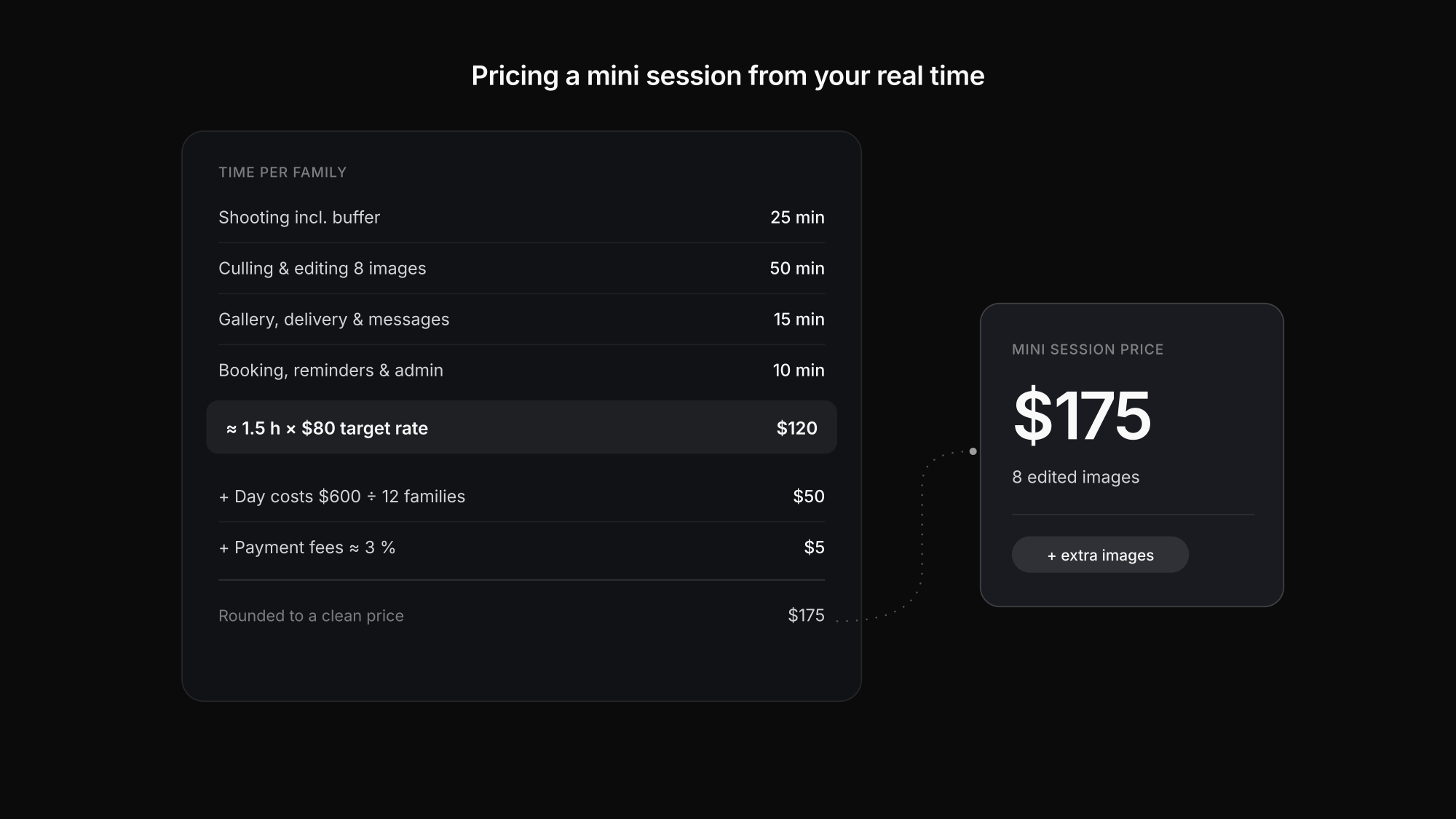
Example calculation (12 families, target rate $80 per hour):
- Time per family: 1.5 h × $80 = $120
- Day costs: $300 set and props + $150 location + $150 marketing = $600 ÷ 12 families = $50
- Subtotal $170, plus about 3 % payment fees → round to $175 for 8 edited images
- Extra images as an upsell: a price per image or a "full gallery" upgrade
Your numbers will differ, and so will your taxes – the point is the method. The U.S. Small Business Administration's guide to managing your business finances is a good baseline for tracking costs like these. For the broader logic of packages and usage rights, see our guide to photography pricing.
Two pricing decisions to make up front:
- What's included. A fixed number of images (5–10 is common) keeps editing time predictable. "All images" sounds generous and doubles your culling time.
- Prepayment. Take the full price, or at least a non-refundable deposit, at booking. No-shows hurt minis more than any other format, because a slot that stays empty can't be resold on the day.
Booking and payment
Mini sessions live or die on booking without back-and-forth. What works:
- One booking page with the date, location, the slots, what's included and the price – no "message me for details".
- Payment at booking, not on the day. Unpaid slots are the ones that don't show up.
- Clear terms: what happens with lateness, rain, rescheduling and extra people. A short photography contract covers this better than a paragraph in an email.
- Two reminders: one a week before (with outfit tips), one the day before (with the address and the slot time).
A note on tools: Exportlab doesn't book appointment slots, so you'll need a booking tool or calendar for that part. Where Exportlab starts is the moment the families arrive.
The shoot day: check-in and keeping families apart
On a mini session day, the tricky part isn't the photography. It's knowing afterwards which of 600 frames belong to which family. A common workaround is photographing a name card at the start of each session – it works until one card gets skipped.
A cleaner way is a structured check-in. With Exportlab's Group Shoot, each family checks in at arrival via a QR code or link, optionally with a selfie, and receives a short access code. After the shoot you assign the photos to the families – by hand, or with face-matching suggestions based on the check-in selfie. Each family then opens the gallery with its code and sees only its own photos.
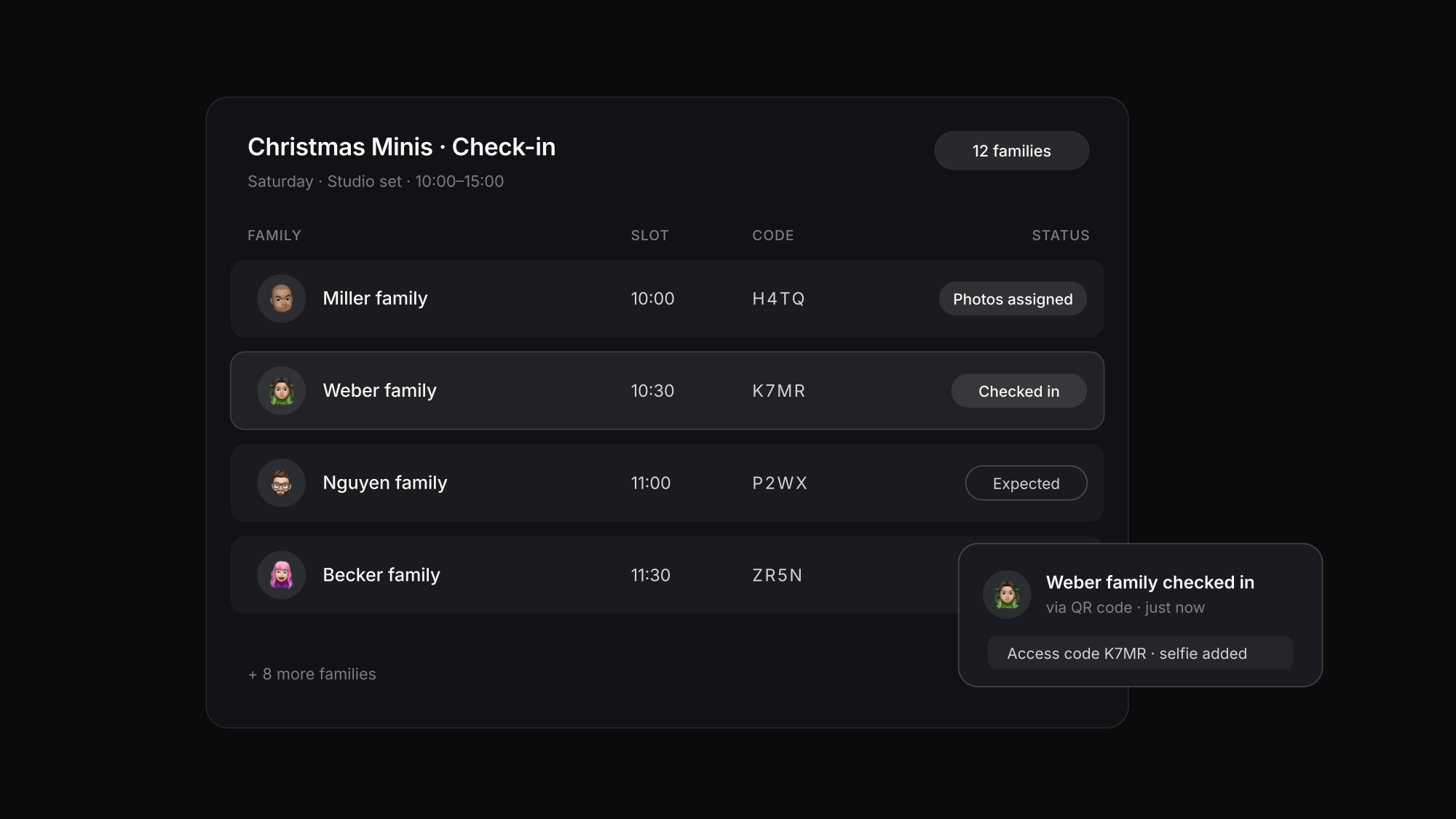
Group Shoot is part of the Creator plan and up, not the trial. During check-in, families can also choose and pay for a photo package – that feature is currently in beta. More on selling packages on the day in our guide to selling photography packages.
If you'd rather keep things simple, one private gallery per family works on every plan: name it after the family, upload their images, send the link.
Delivering mini session photos
Delivery is where mini sessions earn their reviews – or their complaints. Three things make the difference:
- A promised turnaround, and keeping it. One to two weeks is common. For Christmas minis, the deadline is the card: families need their photos in time to order prints.
- One gallery per family, never a shared folder. Parents share the link with grandparents; nobody should scroll past another family's children.
- Selection before the upsell. Show the full proofed set, let the family pick their included images, and offer the rest as an upgrade. That's where much of the mini session margin sits – our guide to client photo selection covers the workflow.
Deliver in full resolution plus a web size, so the card printer gets the right file. Our guide on delivering photos to clients has the details on resolutions and download options.
Christmas mini sessions: work backwards from the card
Christmas minis are the most popular season, and the least forgiving. Plan backwards from the date families order their cards:
| When | What |
|---|---|
| Early October | Fix dates, location and set; open bookings |
| Mid-October | Announce on social media and to past clients; early-bird price |
| Early to mid-November | Shoot days |
| Within 1–2 weeks | Galleries delivered, selection and upsell |
| End of November | Last delivery – time left for card and print orders |
If you're reading this in late October, you're not too late, but shorten the chain: book one weekend in mid-November, keep the set simple, and promise delivery within ten days.
FAQ
What is a mini session in photography?
A mini session is a short, standardized photo session – usually 15 to 30 minutes – at a set location and time, with a fixed number of edited images at a lower price than a full session. Photographers run many of them back to back on one day, often seasonally around Christmas, fall or spring.
How long should a mini session be?
Most photographers book 15 to 30 minutes per session, plus a buffer of 5 to 10 minutes between families. Twenty minutes with a ten-minute buffer is a common default: long enough for a relaxed family photo, short enough to fit two families per hour.
How many photos should I include in a mini session?
Five to ten edited images is the usual range. A fixed number keeps editing time predictable; extra images can be offered as an upgrade once the family has seen the full proofed set.
How much should I charge for a mini session?
Price from your time per family rather than as a fraction of your full session: shooting, culling, editing, gallery and admin typically add up to about 1.5 hours per family. Multiply that by your target hourly rate, add your share of the day's costs (set, location, marketing, fees), and round up.
What's the difference between a mini session and a regular session?
A regular session is planned individually – location, length and style follow the client. A mini session is the same setup for everyone, with a short fixed slot and a fixed number of images, which makes it cheaper for the client and repeatable for you.
Conclusion
Mini sessions pay off when the plan holds: a schedule with buffers, a price that counts your real time per family, payment at booking, and a delivery that keeps every family's photos separate. Plan your mini sessions backwards from the delivery date – especially for Christmas – and the shoot day becomes the easy part.